



A recently published paper asserting that a structure in Indonesia may be the world’s oldest pyramid has caught the attention of archaeologists and triggered an investigation by the journal that released it, according to information obtained by Nature.
The study, featured in the Archaeological Prospection journal on October 20, made headlines globally. Its primary assertion suggests that a pyramid beneath the prehistoric location of Gunung Padang in West Java, Indonesia, could potentially date back as far as 27,000 years.
Such an age estimate would surpass the antiquity of the earliest colossal Egyptian pyramid, the 4,600-year-old Pyramid of Djoser. Additionally, it would predate the oldest recognized megalithic site, Göbekli Tepe in Turkey, constructed approximately 11,000 years ago by skilled stone masons. This revelation has the potential to reshape our understanding of human civilization in the region, challenging existing narratives.
The paper’s co-author, Danny Hilman Natawidjaja, a geologist at the National Research and Innovation Agency (BRIN) in Bandung, Indonesia, emphasizes the pyramid’s significance as a symbol of advanced civilization. According to Natawidjaja, constructing pyramids requires exceptional masonry skills, making it a challenging feat. He asserts that the pyramid’s existence challenges the conventional understanding of advanced societies and underscores the complexity involved in their architectural achievements.
These assertions have failed to garner unanimous support from fellow researchers. Lutfi Yondri, an archaeologist affiliated with BRIN, points to his research indicating human habitation in the region within the timeframe of 12,000 to 6,000 years ago. According to Yondri, this timeline postdates the purported construction of the pyramid, and excavations from this era have yet to unveil any indications of advanced stonemasonry practices.
Flint Dibble, an archaeologist at Cardiff University in the UK, expresses surprise at the paper’s publication in its current form. While acknowledging the presence of “legitimate data” in the paper, Dibble contends that the conclusions drawn regarding the site and its age lack sufficient justification.
When foundations are not solid: A critical issue
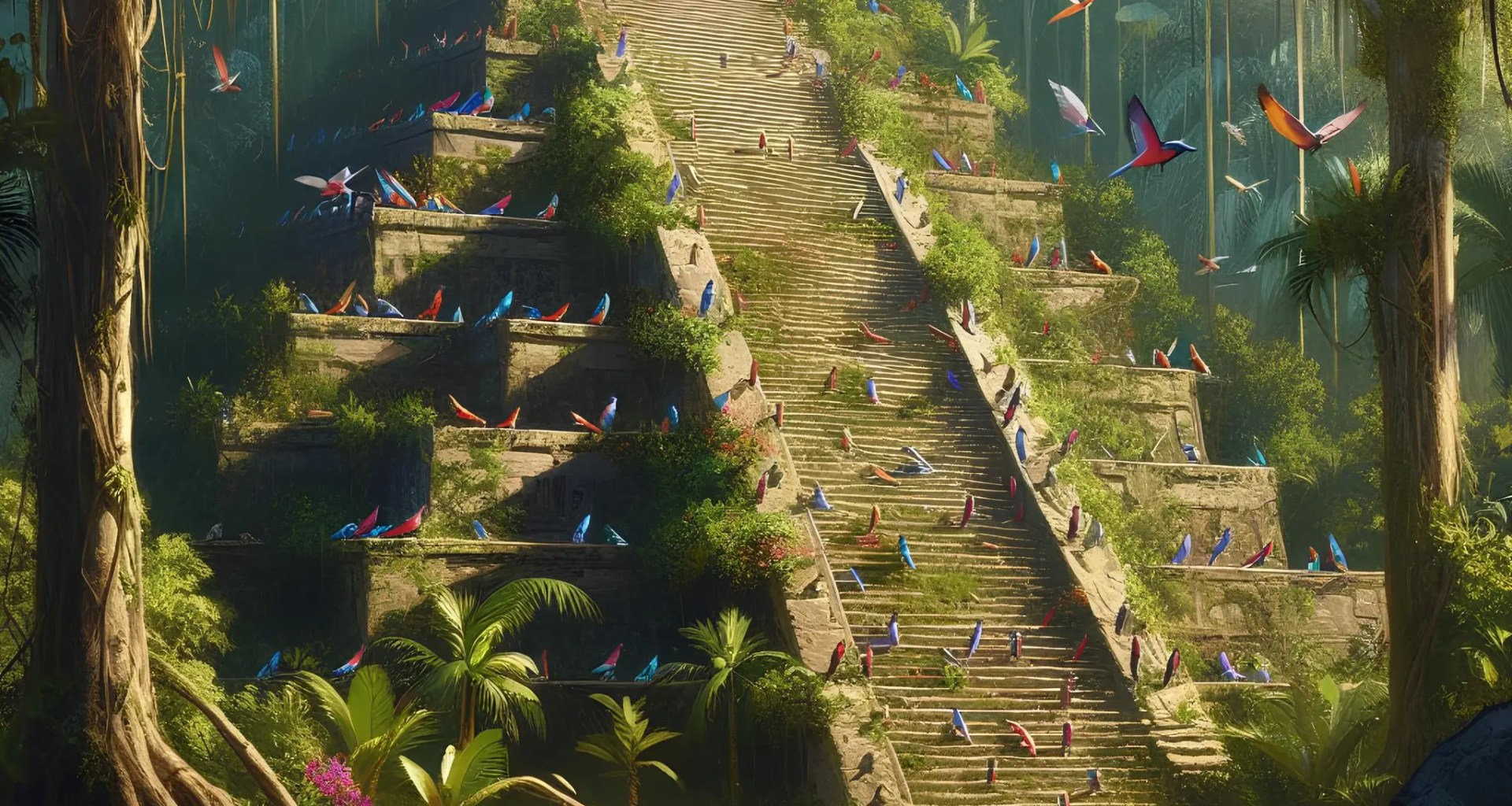
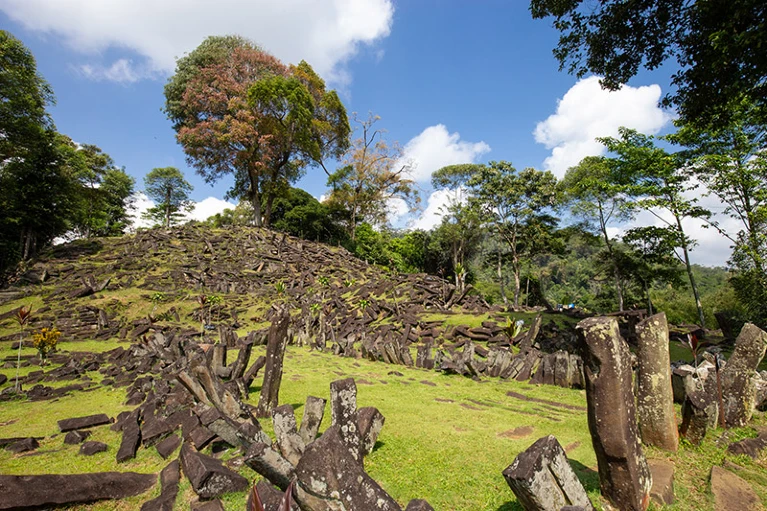
Gunung Padang is composed of five stepped stone terraces, complete with retaining walls and interconnected staircases, situated atop an extinct volcano. From 2011 to 2014, Natawidjaja and his team utilized various ground-penetrating techniques to explore the hidden layers beneath the terraces.
Their investigation identified four distinct layers, representing different construction phases. The innermost layer consists of a meticulously sculpted, hardened lava core. The subsequent layers, resembling arranged bricks, were added on top of the original layer. Carbon dating of these layers, performed using soil from rocks obtained through core drilling, indicates that the initial construction phase occurred between 27,000 and 16,000 years ago. Additional enhancements were made between 8,000 and 7,500 years ago, with the final layer, including the visible stepped terraces, added between 4,000 and 3,100 years ago, as detailed in the paper.
Dibble contends that there is insufficient evidence to definitively attribute the construction of the buried layers to human activity, suggesting that natural weathering and the gradual movement of rocks over time could be alternative explanations. He emphasizes that if rocks were rolling down a hill, they would tend to orient themselves in a particular way due to the force of gravity.
Contrastingly, Natawidjaja argues that the column-shaped stones found in the layers were too sizable and meticulously arranged to be the result of mere rolling or natural processes. According to him, the neatly organized, shaped, and massive nature of these rocks, some weighing up to 300 kilograms, diminishes the likelihood of them being transported over significant distances by natural forces.
Natawidjaja highlights the discovery of a dagger-shaped stone, asserting that its regular geometry, distinct composition, and materials distinct from the surrounding rocks indicate its human-made origin. However, Dibble challenges this interpretation, expressing skepticism about the human shaping of the rock. According to him, the absence of evidence such as signs of working or indications of human craftsmanship raises doubts about the stone being intentionally shaped by humans.
The power and controversy of extraordinary claims
The Gunung Padang site gained attention in the 2022 Netflix documentary “Ancient Apocalypse,” hosted by British author Graham Hancock. Hancock advocates the idea that an advanced global civilization was eradicated 12,000 years ago at the conclusion of the last ice age. Notably, the authors credit Hancock for proofreading their paper.
Natawidjaja contends that Gunung Padang’s construction predating the last ice age underscores the capabilities of people from that era to build intricate structures, rendering it a compelling monument. Conversely, Bill Farley, an archaeologist at Southern Connecticut State University in New Haven, challenges the paper’s argument, asserting that it lacks evidence supporting the existence of an advanced civilization during the last ice age. According to Farley, the 27,000-year-old soil samples from Gunung Padang, while accurately dated, lack indicators of human activity, such as charcoal or bone fragments. Archaeological records indicate that the shift from hunter-gatherer societies to complex settlements occurred after the onset of the Holocene, approximately 11,700 years ago. The oldest known city, Çatalhöyük in present-day Turkey, dates back 9,000 years.
Following the publication of the paper, both Archaeological Prospection and its publisher, Wiley, have initiated an investigation. Eileen Ernenwein, co-editor of the journal and an archaeological geophysicist at Tennessee State University in Johnson City, confirmed that an inquiry is underway, stating that the editors and the Wiley ethics team are actively investigating the paper in accordance with Committee on Publication Ethics guidelines. However, she refrained from providing further details regarding the specific concerns that prompted the investigation.
According to Farley, the emphasis regarding Gunung Padang should be on celebrating its intrinsic value as “an amazing, important, and cool site” rather than attempting to fit it into a specific narrative about the evolution of human civilization. Farley suggests appreciating the site for its unique characteristics and significance without necessarily attributing it to a predetermined storyline about human development.
Natawidjaja expresses a hope that the ongoing controversy surrounding the paper does not lead to discord within the scientific community. He emphasizes their openness to collaboration with researchers worldwide who are interested in conducting research programs on Gunung Padang. According to Natawidjaja, the intention is to expand knowledge about human history, acknowledging the existing gaps in understanding and encouraging a collaborative approach to address these gaps.
Resources
- JOURNAL Lewis, D. (2023). A 27,000-year-old pyramid? Controversy hits an extraordinary archaeological claim. Nature. [Nature]
- JOURNAL Natawidjaja, D. H., Bachtiar, A., Nurhandoko, B. E. B., Akbar, A., Purajatnika, P., Daryono, M. R., Wardhana, D. D., Subandriyo, A. S., Krisyunianto, A., Tagyuddin, Ontowiryo, B., & Maulana, Y. (2023). Geo‐archaeological prospecting of Gunung Padang buried prehistoric pyramid in West Java, Indonesia. Archaeological Prospection. [Archaeological Prospection]
- JOURNAL Orton, D., Anvari, J., Gibson, C., Bogaard, A., Rosenstock, E., & Biehl, P. F. (2018). A tale of two tells: dating the Çatalhöyük West Mound. Antiquity, 92(363), 620–639. [Antiquity]
Cite this page:
APA 7: TWs Editor. (2023, December 1). The Ancient Pyramid That Could Be 27,000 Years Old: A Controversial Discovery. PerEXP Teamworks. [News Link]


