



APA 7: TWs Editor & ChatGPT. (2023, October 20). Astronomers Identify Farthest Fast Radio Burst Ever Recorded. PerEXP Teamworks. [News Link]
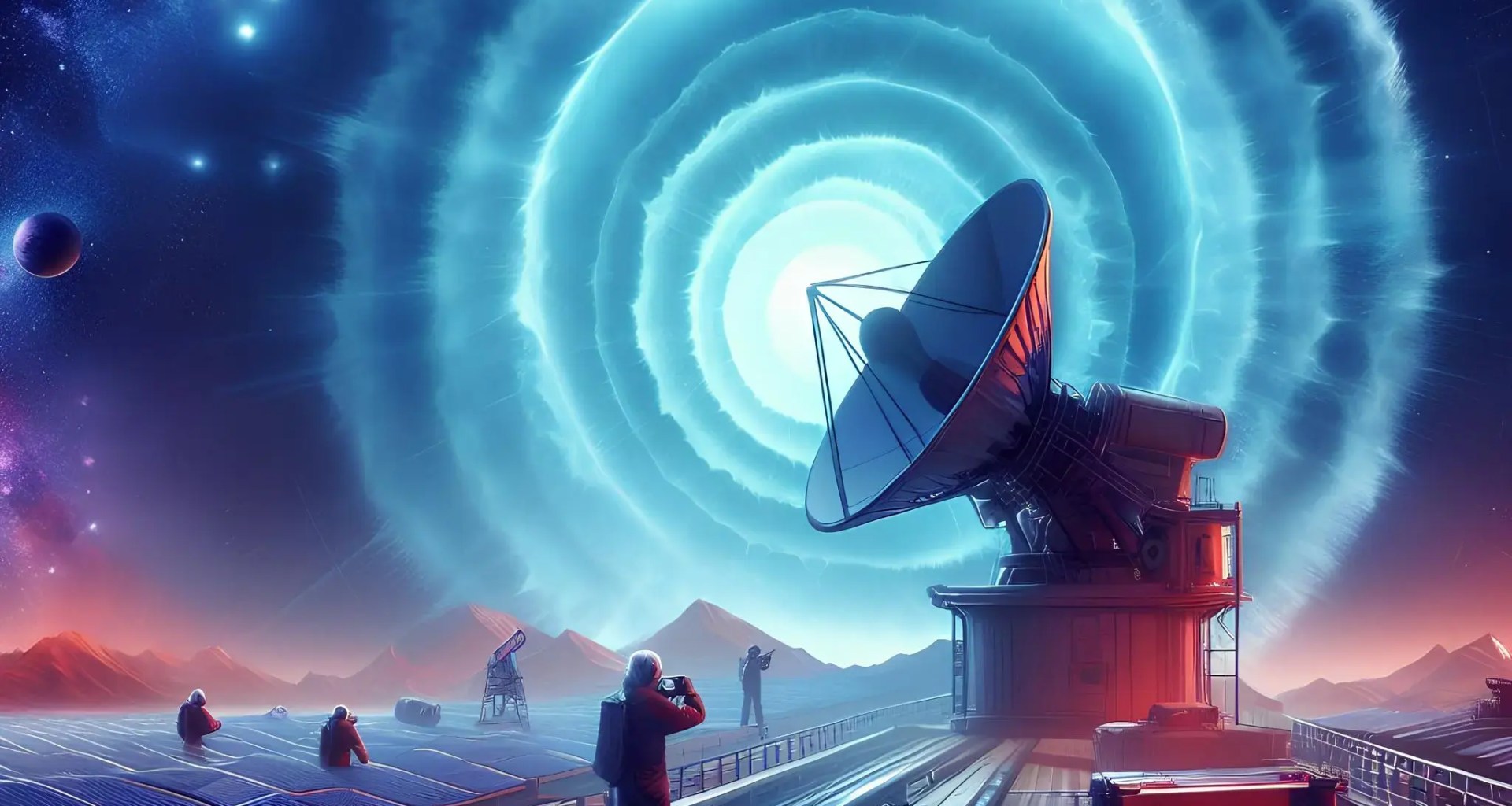
In June of the previous year, the ASKAP radio telescope in Australia made a groundbreaking discovery, capturing a cosmic burst designated as FRB 20220610A. This remarkable finding shattered the team’s prior distance record by an impressive 50 percent.
Using ASKAP’s array of dishes, we were able to determine precisely where the burst came from.
Then we used [ESO’s VLT] in Chile to search for the source galaxy, finding it to be older and further away than any other FRB source found to date and likely within a small group of merging galaxies.
Stuart Ryder
An astronomer from Macquarie University in Australia
The co-lead author of the study published today in Science
This discovery serves as confirmation that fast radio bursts (FRBs) can serve as valuable tools for gauging the elusive matter residing between galaxies. It introduces a novel approach to effectively measure the vast expanse of the Universe. Existing techniques for determining the mass of the Universe are generating contradictory outcomes, thereby posing challenges to the conventional model of cosmology.
If we count up the amount of normal matter in the Universe — the atoms that we are all made of — we find that more than half of what should be there today is missing.
We think that the missing matter is hiding in the space between galaxies, but it may just be so hot and diffuse that it’s impossible to see using normal techniques.
Fast radio bursts sense this ionised material. Even in space that is nearly perfectly empty they can ‘see’ all the electrons, and that allows us to measure how much stuff is between the galaxies
Ryan Shannon
A professor at the Swinburne University of Technology in Australia
Who also co-led the study
Detecting faraway FRBs is essential for precisely quantifying the Universe’s missing matter, as demonstrated by the work of the late Australian astronomer Jean-Pierre (‘J-P’) Macquart in 2020.
J-P showed that the further away a fast radio burst is, the more diffuse gas it reveals between the galaxies. This is now known as the Macquart relation. Some recent fast radio bursts appeared to break this relationship. Our measurements confirm the Macquart relation holds out to beyond half the known Universe.
Stuart Ryder
An astronomer from Macquarie University in Australia
The co-lead author of the study published today in Science
While we still don’t know what causes these massive bursts of energy, the paper confirms that fast radio bursts are common events in the cosmos and that we will be able to use them to detect matter between galaxies, and better understand the structure of the Universe.
Ryan Shannon
A professor at the Swinburne University of Technology in Australia
Who also co-led the study
This achievement marks the current limits of telescopic technology, yet astronomers are on the brink of a new era where they can identify even more ancient and remote bursts, precisely trace their source galaxies, and unravel the mysteries of the Universe’s elusive matter. The international Square Kilometre Array Observatory is currently constructing two powerful radio telescopes in South Africa and Australia, poised to discover thousands of FRBs, including those from the farthest reaches beyond the reach of current instruments. ESO’s Extremely Large Telescope, a massive 39-meter telescope being assembled in the arid expanse of the Chilean Atacama Desert, stands as one of the select few that will probe the source galaxies of bursts even more distant than FRB 20220610A.
Resources
- NEWSPAPER ESO. (2023, October 19). Astronomers detect most distant fast radio burst to date. ESO. [ESO]
- JOURNAL S. D. Ryder, K. W. Bannister, S. Bhandari, A. T. Deller, R. D. Ekers, M. Glowacki, A. C. Gordon, K. Gourdji, C. W. James, C. D. Kilpatrick, W. Lu, L. Marnoch, V. A. Moss, J. X. Prochaska, H. Qiu, E. M. Sadler, S. Simha, M. W. Sammons, D. R. Scott, N. Tejos, R. M. Shannon. (2023). A luminous fast radio burst that probes the Universe at redshift 1. Science, 382(6668), 294–299. [Science]