



The longest rock core ever extracted from beneath Greenland’s thick ice may provide crucial insights into the pace of melting of the island’s ice sheet amid global warming. Preliminary analysis of the rock and sediment within the core indicates that, at some point within the past three million years, this material was exposed to air, indicating temporary melting of the overlying ice.
This study contributes to a growing body of research utilizing Greenland’s bedrock to understand the historical instability of its ice cover. The significance of this core lies in being the first such material collected in decades, containing a substantial amount of bedrock material never before retrieved from beneath Greenland’s ice. Allie Balter-Kennedy, a glacial geologist at the Lamont–Doherty Earth Observatory, highlights the wealth of information the core holds about past exposure. Initial findings from the drilling project, named GreenDrill, were presented at a meeting of the American Geophysical Union.
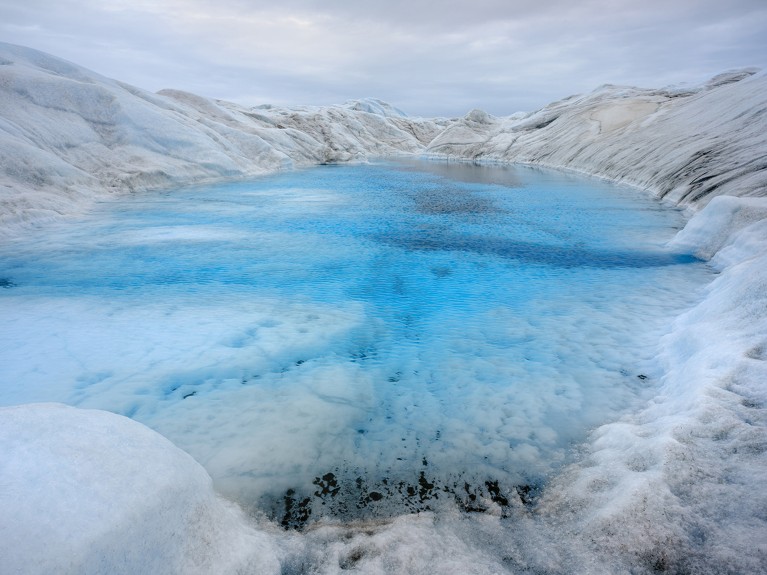
Uncovering the secrets of the depths
The ongoing melting of Greenland’s ice sheet plays a crucial role in the rising sea levels observed today. To unravel the environmental history preserved within the ice, researchers have undertaken drilling campaigns. However, due to technical challenges, very few projects have successfully penetrated through the entire ice sheet to reach the underlying bedrock.
This year, the GreenDrill project, equipped with state-of-the-art technology and a budget of $7 million, achieved this feat. Drilling at the Prudhoe Dome site, the project successfully pierced through 509 meters of ice, extracting 7.4 meters of frozen sediment and rock, providing valuable insights into the ice sheet’s past and future dynamics.
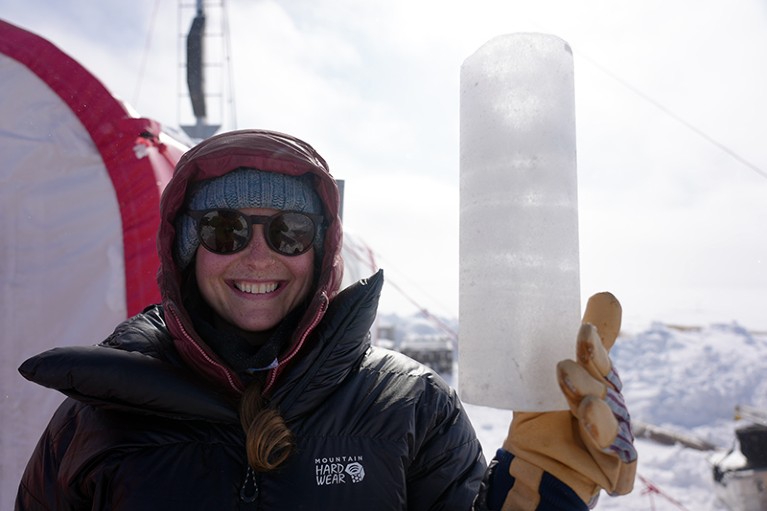
Researchers employ a method involving the analysis of radioactive isotopes to discern past ice coverage at specific locations. By examining isotopes like beryllium-10, generated in rock exposed to air and cosmic rays, the GreenDrill team’s initial findings indicate significantly elevated levels of beryllium-10 in the core, particularly in the sediment portion. This surpasses levels observed elsewhere and corresponds to approximately 40,000 years of air exposure, according to Allie Balter-Kennedy, presenting the findings at the meeting.
The substantial beryllium-10 content suggests periods of exposure, either as a singular, prolonged event or multiple episodes spanning several million years. Calculations by the researchers propose that if the Prudhoe Dome site was indeed devoid of ice, whether temporarily or for an extended duration, the resulting melting in Greenland could have contributed between 19 and 73 centimeters to global sea-level rise. Paul Bierman, a geoscientist at the University of Vermont, commends the study for its unique findings, emphasizing the significance of this data in understanding Greenland’s glacial history.
Ice on the rocks
Allie Balter-Kennedy offers a cautious interpretation of the preliminary findings, noting the potential for sediment disturbance or movement that could impact the accuracy of measurements. However, she points out that smaller amounts of beryllium-10 in the rock beneath the sediment lend support to the hypothesis of past exposure to air.
Previous rock and sediment cores from beneath Greenland’s ice, such as the GISP2 core from 1993 and a 1966 core from northwest Greenland, have indicated instances of ice-free conditions in the past. The GISP2 core, obtained from central Greenland, suggests multiple periods of ice absence over the past 2.6 million years, aligning with the approximate timeframe proposed by the Prudhoe Dome core. Similarly, a 1966 core in northwest Greenland indicates a period of ice-free conditions around 400,000 years ago. Balter-Kennedy acknowledges the need for further confirmation of the measurements and emphasizes the importance of this research in advancing our understanding of Greenland’s glacial history.
Resources
- JOURNAL Witze, A. (2023). Scientists drilled through 500 metres of Greenland’s ice — here’s what they found at the bottom. Nature. [Nature]
- JOURNAL Schaefer, J. M., Finkel, R. C., Balco, G., Alley, R. B., Caffee, M. W., Briner, J. P., Young, N. E., Gow, A. J., & Schwartz, R. (2016). Greenland was nearly ice-free for extended periods during the Pleistocene. Nature, 540(7632), 252–255. [Nature]
- JOURNAL Christ, A. J., Rittenour, T. M., Bierman, P. R., Keisling, B. A., Knutz, P. C., Thomsen, T. B., Keulen, N., Fosdick, J. C., Hemming, S. R., Tison, J., Blard, P., Steffensen, J. P., Caffee, M. W., Corbett, L. B., Dahl-Jensen, D., Dethier, D. P., Hidy, A. J., Perdrial, N., Peteet, D. M., . . . Thomas, E. K. (2023). Deglaciation of northwestern Greenland during Marine Isotope Stage 11. Science, 381(6655), 330–335. [Science]
Cite this page:
APA 7: TWs Editor. (2023, December 15). Greenland’s Secrets Revealed: The Findings from Drilling 500 Metres Deep into the Ice. PerEXP Teamworks. [News Link]


