




If life once thrived on Mars, the Perseverance rover’s confirmation of lake sediments at the Jezero crater’s base ignites the possibility of discovering remnants within the crater.
New findings, detailed in a recent study published in Science Advances by a team led by UCLA and The University of Oslo, unveil that the crater once held water, gradually accumulating sediment layers on its floor. Over time, the lake receded, leaving behind vast deltas formed by sediment transported by the river that once fed it. The gradual dissipation of the lake led to the erosion of crater sediments, shaping the distinctive geological features visible today.
These prolonged processes of deposition and erosion, as revealed by radar data, validate previous interpretations of the Jezero crater’s geological evolution based on orbital observations of Mars.
David Paige, a UCLA professor of Earth, planetary and space sciences and the paper’s lead author, highlights the significance of this insight. He emphasizes that while orbital imagery offers glimpses of diverse deposits, understanding their origin and evolution necessitates probing beneath the surface.
The rover, approximately the size of a car and equipped with seven scientific instruments, has been exploring the 30-mile-wide Jezero crater since 2021. It’s been diligently studying the crater’s geology, atmosphere, and collecting samples. Perseverance’s soil and rock samples are slated for return to Earth by a subsequent mission, where they’ll undergo thorough examination for any signs of past life.
From May to December 2022, Perseverance journeyed from the crater floor onto the delta, an extensive area featuring 3 billion-year-old sediments reminiscent of Earth’s river deltas when observed from orbit.
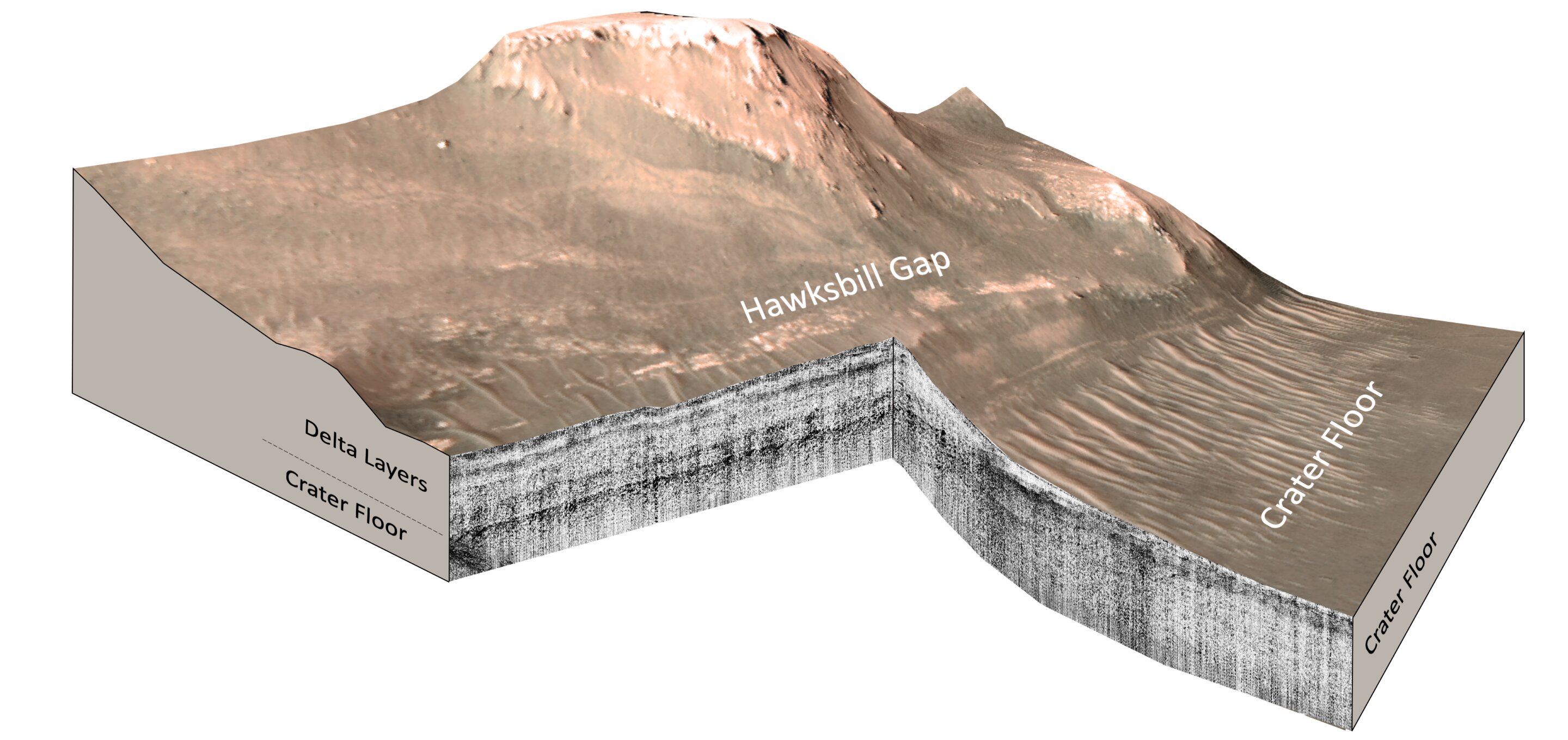
Upon reaching the delta, Perseverance’s Radar Imager for Mars’ Subsurface Experiment (RIMFAX) instrument initiated radar waves directed downward at 10-centimeter intervals. These waves measured reflections from depths approximately 20 meters below the surface. Through this radar imaging, scientists gained visibility down to the base of the sediments, revealing the topography of the buried crater floor.

After years of research utilizing ground-penetrating radar and testing RIMFAX on Earth, scientists have honed their ability to interpret the structure and composition of subsurface layers through radar reflections. The resulting subsurface images depict rock layers akin to those exposed in highway road cuts.
Paige, the deputy principal investigator of RIMFAX, noted that some geologists liken the radar’s capability to peer beneath the surface to “cheating.”
According to reports from UCLA and the University of Oslo, RIMFAX imaging unveiled two distinct phases of sediment deposition flanked by two periods of erosion. Additionally, observations indicate that the crater floor beneath the delta is not uniformly flat, implying a preceding era of erosion before the deposition of lake sediments.

Radar images indicate that the sediments exhibit uniform horizontal layers, resembling those found in Earth’s lake deposits. While prior studies had hinted at the presence of lake sediments, this recent research provides definitive confirmation.
Furthermore, a subsequent phase of deposition occurred when fluctuations in the lake level permitted the river to deposit a wide delta, which originally extended far into the lake but has since receded closer to the river’s entrance.
Paige elaborated that the observed changes in the rock formations reflect significant shifts in the Martian environment. The remarkable aspect lies in the wealth of evidence depicting environmental changes within a confined geographic area, allowing for broader implications across the entire crater.
Resources
- ONLINE NEWS University of California, Los Angeles. (2024, January 26). Confirmation of ancient lake on Mars offers hope that Perseverance rover’s soil and rock samples hold traces of life. Phys.org. [Phys.org]
- JOURNAL Paige, D. A., Hamran, S., Amundsen, H. E. F., Berger, T., Russell, P., Kakaria, R., Mellon, M. T., Eide, S., Carter, L. M., Casademont, T. M., Nunes, D. C., Shoemaker, E. S., Plettemeier, D., Dypvik, H., Holm‐Alwmark, S., & Horgan, B. (2024). Ground penetrating radar observations of the contact between the western delta and the crater floor of Jezero crater, Mars. Science Advances, 10(4). [Science Advances]
Cite this page:
APA 7: TWs Editor. (2024, January 29). Perseverance Rover’s Samples Spark Life Hope in Martian Lake!. PerEXP Teamworks. [News Link]


