



In a speculative scenario exploring the aftermath of the Big Bang, scientists posit the possibility of minuscule primordial black holes being ensnared by nascent stars during their formation. Spearheaded by researchers at the Max Planck Institute for Astrophysics, an international team delves into the intricacies of these entities, termed “Hawking stars,” through a comprehensive model elucidating their evolutionary trajectories. Surprisingly, the research unveils that these enigmatic celestial bodies can exhibit remarkably protracted lifetimes, mirroring numerous characteristics of conventional stars. The culmination of this inquiry is documented in a publication within The Astrophysical Journal.
This scientific exploration extends beyond theoretical musings, suggesting that asteroseismology, the study of stellar oscillations, could serve as a key tool in identifying Hawking stars. The detection of such stars, in turn, holds the potential to provide empirical evidence concerning the existence of primordial black holes and their potential role as constituents of dark matter.
Embarking on a hypothetical journey, scientists consider the scenario where a substantial number of diminutive black holes, known as primordial black holes, were generated shortly after the Big Bang. While the existence of such entities remains uncertain, the exercise aims to unravel the hypothetical implications of these black holes being captured during the embryonic stages of star formation.
Selma de Mink, the director of the stellar department at the Max Planck Institute for Astrophysics, emphasizes the speculative nature of the inquiry, stating, “Scientists sometimes ask crazy questions in order to learn more. We don’t even know whether such primordial black holes exist, but we can still engage in an interesting thought experiment.”
The hypothesized primordial black holes could have originated with a diverse range of masses, spanning from dimensions as minute as an asteroid to those rivaling thousands of solar masses. Intriguingly, these black holes could potentially serve a dual role as a constituent of dark matter and as the progenitors of the supermassive black holes found at the cores of contemporary galaxies.
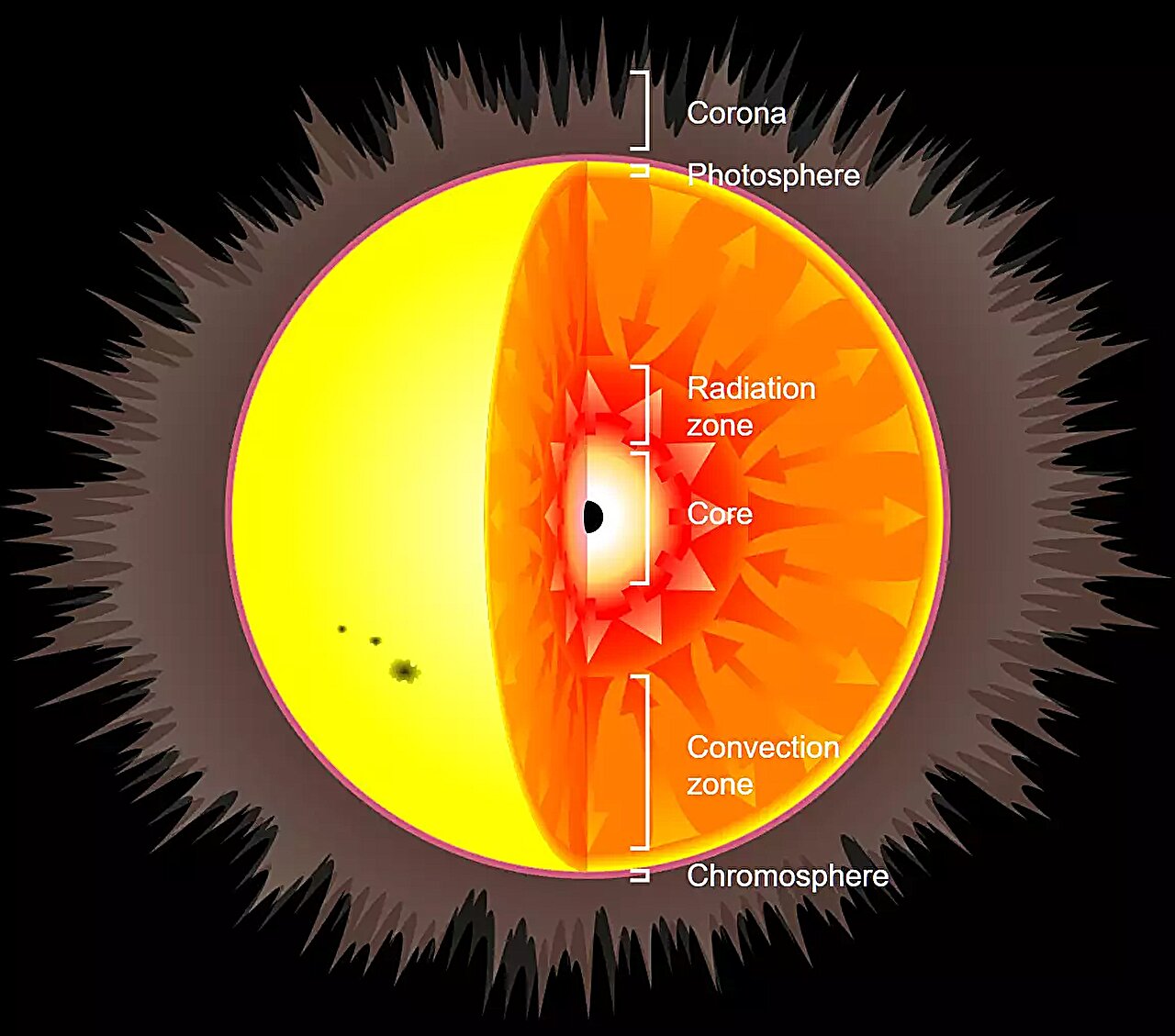
The scientific exercise explores the remote possibility that during the formation of a new star, there exists a minute probability of a black hole with the mass of an asteroid or a small moon being captured, thus occupying the central region of the star. Such a celestial entity is christened a “Hawking star,” in homage to Stephen Hawking, who initially proposed this concept in a seminal paper during the 1970s.

Throughout the normal solar evolution, nuclear fusion (depicted in red) dominates solar luminosity until the black hole attains sufficient mass to suppress these reactions. The black hole’s presence induces convection (hatched areas), facilitating the mixing of the core’s innermost components and, eventually, the entire star. It is noteworthy to observe the variations in the y-axis scale between the depicted panels.
(The Astrophysical Journal)
The growth of a black hole at the core of a Hawking star unfolds gradually, impeded by the outward flow of luminosity hindering the infall of gas that would otherwise nourish the black hole. In a collaborative effort, an international team of scientists has undertaken a comprehensive modeling of the evolutionary trajectory of such stars, incorporating varied initial masses for the black hole and diverse accretion models for the stellar center. The remarkable outcome of their study suggests that when the black hole’s mass is relatively small, the Hawking star closely resembles a conventional star.
Lead researcher Earl Patrick Bellinger, a former Postdoc at the Max Planck Institute for Astrophysics and currently an Assistant Professor at Yale University, emphasizes the longevity of stars housing a black hole at their core. Bellinger notes, “Stars harboring a black hole at their center can live surprisingly long. Our sun could even have a black hole as massive as the planet Mercury at its center without us noticing.”
The key divergence between a Hawking star and a typical star lies in the core region, which becomes convective due to the accretion process onto the black hole. Despite this transformation near the core, the surface properties of the star remain unchanged, evading current detection capabilities. However, the study suggests that asteroseismology, a burgeoning field that employs acoustic oscillations to probe a star’s interior, could potentially unveil the presence of a black hole.
As these Hawking stars progress into the red giant phase of their evolution, the black hole’s influence may manifest in distinctive signatures. Future projects like PLATO hold the promise of discovering such celestial objects. Nevertheless, the researchers emphasize the necessity for additional simulations to comprehend the implications of integrating a black hole into stars of varying masses and metallicities.
The prospect of locating primordial black holes, assumed to have formed shortly after the Big Bang, lends significance to the search for Hawking stars. Professor Matt Caplan from Illinois State University, a co-author of the study, highlights the potential prevalence of Hawking stars in globular clusters and ultra-faint dwarf galaxies. This suggests that Hawking stars could serve as a valuable tool for investigating both the existence of primordial black holes and their potential role as dark matter.
Resources
- ONLINE NEWS Max Planck Society. (2023, December 22). What happens if you put a black hole into the sun? Phys.org. [Phys.org]
- JOURNAL Bellinger, E. P., Caplan, M. E., Ryu, T., Bollimpalli, D. A., Ball, W. H., Kühnel, F., Farmer, R., De Mink, S. E., & Christensen‐Dalsgaard, J. (2023). Solar Evolution Models with a Central Black Hole. The Astrophysical Journal, 959(2), 113. [The Astrophysical Journal]
Cite this page:
APA 7: TWs Editor. (2023, December 25). How Would the Sun React to a Black Hole Intrusion? PerEXP Teamworks. [News Link]


