

Galileo Galilei, the Italian astronomer, physicist, and engineer known as the “Father of Modern Physics,” made groundbreaking contributions to the history of science and is one of the most important figures of the scientific revolution. His discoveries in astronomy, facilitated by the development of the telescope, and his approach based on experimental science, set him apart as a scientist ahead of his time. But beyond his scientific achievements, who is Galileo Galilei?
His life and early education
Galileo was born on February 15, 1564, in Pisa, which was then part of Florence. He was the eldest of six siblings. His father, Vincenzo Galilei, was a famous lutenist and musician, and his mother, Giulia Ammannati, married in 1562. Galileo learned lute technique, the ability to question authority, careful measurement and experimentation, examining rhythm from a musical perspective, and reaching conclusions using mathematics and experimental methods from his father at a young age.
Two of Galileo’s five siblings died in infancy. His youngest brother, Michelangelo, also became a talented lutenist and musician; however, Michelangelo caused financial difficulties for the family during Galileo’s youth. Michelangelo could not fulfill his father’s dowry promises to his sisters, leading to lawsuits. From time to time, Galileo had to lend money to his brother for his musical projects. These financial difficulties sparked Galileo’s desire to create inventions that would bring in money at an early age.

Who is Galileo Galilei with his education life? Galileo began his education in a monastery and was so influenced by his teachers there that he decided to become a clergyman. However, he was dissuaded by his father and began studying medicine at the University of Pisa. But he never completed this program. After accidentally attending a geometry class, he was deeply influenced and decided to study mathematics or philosophy. After completing his education in Pisa, he began working as a mathematics professor at the University of Pisa in 1589. There, he made significant contributions to the scientific world by working on the dynamics of moving objects.
Among Galileo’s scientific achievements, his use of the telescope for astronomical observations stands out. After improving the telescope in 1609, he observed the craters on the Moon, the moons of Jupiter, and the phases of Venus, providing evidence supporting Copernicus’s heliocentric model of the universe. These findings led Galileo into disputes with the scientific and religious authorities of the time. Besides these, he also invented the thermostat, laying the foundation for the modern thermometer, and established the basis for classical mechanics, which Newton later developed.
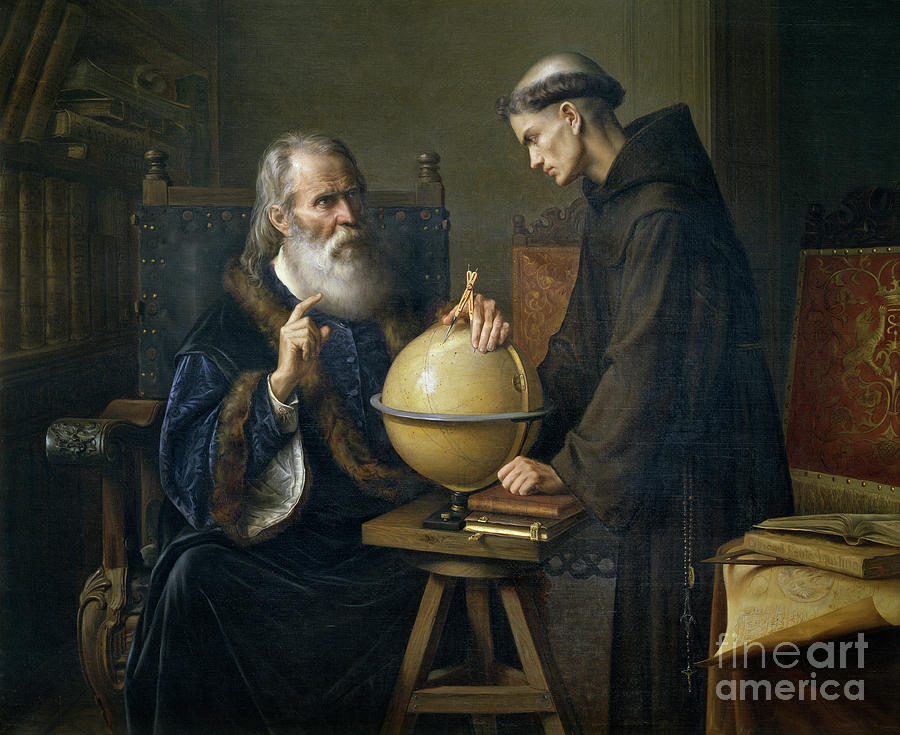
(Credit: TheCollector)
Galileo’s scientific works were criticized by the Catholic Church of the time. In 1616, he was tried by the church for defending Copernicus’s heliocentric model, and in 1632, a decree was issued in Rome requiring its denial. He lived under house arrest until his death in 1642. Galileo’s scientific contributions laid the foundations of modern science, and he is regarded as a pioneer of scientific methodology or the “father of science.”
Galileo Galilei’s contributions to science
Who is Galileo Galilei in terms of the history of science? Galileo Galilei is considered one of the most important figures in the history of modern science and one of the pioneers who laid the foundations of scientific thinking. The development of the scientific method, in particular, paved the way for countless scientific advances over the past 500 years. At a time when Renaissance Europe was still firmly committed to the geocentric model supported by the church, Galileo had the courage to question these long-held beliefs. Advocating that the Sun, not the Earth, was at the center of the universe, Galileo revolutionized humanity’s understanding of the universe with these groundbreaking ideas. In addition, Galileo’s work laid the foundations of classical physics, which Isaac Newton would later build upon, in areas such as pendulums, freely falling bodies, and projectile motion.
Pendulum Experiment: From a chandelier to clocks
According to Vincenzo Viviani, Galileo’s student, son, and one of his first biographers, Galileo’s interest in pendulums began during his university years. While observing the slow oscillations of a chandelier in Pisa Cathedral, Galileo measured the period of these oscillations using his pulse and discovered that the time required for a complete swing (the period) was independent of the chandelier’s weight and instead was determined by the length of the rope (for small angles, i.e., 0-20°). This discovery was a significant breakthrough, but the idea of applying this principle to time measurement devices did not occur to Galileo until later in his life.

Viviani recounts that in 1641, while living at his villa in Arcetri, Galileo developed the idea that pendulums could be used in clocks. “Galileo believed that the regular and natural movements of the pendulum could correct the flaws in existing time measurement devices. However, his deteriorating eyesight prevented him from making detailed drawings and models. Nevertheless, with the help of his son Vincenzio, they began working on bringing this idea to life. Although Galileo’s design for a pendulum clock was not fully developed during his lifetime, his views on this subject paved the way for future innovations.”
Free Fall Experiment: A first look at the equivalence principle
Who is Galileo Galilei in terms of physicist? One of Galileo’s most significant contributions to physics is demonstrating that gravitational acceleration is independent of an object’s mass. In a now-legendary experiment, Galileo dropped two spheres of different masses from the Leaning Tower of Pisa. According to the Aristotelian view prevalent at the time, heavier objects were expected to fall faster than lighter ones. However, Galileo observed that both spheres reached the ground simultaneously. This experiment laid the foundation for the modern understanding of gravity, showing that, in the absence of air resistance, all objects fall at the same rate.

(Credit: Wikipedia English)
Galileo’s findings laid the groundwork for the equivalence principle, one of the cornerstones of modern physics, formalized by Albert Einstein in his theory of general relativity (the principle that gravitational and inertial forces are locally indistinguishable). Another experiment demonstrating the significance of this discovery was conducted by science communicator Carl Sagan. Sagan dropped a feather and a bowling ball from the same height in a giant vacuum chamber, showing that both objects fell at the same speed without air resistance.
When Isaac Newton said, “If I have seen further, it is by standing on the shoulders of giants,” he was referring to the work of scientists like Galileo. Galileo’s research on free fall and projectile motion laid the groundwork for the laws of motion and gravity that Newton would later formulate. By discovering that gravitational acceleration is constant, Galileo predicted that a horizontally launched object (ignoring air resistance) would maintain its horizontal speed. He not only predicted these motions theoretically but also defined them mathematically, laying the foundations of classical mechanics.

Telescope development: a new perspective
Who is Galileo Galilei in terms of inventor? In 1609, Galileo’s life underwent a profound transformation when he learned about the telescope developed by a Dutch inventor. Quickly working on improving this new device, Galileo created his own versions, significantly increasing its magnification power. His success was rewarded by the university he worked at with a doubling of his salary. Galileo began systematically observing the sky with this powerful instrument, and these observations led to findings that fundamentally challenged the geocentric model accepted at the time.
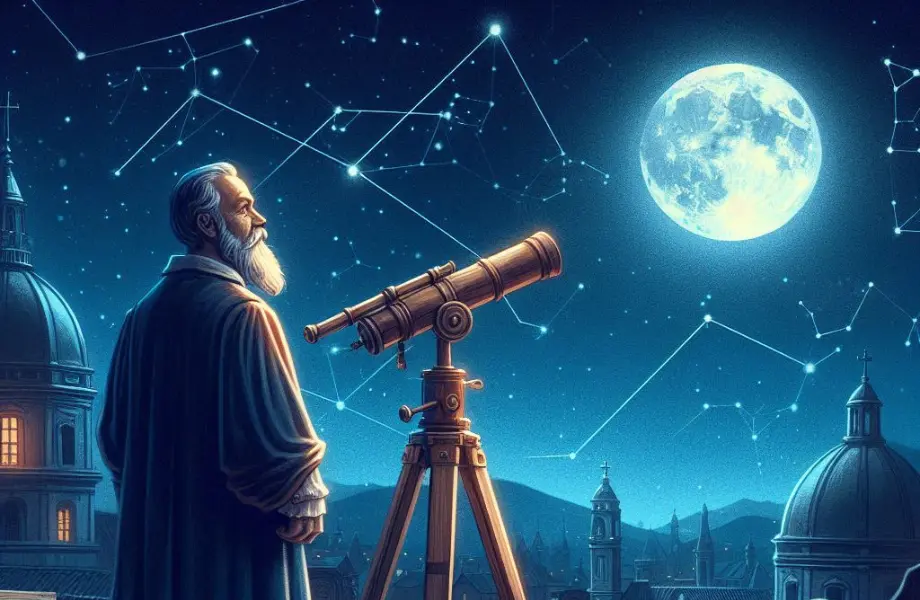
Galileo’s first major discovery came from his observations of the Moon. Contrary to Aristotle’s view that celestial bodies were perfect spheres, Galileo observed that sunlight reflected off the Moon’s surface deviated in some places and discovered some irregularities on the Moon’s surface at its rise and set, with the help of a telescope, he confirmed that there were mountains and craters on the Moon’s surface. This finding shattered the belief that the heavens were perfect and unchanging. Turning his telescope to Jupiter, Galileo discovered four large moons, now known as the Galilean moons. This discovery provided direct evidence that not all celestial bodies revolved around the Earth and showed that the universe had more than one center of motion. Galileo’s observations of Venus revealed that it, like the Moon, went through phases, thus confirming that the planets (including Earth) revolved around the Sun.
Galileo also directed his attention to the Sun and independently discovered sunspots. This discovery led to a debate with Christoph Scheiner, who argued that sunspots were small satellites orbiting the Sun, attempting to maintain the perfection of celestial bodies. However, Galileo correctly determined that these spots were cloud-like objects on or near the Sun’s surface.
The breadth of Galileo’s contributions to science
Galileo’s influence extended beyond astronomy and physics. In 1583, by order of the Grand Duke of Tuscany, he published a work titled “Thoughts on Dice Games,” seeking answers to questions like “Why does the sum of 10 come up more often than 9 when rolling three dice?” This work made significant contributions to the theory of probability. Additionally, he invented the thermoscope, a precursor to the thermometer, and in 1586 wrote a book on the hydrostatic balance he had invented.

Galileo’s interests also included the fine arts. Studying the concept of Disegno, Galileo began teaching perspective and chiaroscuro at the Accademia delle Arti del Disegno in Florence in 1588. The impact of his scientific observations on art is evident in his friendship with the Florentine painter Cigoli, who incorporated Galileo’s lunar observations into his paintings, helping him accurately depict what he saw. Florentine painter Cigoli, who incorporated Galileo’s lunar observations into his paintings, helping him accurately depict what he saw.
Galileo’s conflict with the Church
When Galileo challenged the geocentric cosmological system that had persisted for nearly a thousand years, it was inevitable that this innovation would cause unrest. This situation became even more complex in a society living under the heavy pressure of the church, especially in Early Modern Europe. Moreover, the Christian Bible also supported the view that the Earth was the center of the universe. However, despite these obstacles, Galileo did not back down; he continued to develop his theory and engaged in a relentless struggle with the church. But who is Galileo Galilei from the point of view of the Church, and why did he “disturb” the Church?
The Geocentric Theory
In the 1st century, the geocentric theory, which the church advocated, was actually developed by Greek philosophers in the 4th century. According to the theories of Plato and his student Aristotle, the Earth was the center of the universe, and the other celestial bodies—the Moon, Sun, Venus, Mercury, Mars, Jupiter, Saturn, and the fixed stars—surrounded this center. According to Plato, the Earth and other celestial bodies were perfect spheres. Aristotle further posited that the celestial bodies moved in perfect circular orbits and that their surfaces were also in the form of perfect circles. This idea was based on the belief that celestial bodies in the universe had to be flawless.

Another reason the church supported this theory was the belief, according to the Bible, that the Earth was the center of the universe and that it never moved from its place.
The Heliocentric Theory
Before Galileo began his observations with the telescope, he believed that the Earth could be at the center of the universe. However, his observations with the telescope changed this belief. By observing that Jupiter’s moons revolved around Jupiter, Galileo discovered that the universe could not have just one center and that there could be multiple centers of motion. Additionally, through his observations of Venus, he discovered that Venus also had phases, indicating that Venus revolved around the Sun and, therefore, all the planets must revolve around the Sun. Based on this evidence, Galileo advanced the heliocentric theory developed by Copernicus and published his findings in “Sidereus Nuncius” (The Starry Messenger).
The first great battle between science and religion
As Galileo continued to publish books on the heliocentric theory, which aimed to disprove the geocentric theory supported by the church, he began to attract the attention of the church. He especially drew attention with his remarks directed at the Popes. Before the trials of the 1630s, a church representative told Galileo, “Even if your evidence shows that the Earth moves, the church will not admit that our view is wrong; instead, it will say that there is an error in your evidence.” In response to this warning, Galileo continued his work secretly to avoid execution, thus escaping the death penalty.

(Credit: Alexandra Lamb)
Despite this, the church began to see the heliocentric theory Galileo advocated in his books as a serious threat to its teachings. The publication of his observations supporting Copernicus’ theory, in particular, could undermine the church’s authority and lead to a crisis of faith among the public. This increased the church’s pressure to silence Galileo. As a result, at the Inquisition Court in 1633, Galileo was ordered to retract his teachings and avoid any expressions that questioned the church’s views. To escape the death penalty, Galileo was forced to comply with these conditions and was sentenced to house arrest instead of execution.
During Galileo’s house arrest, Maffeo Barberini, who was elected as the 8th Pope Urban, was a close friend of Galileo’s. Before the house arrest decision, he had supported Galileo’s research and had been a strong sponsor of him. During the house arrest period, he also provided many privileges to Galileo; he even allowed him to publish a book, provided that they objectively examined contemporary issues. In his book “Dialogue Concerning the Two Chief World Systems,” published while under house arrest, Galileo included a symbol indicating the approval of the then Pope Urban. Despite harshly criticizing the church and continuing to explain the heliocentric theory in this book, Galileo was spared from punishment thanks to his close friendship with Barberini. The book received widespread attention throughout Europe and was translated from Italian into several languages, including French, English, and Latin.

The effects of Galileo Galilei on today’s science
Galileo’s work deeply influenced not only scientists but also the philosophy of modern science. The scientific method he developed remains the fundamental approach used in scientific research today. Galileo’s method of studying natural phenomena through experimental science and mathematical analysis played a vital role in the development of modern scientific thought and technology.

Galileo’s mathematical contributions and the laws of motion
Galileo was one of the first scientists to study natural phenomena through mathematical analysis. In particular, his work on the laws of motion formed the basis of Newton’s classical mechanics. By analyzing the motion of free fall, Galileo discovered that objects fall at the same speed regardless of their mass. This experiment has an important place in modern physics and directly inspired Newton’s law of universal gravitation.
Galileo’s inclined plane experiment showed that the gravitational acceleration (g) is constant and that the speed of an object increases linearly with time. These studies had a major impact not only on mechanics, but also on modern engineering and technology.
Galileo and the Copernican Model: The power of scientific evidence
Galileo challenged the geocentric conception of the universe of his time by defending the Copernican model of a heliocentric universe. His telescopic observations provided strong scientific evidence in favor of this model. In particular, the phases of Venus showed that a planet orbiting the Sun could only be explained by this model. This observation demonstrated the invalidity of the geocentric model of the universe and initiated a radical change in astronomy.
In addition, Galileo’s discovery of Jupiter’s four large moons provided another strong argument for the invalidity of the geocentric model. His observation that these moons revolved around Jupiter proved that not all celestial bodies in the Solar System revolve around the Earth.
Galileo and the development of experimental science
Who is Galileo Galilei with his approach to science? Galileo played a critical role in the development of the scientific method. His approach, based on experimentation and observation, increased the accuracy and reliability of scientific knowledge. The free-fall experiment he is said to have performed on the Leaning Tower of Pisa is a striking example of how this method was applied. Galileo is considered to be the father of experimental science because he argued that scientific knowledge should be obtained through direct observation and experimentation, and this approach formed the basis of the modern scientific method.

Historical context and Galileo’s social impact
Galileo’s work, when considered in the context of the Renaissance and the Scientific Revolution, reflects this period’s intellectual vitality and scientific curiosity. Galileo interacted with other scientists, such as Kepler and Brahe, and contributed to accelerating the scientific revolution. The humanist ideas of the Renaissance and the movement back to ancient texts also shaped Galileo’s approach to science.
Galileo’s conflict with the Catholic Church is one of the most famous examples of tensions between science and religion. Since the Church accepted the geocentric model of the universe as religious dogma, Galileo’s defense of the Copernican model was seen as a major threat. Galileo was tried by the Inquisition in 1633 and sentenced to life-long house arrest. However, this conflict paved the way for science to go beyond religious authority and ensure scientific research’s independence.
The influence of Galileo’s work on modern science
Galileo’s work profoundly influenced not only scientists but also the modern philosophy of science. The scientific method he developed is still the most fundamental approach used in scientific research today. Galileo’s method of studying natural phenomena through experimental science and mathematical analysis played a vital role in the development of modern scientific thought and technology.
Galileo’s writings
Who is Galileo Galilei with his works? Galileo authored over 50 known works, covering topics in astronomy, mathematics, philosophy, and mechanics. Among these, three major works stand out: Sidereus Nuncius, Dialogue Concerning the Two Chief World Systems, and Discourses and Mathematical Demonstrations Relating to Two New Sciences.
Sidereus Nuncius
Galileo’s work Sidereus Nuncius contains his findings related to the study of stars and other celestial bodies. In this book, Galileo presents the results of his observations of the Moon’s surface—its mountains, craters, and plains—using a telescope. The book also includes his observations of the four major moons of Jupiter and the phases of Venus. Through these works, Galileo challenged traditional views and sparked a major revolution in astronomy. The importance of this work lies in its groundbreaking contributions to the field.

The Latin words “sidereus” and “nuncius” combine to mean “starry messenger.” As the title suggests (and we know from his drafts that Galileo initially used this name), Galileo wrote this work to share the discoveries he made through his observations. Thus, he became the first scientific-based astronomer to convey news of astronomy to humanity. While writing this work, Galileo used telescopes that he had developed in the 17th century. In 1608, when Dutch optician Hans Lippershey attempted to patent a telescope he had created, Galileo heard about it and developed his version. His initial telescopes had magnifications of 8x and 10x, but the one he used to write Sidereus Nuncius had a 20x magnification.
When observing the Moon, Galileo noticed that the terminator (the dividing line between day and night on the Moon) was smooth in the dark regions but quite irregular in the brighter areas. From this observation, he concluded that the dark regions were flat and low areas, while the bright regions were rugged and mountainous. By estimating the distance of mountain peaks from the terminator based on sunlight, Galileo accurately predicted that the mountains on the Moon were at least four miles high. His engravings provided a new form of visual representation and shaped the study area known as selenography, which contributed significantly to the physical examination of celestial features.
Galileo reported that the number of stars visible through his telescope far exceeded those seen with the naked eye. For instance, while naked-eye observers could only see six stars in the Pleiades cluster, Galileo was able to observe thirty-five stars—nearly six times more. When he turned his telescope to Orion, he saw eighty stars instead of the previously observed nine—almost nine times more. In Sidereus Nuncius, Galileo distinguished between stars seen with the naked eye and those visible through a telescope, reviewing and revising these two groups of stars. Moreover, he discovered that some “fuzzy” stars listed in Ptolemy’s star catalog were actually composed of many smaller stars. This led him to conclude that nebulas and the Milky Way were composed of countless stars clustered together so closely and distantly that they couldn’t be individually distinguished when viewed from Earth.
Dialogue Concerning the Two Chief World Systems
“Dialogue Concerning the Two Chief World Systems” is a book written by Galileo Galilei in 1632, and was translated from its original Italian into Latin by Matthias Bernegger as “Cosmic System.” The first printed copy of the book was obtained on February 22, 1632, and it was dedicated to Galileo’s patron, Ferdinand II.

When Galileo wrote the book, he used the title “Dialogue on the Tides.” However, when he submitted the manuscript for approval to the Inquisition, this title was not accepted. They did not want to allow the term “tides” in the title because they thought it would imply evidence for the Earth’s motion—giving the impression that the Church was accepting the Earth’s movements. Galileo then changed the title to “Dialogue on the Tides of the Sea,” but the Inquisition ordered that the word “tides” should not be used in any form. At that time, the official title on the title page was simply “Dialogue,” followed by Galileo’s name, academic titles, and a long subtitle. It wasn’t until 1744 that the book was reprinted with a preface approved by a Catholic theologian. From then on, the book became known as “Dialogue Concerning the Two Chief World Systems,” and the explanations on the title page were removed by the printer. As a result, although this name was not given by Galileo, it does not fully reflect the content of the work. The book is presented as a series of discussions lasting four days between two philosophers and one amateur. These characters are: Salviati, Sagredo, and Simplicio.
Salviati defends the Copernican theory and directly presents some of Galileo’s views. He is named after Galileo’s friend Filippo Salviati.
Sagredo is initially a neutral layman. He is named after Galileo’s close friend Giovanni Francesco Sagredo.
Simplicio, a staunch follower of Ptolemy and Aristotle, opposes the Copernican theory. According to one theory, his name is derived from Simplicius of Cilicia, a commentator on Aristotle in the 6th century. Another theory suggests that the name is a reference to the Italian word “semplice,” meaning simple or simple-minded.
The discussion not only advances beyond the shadow of astronomy but also covers a large part of contemporary science.
Discourses and Mathematical Demonstrations Relating to Two New Sciences
“Discourses and Mathematical Demonstrations Relating to Two New Sciences” was published in 1638 and is Galileo’s final book. It reflects much of his work over the previous 30 years and serves as a scientific testament. It was written using both Italian and Latin, and its original title in Italian is: Discorsi e dimostrazioni matematiche intorno a due nuove scienze.

(Credit: Wikipedia English)
After “Dialogue Concerning the Two Chief World Systems,” the Roman Inquisition had prohibited the publication of all Galileo’s works, including any future writings. Despite this prohibition, France, Germany, and Poland attempted to publish the book but were unsuccessful. The ban was less effective in the Southern Netherlands, where Lodewijk Elzevir, working in Leiden, was the first to violate it. Although the Venetian Republic also offered Galileo the opportunity to publish his work, it was ultimately not pursued due to the potential problems it could cause for Galileo. Eventually, the book began to be printed in the Netherlands. Despite the violation of the ban, no harm came to Galileo, and when the book arrived at Roman bookstores in January 1639, all copies were quickly sold out.
“Discourses and Mathematical Demonstrations Relating to Two New Sciences” is a continuation of the previous book. It again features Simplicio, Sagredo, and Salviati discussing questions Galileo sought answers to. The style used is similar to that of “Dialogue Concerning the Two Chief World Systems,” but this time the characters have undergone changes influenced by the development of the story. For example, Simplicio is no longer as simple-minded, stubborn, and Aristotelian as his name implies. His arguments represent Galileo’s own early beliefs. The book is divided into four days, each addressing different areas of physics and presenting the topics through a narrative of discussions.
The scientific legacy of Galileo Galilei
Galileo Galilei profoundly changed humanity’s view of the universe through his discoveries in disciplines such as astronomy and physics and his development of the modern scientific method. His bold and innovative approach reinforced the idea that science is an independent and universal pursuit. Perhaps Galileo’s most important discovery is the scientific method itself. Einstein classified Galileo as the “father of modern science.” Galileo’s work extended beyond science and influenced humanity as a whole, including fields such as engineering, philosophy, and mathematics. For this reason, Galileo is considered one of the most important scientific figures not only of his time but in the entire history of humanity. So who is Galileo Galilei with his scientific legacy?
Major discoveries of Galileo Galilei
- The Moon’s Surface: Galileo discovered that the Moon’s surface was not flat but full of mountains and craters.
- Jupiter’s Moons: By observing the four large moons of Jupiter (Io, Europa, Ganymede, and Callisto), he showed that planets can also have moons.
- Mathematical Nature: By arguing that nature has a mathematical structure, he opposed Aristotle’s understanding of the universe and developed a new scientific perspective.
- Phases of Venus: He observed the phases of Venus using a telescope, and these observations supported the heliocentric model of the universe.
- Sunspots: He observed the spots on the surface of the Sun and noted that they changed over time.
- Kepler’s Supernova: By analyzing Kepler’s supernova, he provided evidence that the sky is not immutable and refuted Aristotle’s theory.
- The Principle of Inertia: By explaining the principle of inertia, he paved the way for important developments in physics.
- Classical Mechanics: He laid the foundations of the theory of classical mechanics, which Newton would later develop, and made important contributions in this field by analyzing the movements of objects dropped from towers.
- Sun-centered Universe: With his telescope observations, he destroyed the Aristotelian earth-centered universe model and strengthened Copernicus’ understanding of the Sun-centred universe.
- Saturn’s Rings: He observed Saturn’s rings, but mistakenly interpreted them as moons.
- Contributions to Science: He made great contributions to science with his inventions, discoveries, and developments and developed himself in astronomy, mathematics, physics, and philosophy.
- His Role as an Educator: As both a successful scientist and an effective teacher, his contributions to science have survived to the present day through his works.
- Foundations of Modern Science: Stephen Hawking has stated that Galileo had more influence on the birth of modern science than Einstein.
The question “Who is Galileo Galilei?” reveals not only a scientist but also a genius who laid the foundations of modern science. His discoveries paved the way for the greatest scientific revolutions in human history. Therefore, to understand Galileo is to understand how science has evolved and how it has reached its present state.
- WEBSITE Origins. (2016, February 1). The Catholic Church and Copernicanism. Origins. [Origins]
- DICTIONARY ENTRY Wikipedia English. (n.d.). Science and the Catholic Church. In Wikipedia English. [Wikipedia English]
- DICTIONARY ENTRY Wikipedia English. (n.d.). Galileo affair. In Wikipedia English. [Wikipedia English]
- WEBSITE NASA Science Editorial Team. (2009, February 24). Galileo’s observations of the Moon, Jupiter, Venus and the Sun. NASA Science. [NASA Science]
- DICTIONARY ENTRY Machamer, P., & Miller, D. M. (2005). Galileo Galilei. In Stanford Encyclopedia of Philosophy. [Stanford Encyclopedia of Philosophy]
- BOOK Duhem, P. (1969). To save the phenomena: An Essay on the Idea of Physical Theory from Plato to Galileo. University of Chicago Press.
- BOOK Feyerabend, P. (1975). Against method. National Geographic Books.
- BOOK Koestler, A. (1968). The Sleepwalkers: A History of Man’s Changing Vision of the Universe. Penguin Books.
- WEBSITE New Mexico Museum. (n.d.). Galileo Galilei. New Mexico Museum of Space History. [New Mexico Museum of Space History]
- WEBSITE Toli Games. (2022, May 8). Galileo Galilei Kimdir? Toli Games. [Toli Games]
- DICTIONARY ENTRY Wikipedia English. (n.d.). Dialogue concerning the two chief world systems. In Wikipedia English. [Wikipedia English]
- DICTIONARY ENTRY Wikipedia English. (n.d.-b). Two New Sciences. In Wikipedia English. [Wikipedia English]
- WEBSITE Alpar, A. (2017, April 17). Galileo’nun “İki Büyük Dünya Sistemi Hakkında Diyaloglar”ı. Sarkaç. [Sarkaç]
- DICTIONARY ENTRY Van Helden, A. (n.d.). Galileo | Biography, Discoveries, Inventions, & Facts. In Encyclopedia Britannica. [Britannica]
- WEBSITE BMJ Publishing Group. (2006, September 1). Galileo Galilei (1564‐1642). NIH. [NIH]
- BOOK Biagioli, M. (1993). Galileo, Courtier: The Practice of Science in the Culture of Absolutism. University of Chicago Press.
- BOOK Koyré, A. (1957). From the closed world to the infinite universe. Library of Alexandria.
- BOOK Biagioli, M. (2007). Galileo’s instruments of credit: Telescopes, Images, Secrecy. University of Chicago Press.
APA 7: Göktaş, S. M., Arslan, E. Ö., Açıkgöz, E. D., & Yiğit, M. (2024, August 27). Galileo Galilei Kimdir? – Modern Fiziğin Babası. PerEXP Teamworks. [Biyografi Bağlantısı]
This article was originally written in Turkish and the citation has been edited in accordance with APA guidelines.
This translation was made by Serhat Mete Göktaş.


