



APA 7: TWs Editor & ChatGPT. (2023, October 2). Revealing the Secrets of Concealed Supermassive Black Holes via Radio Signals. PerEXP Teamworks. [Article Link]
An international team of astronomers, spearheaded by Newcastle University and Durham University in the UK, has harnessed fresh insights from the Dark Energy Spectroscopic Instrument (DESI). This instrument is engaged in a comprehensive five-year investigation of the universe’s large-scale structure, encompassing optical spectra for approximately 3 million quasars – those dazzling galaxies energized by supermassive black holes. Their discovery reveals a clear connection: quasars adorned with higher levels of dust, and thus exhibiting a reddish hue, tend to emit more potent radio signals compared to their dust-scarce counterparts, which typically appear bluish.
Nearly every documented galaxy houses a supermassive black hole at its core, boasting a mass millions to billions times that of our Sun. This cosmic centerpiece includes our own Milky Way. In certain galaxies, an abundance of material congregates at the core, serving as nourishment for the supermassive black hole. This infusion of resources results in heightened activity and vigor. The zenith of this energetic phenomenon manifests as “Quasars” the most potent subtype among active galaxies and some of the cosmos’s most radiant entities. Typically, quasars present a vivid blue appearance, a consequence of the luminous matter disk that whirls around and sustains the central supermassive black hole. This brilliance primarily manifests in optical and ultraviolet wavelengths. Intriguingly, a noteworthy fraction of quasars deviates from the norm, exhibiting a striking red hue. The precise nature of these crimson outliers remains a compelling enigma in the realm of astrophysics.
To unravel the enigma surrounding these crimson-hued quasars, a comprehensive understanding of their physics demands the application of “Spectroscopic” measurements. These specialized measurements dissect the quasar’s luminance across various wavelengths, unveiling crucial insights into the quantity of enveloping dust in the central domain. Additionally, scrutinizing the radio emissions emitted by quasars can provide invaluable intel regarding the dynamics of the central supermassive black hole. This examination unveils whether this cosmic giant is instigating formidable phenomena like “Winds” or “Jets” potentially influencing the structure of the neighboring galaxy.
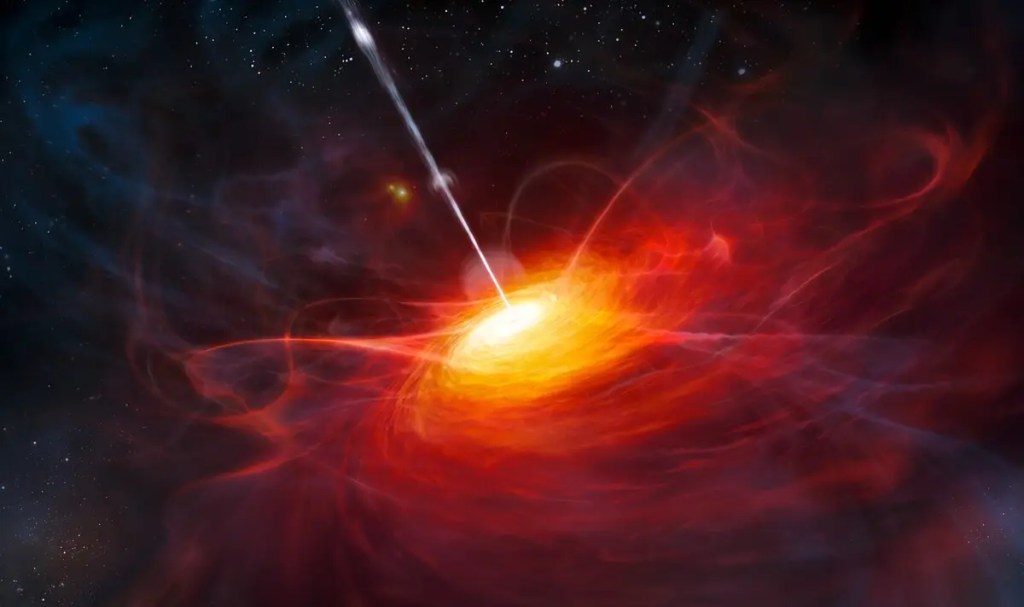
Conducted under the leadership of Dr. Victoria Fawcett from Newcastle University, and formerly Durham University, this recent investigation harnesses the power of spectroscopic observations courtesy of DESI. By scrutinizing around 35,000 quasars, the study meticulously gauges the extent of dust, indicated by reddening, and establishes a compelling correlation with the observable radio emissions. What sets DESI apart is its remarkable capability to detect exceedingly red (Dusty) quasars, a feat surpassing similar past spectroscopic surveys like the Sloan Digital Sky Survey (SDSS). The findings underscore a significant pattern: the crimson-hued quasars, indicative of heightened dust levels, exhibit a notably greater propensity for robust radio emissions in comparison to their more typical blue counterparts.
It was really exciting to see the amazing quality of the DESI data and to discover thousands of these, previously rare, red quasars. I feel like this study puts lots of the puzzle pieces together in our understanding of red quasars and definitively links the dust in a quasar to its radio emission. I think this is the strongest evidence so far that red quasars are a key element in how galaxies evolve.
Victoria Fawcett
The intriguing link between reddening and heightened radio emissions can be attributed to the formidable gas outflows propelled away from the supermassive black hole. These surges collide with the enveloping dust, generating shocks and, consequently, radio emissions. Over time, these outflows are expected to disperse all the dust and gas within the galaxy’s central domain. This transformation unveils the blue quasar appearance while resulting in diminished radio emissions. This alignment aligns with the emerging perspective that red quasars signify a more youthful, transformative “Blow-out” phase in the galaxy’s evolutionary journey. Consequently, red quasars hold significant promise in unraveling the intricate tapestry of how galaxies metamorphose over time.
There are still many unanswered questions surrounding red quasars, such as whether black hole winds or radio jets are ultimately responsible for this enhanced radio emission. However, with the sample of DESI red quasars continuing to grow over the next few years of the survey, I am confident that we are on the brink of fully understanding the nature of these red quasars.
Victoria Fawcett
Resources
- NEWSPAPER Madanapalle, A. (2023, October 1). Astronomers find link between red quasars and amount of surrounding dust. News9live. [News9live]
- JOURNAL Fawcett, V. A., Alexander, D. M., Brodzeller, A., Edge, A., Rosario, D. J., Myers, A. D., Aguilar, J. A., Ahlen, S. P., Alfarsy, R., Brooks, D., Canning, R., Circosta, C., Dawson, K., De La Macorra, A., Doel, P., Fanning, K., Font-Ribera, A., Forero-Romero, J. E., Gontcho, S. G. A., . . . Zou, H. (2023). A striking relationship between dust extinction and radio detection in DESI QSOs: evidence for a dusty blow-out phase in red QSOs. Monthly Notices of the Royal Astronomical Society, 525(4), 5575–5596. [Monthly Notices of the Royal Astronomical Society]


