



APA 7: TWs Editor & ChatGPT. (2023, November 1). Revolutionary Technique Unveiled for Asteroid Metal Extraction! PerEXP Teamworks. [News Link]
The research team examined a trio of meteorite types, including two chondrites and one iron meteorite. These chondrite specimens were composed of silicates with metal-rich components, including native alloys, sulfides, and oxides. Among these components, metallic iron-nickel and troilite were the most prevalent metal-bearing phases across all three samples, exhibiting distinctive characteristics in the iron-rich meteorite.
The researchers conducted chemical micro-etching experiments on the samples using a deep eutectic solvent. This solvent was created by combining choline chloride and ethylene glycol and included iodine and iron (III) chloride as oxidizing agents.

Iron meteorites from beyond Earth
Extraterrestrial metal extraction holds the potential for sustainable resource utilization in space endeavors, offering a means to reduce mission costs, environmental impacts, and reliance on materials from Earth. Large metal-rich asteroids, the precursors of iron meteorites and metal-rich carbonaceous chondrites, represent abundant sources of valuable metals. These resources could facilitate the establishment of human colonies in space or on other celestial bodies. Notably, near-Earth asteroids house valuable platinum group metals, iron, nickel, and cobalt in quantities surpassing those available on Earth’s surface.
The asteroid signatures closely resembled those of asteroid 16 Psyche, known as the largest metal-rich object in the solar system. This study explored a proof-of-concept technique for extracting metals from meteorite proxies of asteroids using non-aqueous deep eutectic solvents.
Rivera and his team assessed the depth and dissolution rates by examining the 3D surface features of the meteorite samples both before and after the etching process. Chondrite meteorites exhibit varied mineral composition, with olivine, pyroxene, plagioclase, and kamacite minerals being the most prevalent. The specific composition varies depending on the extent of metamorphism these meteorites have undergone.
Diverse sampling
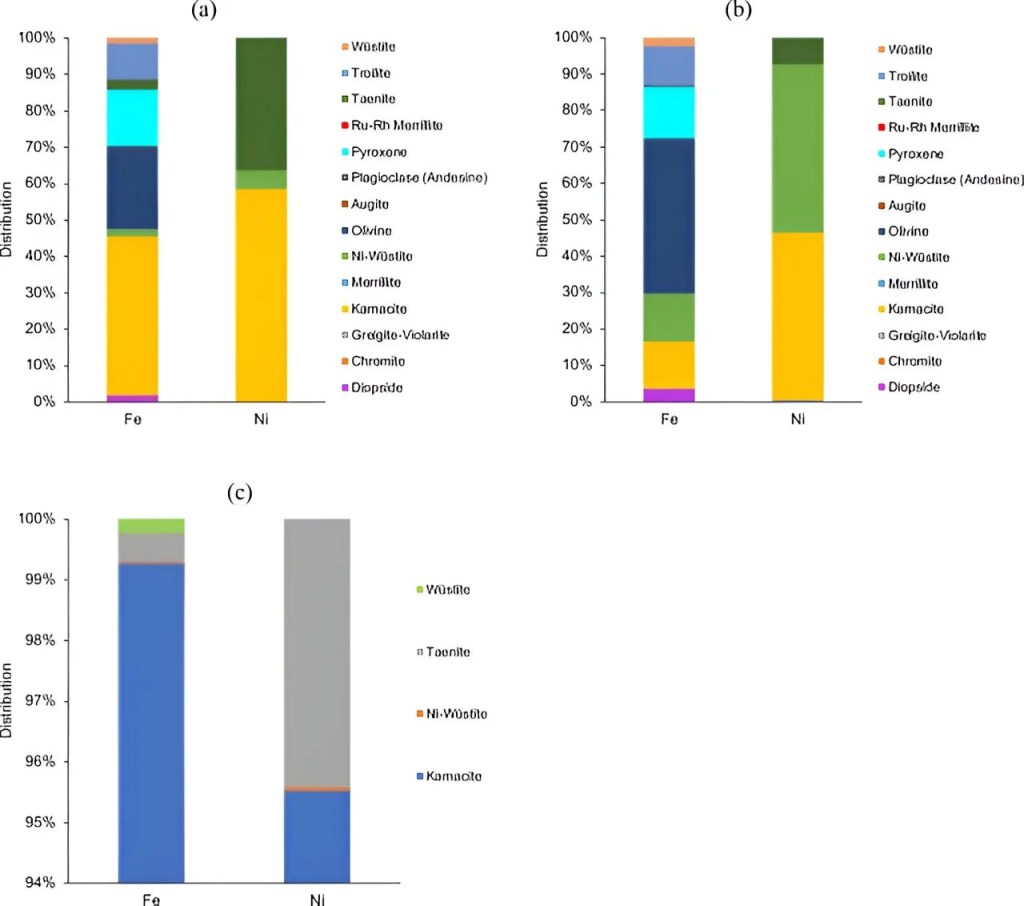
The chondrite samples exhibited a range of compositions, including iron-nickel alloys, iron sulfide, and iron oxide minerals. Iron-nickel-rich minerals were less prevalent but contained a higher proportion of iron sulfide. These meteorites also contained a silicate matrix composed of olivine and pyroxene, which formed chondrules, along with traces of plagioclase feldspar.
The researchers successfully categorized the chondrules of H3 chondrites into six distinct groups based on their petrographic characteristics. For instance, the Campo del Cielo sample is primarily composed of iron-nickel mineral phases. Notably, kamacite within the meteorite was found to contain significant trace elements.
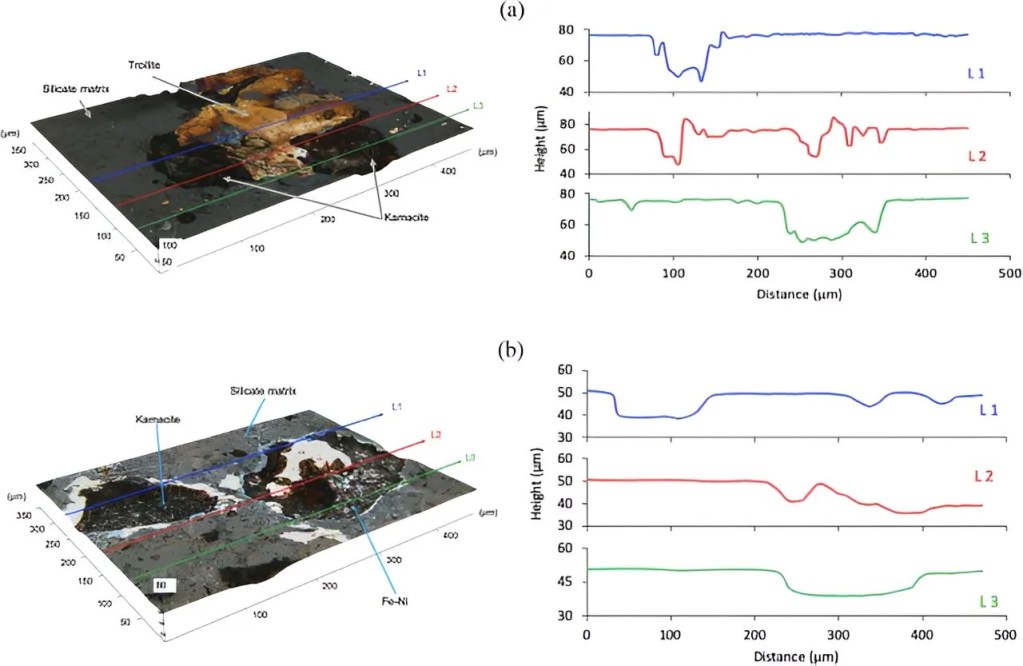
The etching depth of sample references, namely NWA 13876 (a) and NWA 7160 (b), was assessed after 60 minutes of etching with 0.1 mol dm-3 iodine as the oxidizing agent. The figures on the left side display 3D reflected light images along with line profiles, while the right side exhibits the topographic line profiles corresponding to the 3D images. (Scientific Reports) 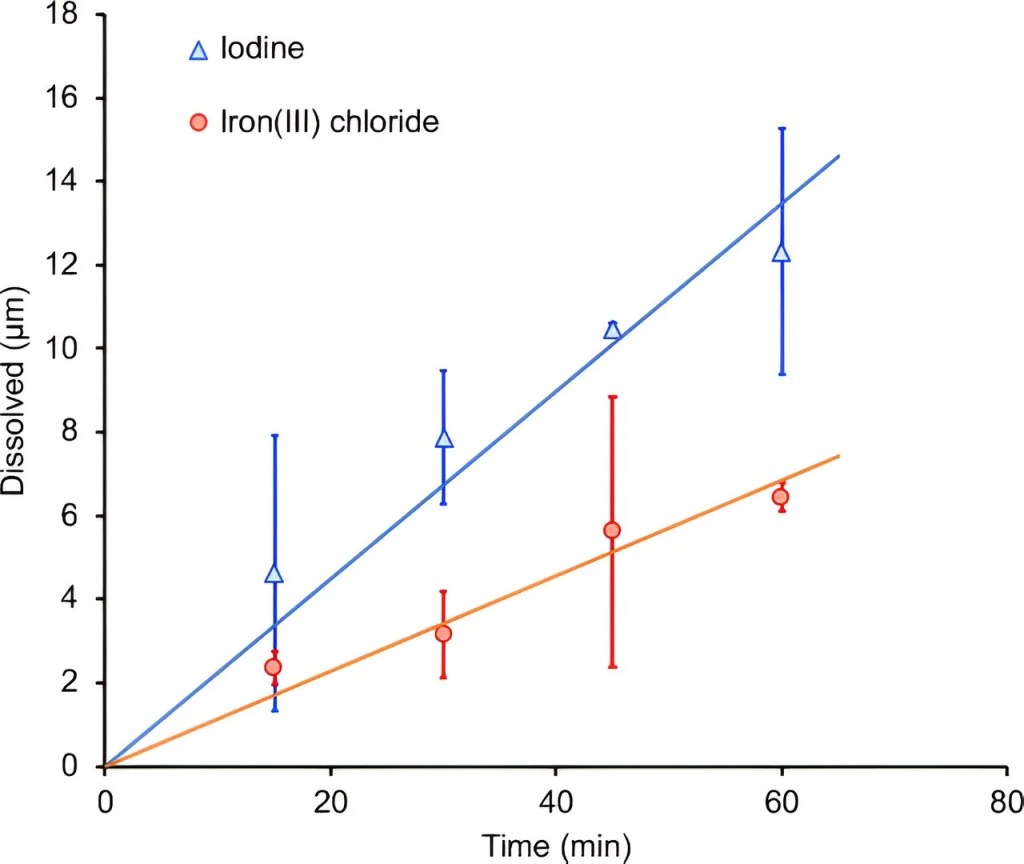
The etching depth of iron-rich phases in the Campo del Cielo meteorite was evaluated using 0.1 mol dm-3 of iodine and FeCl₃ as oxidizing agents within the ChCl: 2EG eutectic system at 50 °C. The graph illustrates the trend with straight lines, and error bars represent the standard deviation derived from triplicate experiments. (Scientific Reports)
In their study, Rivera and his team investigated the distribution of iron and nickel minerals within meteorite samples. They found that iron was predominantly present within silicate phases like olivine, pyroxene, and augite, along with other significant elements. The researchers delved into the catalytic oxidation of metals, including superalloys and minerals, as well as the chemical etching of chondrite meteorites. Additionally, they conducted chemical etching experiments on the Campo del Cielo meteorites using iodine and iron chloride as oxidizing agents, both before and after the etching process.
Conclusion
Rodolfo Marin Rivera and his team employed a deep eutectic solvent in conjunction with iron (III) chloride and iodine as oxidizing agents to dissolve metals from three meteorite proxies representing near-Earth asteroids.
Through analytical investigations, the researchers not only confirmed the chemical binding of nickel with iron-rich metal phases in the initial samples but also detected traces of other valuable metals for space applications, such as ruthenium and rhodium.
Leveraging asteroids for their mineral and metal resources represents a pivotal advancement in space exploration. Although the technology is still in its early stages, it holds significant promise for effective metal recovery, opening the door to potential economic opportunities.
Resources
- NEWSPAPER Jeewandara, T. (2023, October 31). Mining asteroids: A new method to extract metals from asteroids. Phys.org. [Phys.org]
- JOURNAL Rivera, R. M., Bird, P., Jenkin, G. R., & Abbott, A. P. (2023). A novel method for extracting metals from asteroids using non-aqueous deep eutectic solvents. Scientific Reports, 13(1). [Scientific Reports]


Thanks for information!