



In a recent study published in Nature Communications, my colleague, Ph.D. student James Cass, and I unveiled findings showcasing that the motion of a sperm’s tail, scientifically referred to as a flagellum, gives rise to discernible patterns. Remarkably, these patterns can be accurately characterized using Turing’s theory, adding a novel dimension to our understanding of flagellar dynamics.
The intricate patterns resulting from chemical interactions manifest in a diverse array of shapes and colors, including spirals, stripes, and spots. These patterns are pervasive in the natural world and are thought to underlie distinctive features such as the markings on zebras and leopards, the arrangement of seeds in a sunflower head, and the formations observed in beach sand.
The applicability of Turing’s theory extends across diverse scientific domains, encompassing biology, robotics, and even astrophysics. The research team sought to investigate a potential mathematical correlation between the intricate chemical patterns described by Turing’s theory and the movements of sperm tails. Establishing such a connection could imply that nature employs analogous templates to generate patterns of motion on minute scales.
The life of a tail
The mechanics governing the movement of the sperm flagellum are intricately complex. At the molecular scale, the flagellum employs miniature “motors” that facilitate efficient shape-shifting. These motors harness energy in one form and convert it into mechanical work, propelling the flagellum into motion. The source of this motion lies in the activation of tiny fibers organized in a bundle known as an axoneme. These axonemes are remarkably elegant, geometric, and slender structures, measuring up to 0.05 millimeters in length for human sperm—roughly half the width of a human hair.
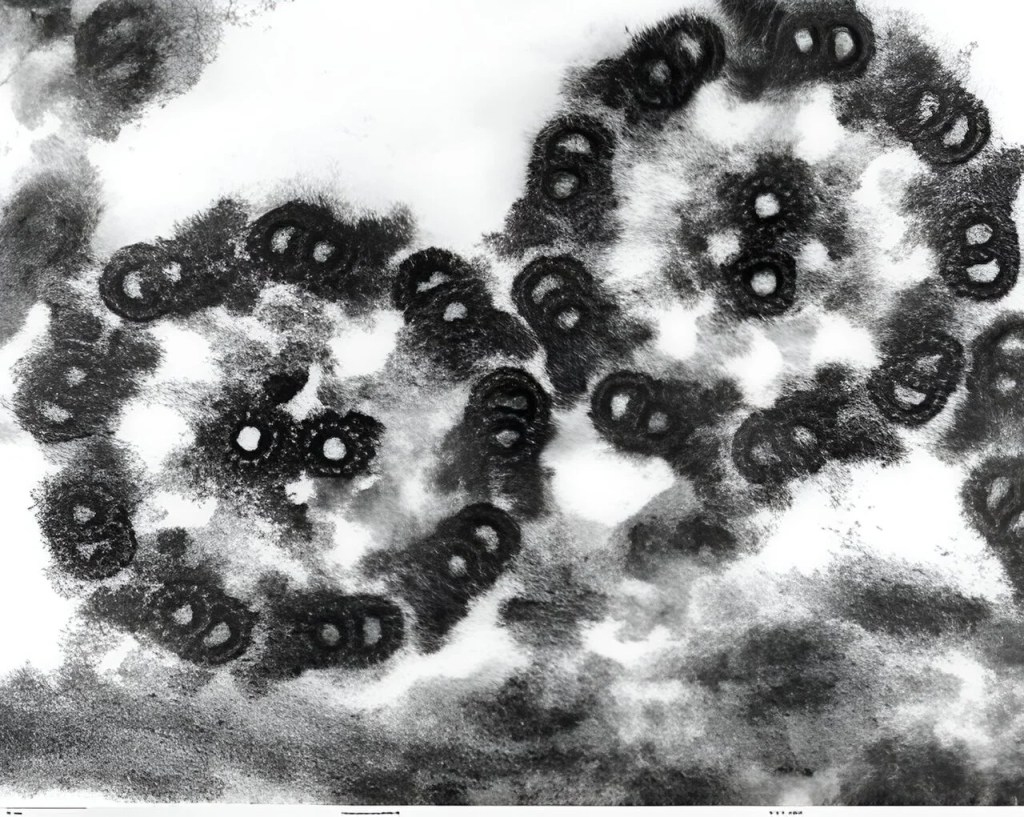
Possessing remarkable flexibility, the axoneme allows micrometer-scale waves to traverse its length. As the dynamic core of the flagellum, the axoneme plays a pivotal role in propelling sperm cells forward. Beyond its locomotive function, it also exhibits the capability to sense and respond to the surrounding environment.
The intricate swimming motion arises from the interplay of intricate interactions among various components, including passive elements like the axoneme and its elastic connectors, as well as active components represented by molecular motors. These elements collaboratively engage with the surrounding fluid to orchestrate the complex dynamics of sperm movement.
The fluidic surroundings through which sperm navigate impose drag, impeding the motion of the flagellum. For sperm to effectively travel, a delicate equilibrium must be achieved among multiple, occasionally conflicting factors. This balance ensures that the undulating movements of the flagellum harmoniously propel the sperm forward despite the resistive effects of the fluid drag.
The research team drew inspiration from scientific insights suggesting that the surrounding fluid minimally impacts sperm flagellum movements. In pursuit of a deeper understanding, the researchers developed a digital counterpart—a virtual “twin” of the sperm flagellum within a computer environment.
James F. Cass at the Polymaths Lab undertook the intricate responsibility of creating a computer-based counterpart, or “twin,” intended to closely emulate the behavior of the actual sperm flagellum.
This approach enabled the research team to assess the extent to which the movement of the tail was influenced by the surrounding fluid. Their findings revealed that fluids with low viscosity, such as watery environments adapted by aquatic species, exerted minimal impact on the shape and behavior of the flagellum.
Through a synthesis of mathematical modeling, simulations, and model fitting, the research team demonstrated that undulations in sperm tails emerge spontaneously, independent of their aqueous surroundings. This observation suggests the presence of a robust mechanism within the flagellum, ensuring effective swimming even in low viscosity fluids.
From a mathematical perspective, this inherent, self-initiated movement mirrors the patterns generated in Turing’s reaction-diffusion system originally designed for chemical patterns. The surprising and noteworthy similarity observed between chemical patterns and patterns of movement adds a unique dimension to the understanding of flagellar dynamics.
Traditionally, the research team wouldn’t have considered that chemical patterns operate similarly to patterns of motion or contractions, nor would they have anticipated mathematical similarities. However, now armed with this insight, the team posits that the motion pattern might necessitate only two straightforward elements. Firstly, chemical reactions propelling molecular motors, and secondly, a bending motion facilitated by the elastic flagellum. Remarkably, in aquatic environments, the surrounding fluid exerts minimal to no influence on these dynamics.
The molecular motors distributed along the sperm’s flagellum generate “shearing” forces, inducing a bending motion in the tail. Comparable to the behavior of an elastic rod, once bent and released, the rod gradually unbends until it attains a straight equilibrium. This process of bending “diffusing” along the structure mirrors the way dye diffuses in a fluid until reaching a state of equilibrium—commonly referred to as dilution equilibrium. This phenomenon resonates with the principles embedded in Turing’s mathematical framework.
In the future, these discoveries hold the potential to enhance our comprehension of fertility challenges linked to irregular flagellar motion. Moreover, the underlying mathematical principles could be investigated for novel applications in robotics, potentially contributing to advancements in artificial muscles and animate materials—materials exhibiting dynamic responses akin to living entities, adapting based on their usage.
The mathematical principles governing the movement of the sperm tail are equally applicable to cilia, which are slender projections found on various biological cells, responsible for propelling fluid along surfaces. Investigating the dynamics of cilia movement has the potential to enhance our understanding of ciliopathies—diseases arising from the inefficient functioning of cilia in the human body.
Nevertheless, it’s imperative for the research team to exercise caution. Mathematics, while a valuable tool, remains an imperfect lens through which to scrutinize the intricacies of nature’s flawless mechanisms. While this progress brings us closer to mathematically decoding the spontaneous movement in flagella and cilia, it’s crucial to acknowledge the inherent limitations of the proposed animated reaction-diffusion theory. Its simplicity falls short of comprehensively encapsulating the full complexity of these biological processes. Various research teams have explored the applicability of Turing’s pattern formation theory in other biological systems, yielding mixed evidence and suggesting a nuanced landscape.
Similarly, alternative mathematical models may prove equally fitting, or perhaps even superior, when compared with experimental outcomes. As the British statistician George Box aptly expressed, “All models are wrong, but some are useful.” The intention is to convey the understanding that while mathematical models may not perfectly mirror the intricacies of natural phenomena, their utility lies in providing valuable insights. The research team aspires that the identified patterns can contribute meaningful perspectives to the broader scientific community.
Resources
- ONLINE NEWS Bloomfield-Gadêlha, H. & The Conversation. (2023, November 26). The way a sperm tail moves can be explained by mathematics worked out by Alan Turing. Phys.org. [Phys.org]
- JOURNAL Cass, J. F., & Bloomfield-Gadêlha, H. (2023). The reaction-diffusion basis of animated patterns in eukaryotic flagella. Nature Communications, 14(1). [Nature Communications]
Cite this page:
APA 7: TWs Editor. (2023, November 27). How Alan Turing’s Mathematics Can Describe the Movement of a Sperm Tail? PerEXP Teamworks. [News Link]


