



APA 7: TWs Editor & ChatGPT. (2023, November 7). Recent Research Reveals the Reasons Behind Dark Deep-Sea Diving Behavior in Certain Animals. PerEXP Teamworks. [News Link]
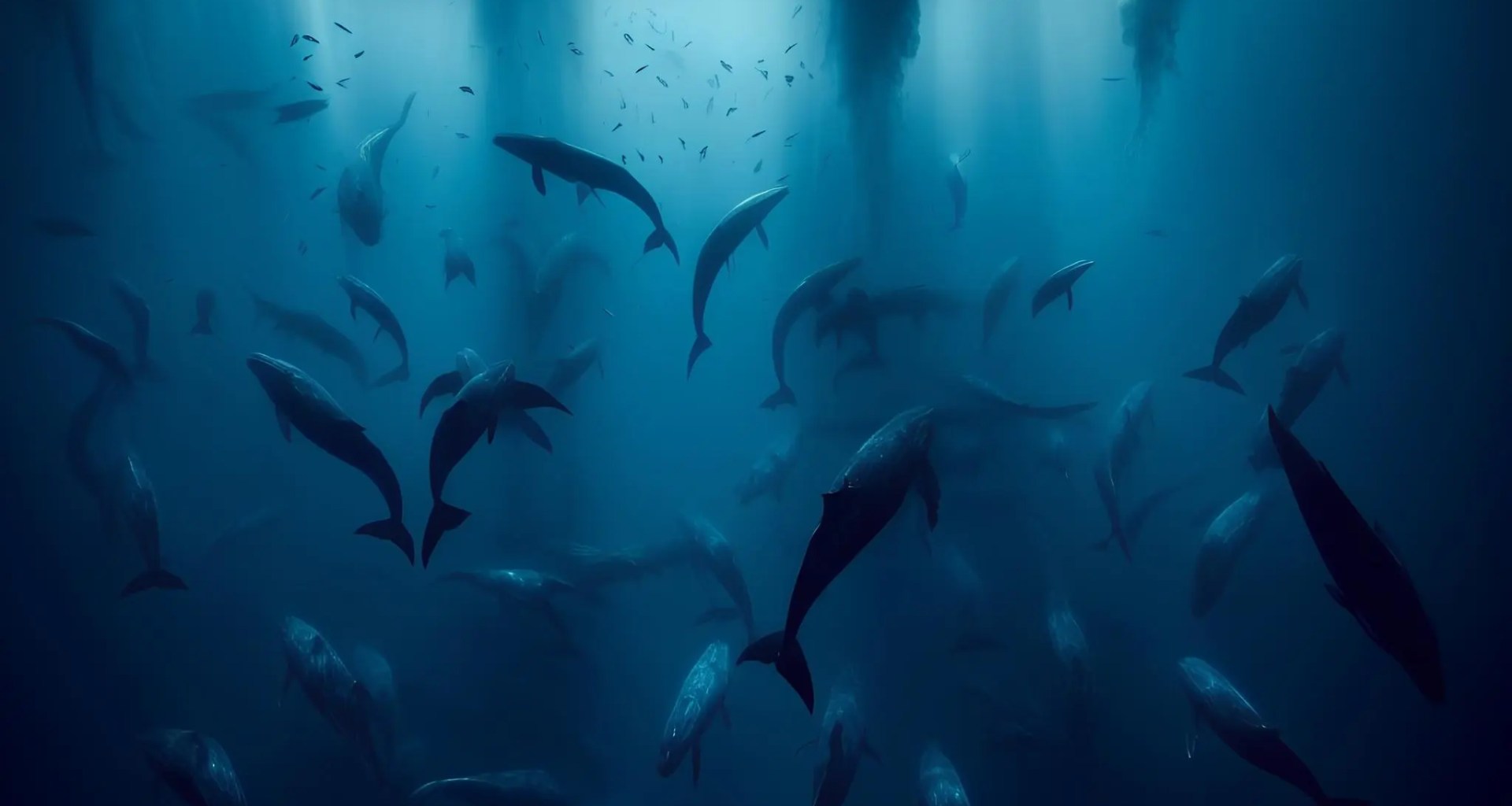
A recent study reveals an unexpected behavior among prominent marine predators such as sharks, tunas, and billfish. These creatures are shown to frequent the deep ocean more often than previously thought, with a significant focus on the mesopelagic zone, located at depths ranging from 200 to 1,000 meters below the sea’s surface. This relatively unexplored region, often referred to as the ocean’s twilight zone, is emerging as a vital habitat for these large predator species, challenging previous assumptions about their behavior. The study’s findings are published in the journal Proceedings of the National Academy of Sciences.
Camrin Braun, an assistant scientist at the Woods Hole Oceanographic Institution (WHOI), spearheaded this comprehensive study, which harnessed an extensive dataset contributed by various scientific collaborators. Through the synthesis of information from electronic tags, shipboard sonar, Earth-observing satellites, and data-assimilating ocean models, Braun and his co-authors quantified the ecological importance of deep dives for these significant pelagic predators. They underlined that maintaining a robust mesopelagic zone not only has ecological advantages but also offers a range of ecosystem services that benefit human interests.
Camrin Braun noted that regardless of the specific apex predator or their location in the world’s oceans, they consistently venture into the deep ocean. These findings challenge the common perception of these creatures as inhabitants of surface waters, revealing a more extensive use of the deep ocean than previously realized.
The researchers collected data from 344 electronic tags, tracking these large marine predators for a total of 46,659 days. Their study encompassed 12 species found in the North Atlantic Ocean, such as white sharks, tiger sharks, whale sharks, Yellowfin tuna, and swordfish, among others.
The data collected from the electronic tags, which revealed the diving behaviors of these fish, were compared with sonar data tracking the daily migrations of the deep scattering layer (DSL). The DSL is a region where an immense concentration of small fish and marine organisms creates such density that early sonar users initially misinterpreted it as the ocean floor. This layer of marine life inhabits the mesopelagic zone during the day.
As the sun sets, numerous creatures within this layer, including fish, mollusks, crustaceans, and various other species, ascend to the surface waters for feeding. With the return of daylight, scattering light across the surface, they descend back into the twilight zone, where they remain until nightfall. This daily behavior is known as Diel Vertical Migration, a pattern that researchers at WHOI have been investigating for many years.
According to Alice Della Penna, a co-author and collaborator at the University of Auckland, New Zealand, who specializes in acoustics, the remarkable alignment of the data sets came as a surprise. She found it exciting that when they examined this particular process from both diving and acoustics perspectives, everything seemed to fit together exceptionally well.
Following years of data collection and analysis, the recent paper provides insights into the predators that appear to be closely associated with the DSL, likely to hunt smaller prey. It also raises questions about the animals that deviate from the usual vertical migration patterns, prompting further inquiries into their deep dives and the reasons behind them, apart from feeding.
“Several species aligned perfectly with the expectations that they’re diving to feed, but there are behaviors that aren’t just for feeding,” noted Braun. However, some species exhibit intriguing deviations from the norm. For instance, swordfish rigorously follow the Diel Vertical Migration pattern, but there are instances of remarkable deviations, such as swordfish venturing to depths of 3,000 or even 6,000 feet, which is significantly deeper than what would typically be expected for feeding purposes.
This suggests that their dives may serve purposes beyond feeding, and these reasons are not yet entirely comprehended. Earlier research has suggested that these vertical movements could be driven by factors like predator avoidance or navigational assistance, as outlined in the study. Despite the occasional deviations in behavior, the study found that all the large predator species examined in some way interacted with the mesopelagic organisms. It appears that these predators find it valuable to venture into the seemingly unwelcoming realms of the deep ocean, characterized by minimal light, high pressure, and near-freezing temperatures.
Simon Thorrold, a fish ecologist at WHOI and a co-author of the study, noted that despite the vast evolutionary differences between sharks and tunas, along with their distinct sensory systems, both groups still see value in engaging in this type of behavior.
Simon Thorrold highlighted the significance of this behavior, noting that the vast number of fish and organisms involved in this vertical migration could potentially transport substantial amounts of carbon dioxide from the ocean’s surface to its deep regions, where it may be sequestered for centuries. However, he pointed out that the full extent of this ecosystem service provided by the mesopelagic zone has not been quantified yet.
Simon Thorrold emphasized the economic value of the ecosystem services provided by the deep-sea biomass in the twilight zone, particularly for commercially-fished large species. He pointed out that these services are of significant monetary worth.
The study emphasizes the collective interest in preserving the mesopelagic zone and suggests a need for more in-depth research on deep ocean food webs before engaging in fishing or extraction activities. The paper highlights the potential risks to this essential ecosystem due to factors such as the current fishing activities, the distribution of pelagic predators, anticipated climate-induced changes in pelagic ecosystems, and the possible extraction of mesopelagic biomass.
According to Della Penna, the mesopelagic zone plays a crucial role in supporting other areas of the ocean. She emphasizes that exploiting these mesopelagic ecosystems without a thorough understanding of their functioning carries a substantial risk of causing irreversible damage.
Resources
- NEWSPAPER Woods Hole Oceanographic Institution. (2023, November 7). New study sheds light on why some animals dive to the dark, deep sea. Phys.org. [Phys.org]
- JOURNAL Braun, C. D., Della Penna, A., Arostegui, M. C., Afonso, P., Berumen, M. L., Block, B. A., … Thorrold, S. R. (2023). Linking vertical movements of large pelagic predators with distribution patterns of biomass in the open ocean. Proceedings of the National Academy of Sciences, 120(47), e2306357120. [PNAS]


It’s amazing, it’s admirable 💫
Thanks Derman Cepe : )
Stumbled across your post on the WordPress feed and just wanted to drop by and say hello ! Your content caught my attention, and I’m thrilled to explore more of your engaging posts. Although I couldn’t locate the follow button (LOL!) , I’ll definitely keep it in my reading list! Rest assured, I’ll stay vigilant for your future posts.
nice! good read