






When Norse longships reappeared off the English coast in 980 CE, decades of relative maritime tranquility abruptly shattered. Facing relentless assaults across vulnerable coastal settlements, Anglo-Saxon leaders turned to systematic silver payoffs known to history as the Danegeld tax [1]. Was buying peace simply an act of royal cowardice or a pragmatic diplomatic maneuver? While later critics derided the policy as disastrous appeasement, historical records demonstrate that these massive payments fundamentally transformed early medieval administration and reshaped Northern European finance [3].
What Was the Danegeld Tax?
The Danegeld tax was a nationwide land assessment engineered across Anglo-Saxon England to raise extraordinary quantities of silver tribute for invading Viking armies [1]. Following a crushing English defeat at the Battle of Maldon in Essex in 991 CE, King Æthelred II—often styled Æthelred the Unready—heeded the counsel of Sigeric, Archbishop of Canterbury, and provincial aldermen to purchase temporary security rather than sustain further slaughter [4]. That initial payment amounted to 10,000 pounds of silver, an immense sum delivered to the Norwegian commander Olaf Tryggvason [3].
Contemporary sources originally referred to these emergency disbursements as gafol, an Old English term signifying tribute or mandatory tax. The payments escalated with terrifying speed as Viking fleets returned to demand further concessions. In 1007 CE, the crown bought two years of peace for 36,000 pounds of silver, and by 1012 CE, following the brutal sack of Canterbury and the murder of Archbishop Ælfheah, the demand climbed to 48,000 pounds [4]. Over the course of Æthelred’s reign, cumulative tributes reached roughly 240,000 pounds of silver [1].
Eighty-four metric tonnes of bullion equated to roughly 58 million silver pennies, exceeding highest scholarly estimates for physical currency circulating within England at that time. No other contemporary western European realm possessed the bureaucratic machinery to generate such liquid capital repeatedly [1].

Continental Roots Along Frankish Rivers
Long before Anglo-Saxon monarchs yielded to Viking extortion, Frankish rulers along the Rhine, Seine, and Meuse pioneered the practice of buying off Scandinavian raiders. In 810 CE, a Danish fleet numbering approximately two hundred ships harried the Frisian coast and overcame local levies in three consecutive battles [3]. To halt immediate devastation, the Frisians gathered one hundred pounds of silver through emergency taxation and delivered it to the invaders, establishing the earliest documented continental antecedent to Danegeld levies [4].
Viking commanders quickly recognized that terrorizing European waterways yielded continuous financial windfalls. When Norsemen burned Antwerp in 836 CE, they demanded direct cash payments before sailing away [3]. The next year, raiders seized prominent regional nobles and instituted an impromptu census, demanding ransoms calibrated to each household’s wealth [5]. In West Francia, after the chieftain Ragnar assaulted Paris in 845 CE, Charles the Bald paid six tons of gold and silver to save the city from complete annihilation [3].
Regional communities across Brittany paid off raiders during 847, 854, and 869 CE, culminating in 873 CE when local counts hired Vikings as mercenaries [3]. In East Francia, Charles the Fat paid tributes to end the Siege of Elsloo in 882 CE [4]. In England, Alfred the Great had likewise paid Viking marauders during the 870s CE. Alfred survived his grueling Viking campaigns, whereas Æthelred ultimately succumbed [1].
How Æthelred Built English Defense Systems
Popular folklore often characterizes King Æthelred II as thoroughly incompetent, yet administrative records reveal an active monarch grappling with fragmented domestic loyalty [1]. Writing in an unreviewed preprint from Flinders University supported by the Australian Research Council, historian Matthew Firth emphasizes that Æthelred mobilized extensive military resistance from 992 CE onward, commissioning provincial naval fleets and fortifying garrisons [2]. Internal aristocratic betrayals repeatedly undermined these ambitious defensive maneuvers [1].
To sustain standing forces, the English crown introduced an annual military tax known as heregeld in 1012 CE. Unlike the reactionary Danegeld tax levied irregularly to satisfy raiders, the heregeld functioned as an institutionalized levy specifically designed to maintain Scandinavian mercenary contingents under Thorkell the Tall [4]. Maintaining military readiness required substantial resources, much like early societies sustained agrarian labor explored in studies on ancient European diets featuring seaweed and freshwater plants [1].
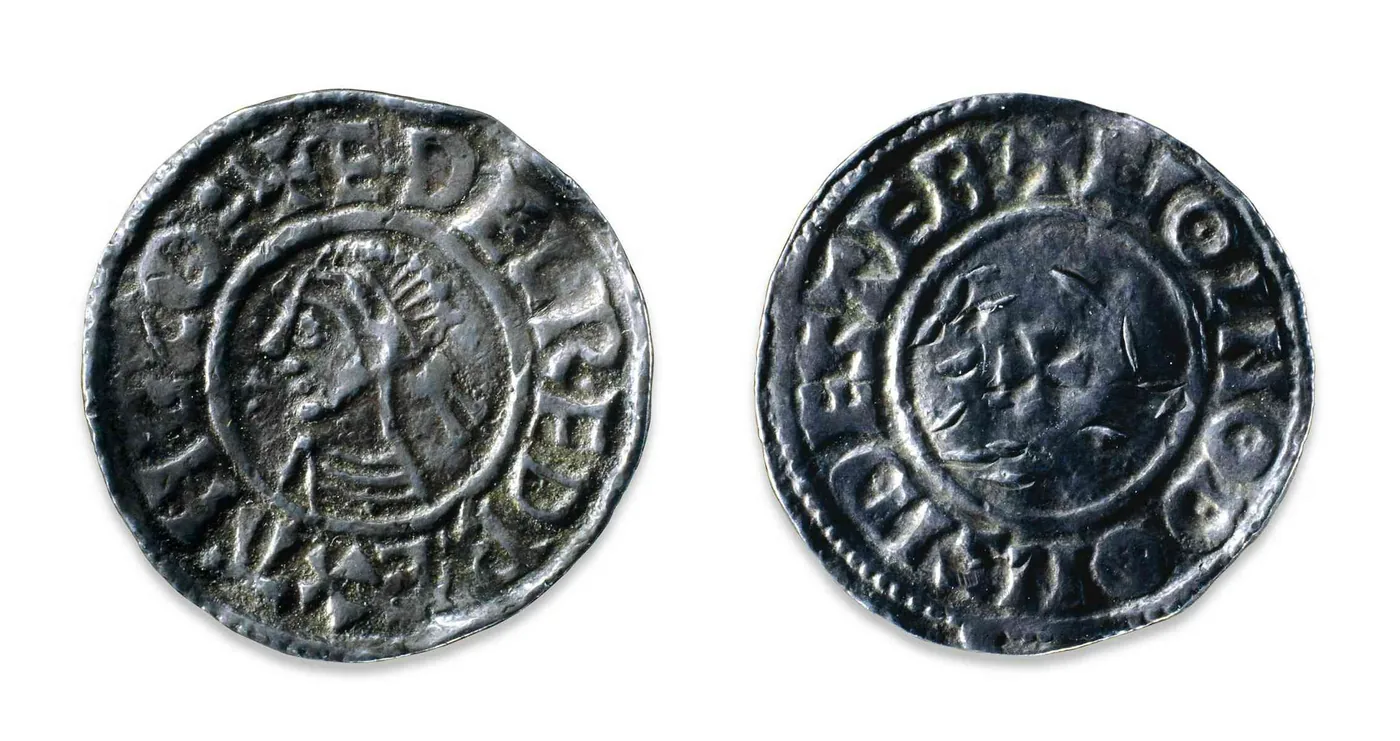
Paying tribute never bought lasting peace. Victorian poet Rudyard Kipling summarized the hazard succinctly: ‘if once you have paid him the Danegeld you never get rid of the Dane’. The medieval Anglo-Saxon Chronicle lamented that ‘for all this truce and tribute, [the Vikings] journeyed nonetheless in bands everywhere, and harried our wretched people, and plundered and killed them’. Dispersed raiding fleets operated independently, meaning satisfaction granted to one warlord did not deter another ambitious fleet from descending upon undefended shores [1].


Viking Danegeld Payments Reshaped Northern Economies
The massive transfer of English bullion catalyzed an unintended economic revolution across Scandinavia. Before receiving systematic Danegeld payments, Norse society relied primarily upon a bullion economy rather than minted coins. Barter dominated early Scandinavian trade. By the ninth century, precious metals circulated as ingots and hack-silver—ornaments intentionally chopped into fragments to meet specific weight measurements [3]. While Roman, Byzantine, and Islamic silver coins reached the north, inhabitants routinely pierced them for pendants rather than circulating them as currency [5].
Anglo-Saxon silver pennies flooded Scandinavian trade networks, fostering monetary sophistication that bridged diverse medieval regions [5]. This cross-border economic integration mirrored broad monetary developments later traced across Europe’s currency and monetary history. King Sweyn Forkbeard struck Denmark’s earliest native coins by directly replicating the dies of Æthelred II, replacing the English monarch’s name with his own likeness. King Olaf Tryggvason followed identical methods in Norway, while Harald Hardrada established a standardized Norwegian coinage following extensive service in Byzantium. In contrast, Sweden raided less frequently in England, minting irregular coinage until the twelfth century [3].

Archaeologists have uncovered far more Æthelredian coins across Scandinavia than in England itself [1]. Valuables followed warriors into the afterlife. In the Heimskringla saga, Snorri Sturluson recounts Odin’s law permitting warriors to enjoy in Valhalla whatever valuables they personally interred in the earth [3]. Runestone U344 at Orkesta in Uppland, Sweden, proudly records that a warrior named Ulf took three separate payments in England under Toste, Thorkell, and Cnut [4].
Why Did Anglo-Saxon Danegeld Become Norman Policy?
The Anglo-Saxon Danegeld endured because conquerors recognized the supreme administrative power of a centralized land tax capable of raising dependable state revenue. When Danish prince Cnut conquered England in 1016 CE following Æthelred’s death, he immediately exploited the existing fiscal machinery [1]. In 1018 CE, feeling secure on the throne, Cnut dismissed all but forty ships of his invasion fleet, paying them off with an astronomical tribute of 72,000 troy pounds of silver collected nationally, plus a further 10,500 pounds extracted from London [4]. He subsequently maintained his standing forces with an annual heregeld levy of roughly £14,000 [1].
Edward the Confessor briefly abolished the annual heregeld in 1051 CE, yet the fiscal framework survived intact [1]. Following the Norman Conquest in 1066 CE, William the Conqueror immediately reinstated the land geld to underwrite military campaigns and administrative expenses across Normandy and Britain [4]. Norman clerks applied the label Danegeld to this regularized assessment, permanently shifting its purpose from buying off maritime invaders to underwriting royal statecraft [1].
William levied this geld annually [1]. Norman kings increased assessment rates significantly, including the infamous six-shilling geld imposed in 1084 CE and a doubled rate levied across Ely in 1096 CE. Historian David Bates observed that this constituted a national tax unknown elsewhere in contemporary Western Europe, establishing an enduring precedent for English royal taxation [4].
Administrative Legacy of Medieval Land Assessment
The centralized administrative machinery engineered to collect the Danegeld tax relied upon standardized territorial units. In southern England, officials assessed land according to the hide, notionally defined as an agricultural tract sufficient to support one peasant household. In Kent, assessments utilized the sulung—equivalent to four yokes of oxen—while northern counties measured taxable agrarian land by the carucate and East Anglia organized assessments by hundreds. Local sheriffs collected silver directly from rural estates, funneling revenues into the royal treasury with remarkable efficiency. As historian J. A. Green notes, this sophisticated apparatus represented the first systematic land taxation system to reemerge in Western Europe following the collapse of the Western Roman Empire [4].
In 1130 CE, Henry I collected roughly £2,400 from Danegeld assessments, generating nearly ten percent of the Exchequer’s total annual revenue. That year, according to chronicler John of Worcester, the king pledged to suspend the tax for seven years, a promise renewed by King Stephen at his coronation but later broken. Although Stephen formally abolished the tax around 1154 CE and Henry II briefly resurrected it in 1155, the tax appeared for the final time on royal pipe rolls in 1162 CE. By the late twelfth century, English monarchs transitioned from arbitrary land assessments toward parliamentary taxes levied on moveable property [4].
Centuries after Viking raids ceased, the fiscal infrastructure forged to pay Danegeld tributes remained the bedrock of medieval English state finance [1].
- PREPRINT Firth, M. (2026). The English paid off the Vikings for almost a century. But was the Danegeld such a bad idea? [Preprint]. The Conversation. [Article Link]
- ONLINE NEWS Firth, M. (2026). The English paid off the Vikings for almost a century. But was the Danegeld such a bad idea? Yahoo News Australia. [Article Link]
- WEBSITE Suess, J. (2026). The Vicious Viking Tax of Danegeld That Bankrupted Anglo-Saxon England. TheCollector. [Article Link]
- WEBSITE Wikimedia Foundation. (2026). Danegeld. Wikipedia. [Article Link]
- WEBSITE Moretti, E. (2026). Danegeld: How the Vikings Turned Fear into Fortune. History Affairs Project. [Article Link]
APA 7: PerEXP Teamworks. (2026). Danegeld Tax Fueled Anglo-Saxon Defense and Viking Economies. PerEXP Teamworks.


