



APA 7: TWs Editor. (2023, November 24). Extreme Weather Events May Rise by 2050 Due to Carbon Neutrality, According to New Research. PerEXP Teamworks. [News Link]
According to the exhaustive study, achieving the 1.5°C target necessitates a crucial timeline: greenhouse gas emissions must reach their peak by 2025 and subsequently undergo a significant decline of 43% for the remainder of the century. This underscores the critical need for prompt and substantial emissions reduction efforts to align with the prescribed climate goals.
While the primary focus remains on implementing strategies to counteract greenhouse gas emissions and achieve carbon neutrality by 2025, recent research published in Nature Communications underscores the urgent concern surrounding atmospheric aerosols and their counterproductive impact on climate warming.
Additionally, research conducted by Associate Professor Pinya Wang and her colleagues from Nanjing University of Information Science & Technology, China, has brought attention to the heightened occurrence and severity of future extreme weather events, spanning from floods to heatwaves. Their findings project potential global implications for communities, attributing this trend to anticipated increases in global surface air temperature and annual mean precipitation—estimated to rise by 0.92°C and 0.10mm per day, respectively, by the year 2100.

Employing the Community Earth System Model, the research team found that a reduction in atmospheric aerosols has adverse effects on the global climate, intensifying the occurrence of extreme weather events more significantly than alterations in greenhouse gases or changes in the tropospheric ozone layer, specifically within the layer up to 10 kilometers above ground level.
Nevertheless, the interconnection among the three factors—greenhouse gases, tropospheric ozone, and aerosols—is intricate. Wang and her colleagues highlight that the reduction of greenhouse gas emissions, particularly from the processing and combustion of fossil fuels, leads to a corresponding decrease in the generation of additional pollutants, including tropospheric ozone and aerosols.
Ozone is produced through chemical reactions involving emissions from vehicles and industrial smokestacks. Its manifestation is frequently observed in the form of smog, a prevalent issue in urban areas. Notably, Dammam in Saudi Arabia has recently ranked at the forefront of locations grappling with concerning levels of atmospheric particulate pollution.
Frequently recognized for its smog-related challenges, China faces a significant task according to recent research. Achieving carbon neutrality by 2060 would necessitate substantial reductions in vehicle and smokestack emissions of key pollutants. Specifically, sulfur dioxide emissions would need to decrease by 93%, nitrogen oxides by 93%, primary particulates with a diameter less than 2.5μm by 90%, and volatile organic compounds by 61%. These substantial reductions underscore the ambitious targets required to align with carbon neutrality goals in the coming decades.

Tropospheric ozone plays a role in influencing the Earth’s temperature by heightening radiative forcing, capturing more incoming solar radiation. In contrast, aerosol particulates can have divergent effects, with sulfates contributing to cooling and black carbon causing warming, for instance. The researchers point to recent investigations examining the impact of the coronavirus pandemic on extreme weather. Notably, they highlight a study that links the elevated occurrence of wildfires in the United States in 2020 to reduced aerosol emissions, which led to increased air temperature and decreased humidity.
The research team employed modeling to assess the radiative forcing impact from greenhouse gases, ozone, and aerosols within the framework of the carbon-neutral Shared Socioeconomic Pathway 1–1.9. In this scenario, carbon dioxide concentrations peak at 437 ppm by 2050, declining to 400 ppm by 2100. Additionally, methane levels reduce from the current 1,884 ppb to 1,061 ppb by the end of the century. Correspondingly, sulfur dioxide emissions under this scenario and timeframe would decrease from the current 3gm−2a−1 to 1gm−2a−1, black carbon from 1gm−2a−1 to 0.1gm−2a−1, and organic carbon from 0.2gm−2a−1 to 0.14gm−2a−1. This comprehensive modeling provides insights into the complex interplay of various emissions and their potential impacts on radiative forcing.
In comparison to a baseline established in 2020, Wang and her colleagues projected a global rise in surface air temperature by 2050. This increase is attributed to the amplified radiative forcing, with the most substantial peak observed at 0.2°C over Greenland, driven primarily by greenhouse gas emissions alone. The findings highlight the spatial variability of temperature impacts and underscore the influence of emissions on climate dynamics.
Nevertheless, when aerosols were integrated into the models, a notable escalation in surface air temperatures across the globe was observed. The models indicated a substantial peak of up to 2°C in the mid-high Northern Hemisphere latitudes, although this effect might be tempered by a slight decrease attributed to the impact of tropospheric ozone. Extrapolating to the year 2100, the warming linked to aerosol reduction continues to exert an upward influence on surface temperatures. This emphasizes the intricate interplay of various factors in shaping long-term climate projections.
Likewise, the model examined alterations in annual mean precipitation worldwide under the same forcings. It revealed that tropical oceans, particularly the Western Pacific, encountered heightened rainfall solely due to greenhouse gas forcing. Introducing a reduction in aerosols to the simulation further intensified rainfall in the Northern Hemisphere but produced a contrasting effect in the Southern Hemisphere. Meanwhile, the reduction of tropospheric ozone had minimal impact on precipitation patterns, emphasizing the complex regional dynamics influenced by different climate forcings.
The modeling indicates that South, East, and Southeast Asia are expected to undergo the most substantial rise in precipitation, reaching 0.3mm per day. This pattern persists over the course of the century, with a more pronounced amplitude. This increase is attributed to elevated atmospheric water vapor levels, driven by warmer temperatures that enhance evaporation and, consequently, specific humidity. These findings underscore the intricate relationship between temperature, humidity, and regional precipitation patterns in the modeled scenarios.
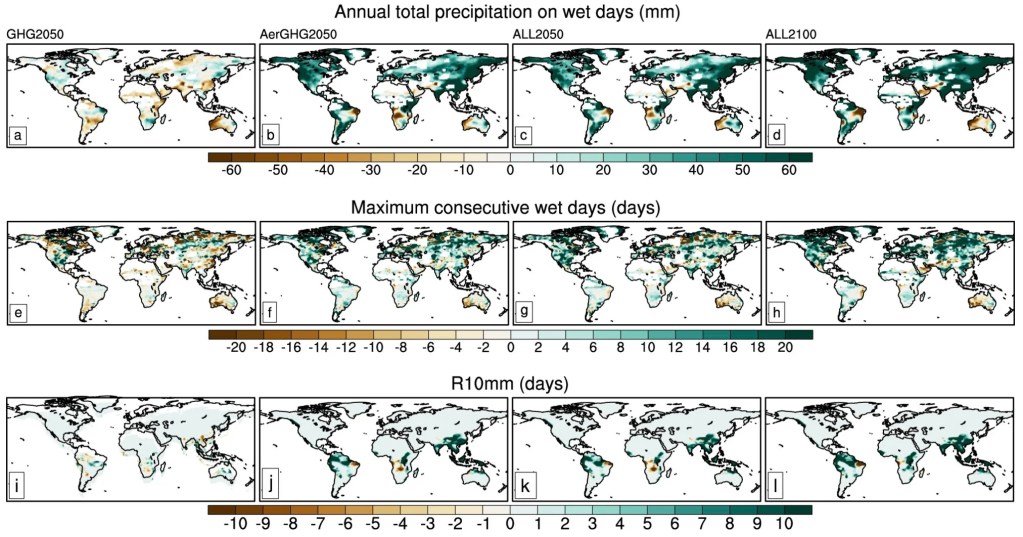
Collectively, the models depicting extreme temperature and precipitation were employed to simulate the occurrence and intensity of heat waves. Under the influence of greenhouse gas-only forcing, the simulations indicated a frequency of five days per year, with each heat wave lasting four days per event and featuring a temperature increase of 0.25°C per day. These simulations provide a comprehensive understanding of the potential impacts of climate change on the frequency and characteristics of heat waves in the modeled scenarios.
Yet, when accounting for the diminishing abundance of aerosols, the models depicted a substantial intensification in heat wave characteristics. By 2050, the simulations projected an increase to over 40 heat wave days per year, each lasting 20 days, with a daily global temperature rise of 0.75°C per day. Moving into the 22nd century, these figures escalated further, with projections indicating 50 days per year marked by heat wave conditions. Individual events were anticipated to endure for 28 days, accompanied by daily temperature fluctuations of 1.5°C. These simulations emphasize the potential amplification of heat wave impacts associated with changes in aerosol levels.
The study underscores the ongoing imperative of discovering sustainable solutions not only for addressing greenhouse gas emissions but also for addressing associated pollutants. Finding effective measures is crucial to enhance the global prospect of achieving ambitious climate targets and to mitigate the diverse array of environmental, economic, and social repercussions anticipated as a result of global warming in the decades and generations ahead.
Resources
- ONLINE NEWS Bird, H. & Phys.org. (2023, November 23). Carbon neutrality likely to increase extreme weather events by 2050, finds study. Phys.org. [Phys.org]
- JOURNAL Wang, P., Yang, Y., Xue, D., Ren, L., Tang, J., Leung, L. R., & Liao, H. (2023). Aerosols overtake greenhouse gases causing a warmer climate and more weather extremes toward carbon neutrality. Nature Communications, 14(1). [Nature Communications]


