



APA 7: TWs Editor. (2023, November 15). Research Indicates Growing Probability of Intense Snowfall Events in the French Alps Due to Climate Change. PerEXP Teamworks. [News Link]
Conversely, the anticipated warming effect at lower to medium mountain elevations is expected to amplify extreme precipitation, with a projected 7% rise in rainfall for every 1°C of global warming. This divergence is poised to impact communities situated in these areas, where the consistency of snowfall is crucial for various livelihoods, including tourism and the skiing industry. Moreover, it poses challenges for hazard mitigation, such as avalanches, which heavily rely on the regularity of snowfall.
Examining alterations in extreme snowfall over both annual and century-long periods, Dr. Erwan Le Roux, a Postdoctoral Researcher at the University of Grenoble Alpes, France, collaborated with colleagues. Their investigation focused on diverse mountain elevations ranging from 900 to 3,600 meters and considered the impact of varying global warming potential (GWP).
Global Warming Potential (GWP) quantifies the heat-trapping capacity of a specific gas in the atmosphere, using carbon dioxide as the reference. The study employed a climate model based on Representative Concentration Pathway 8.5, representing the most severe scenario of greenhouse gas emissions. This scenario foresees a projected temperature rise of 4.3°C by the year 2100 compared to pre-industrial levels.
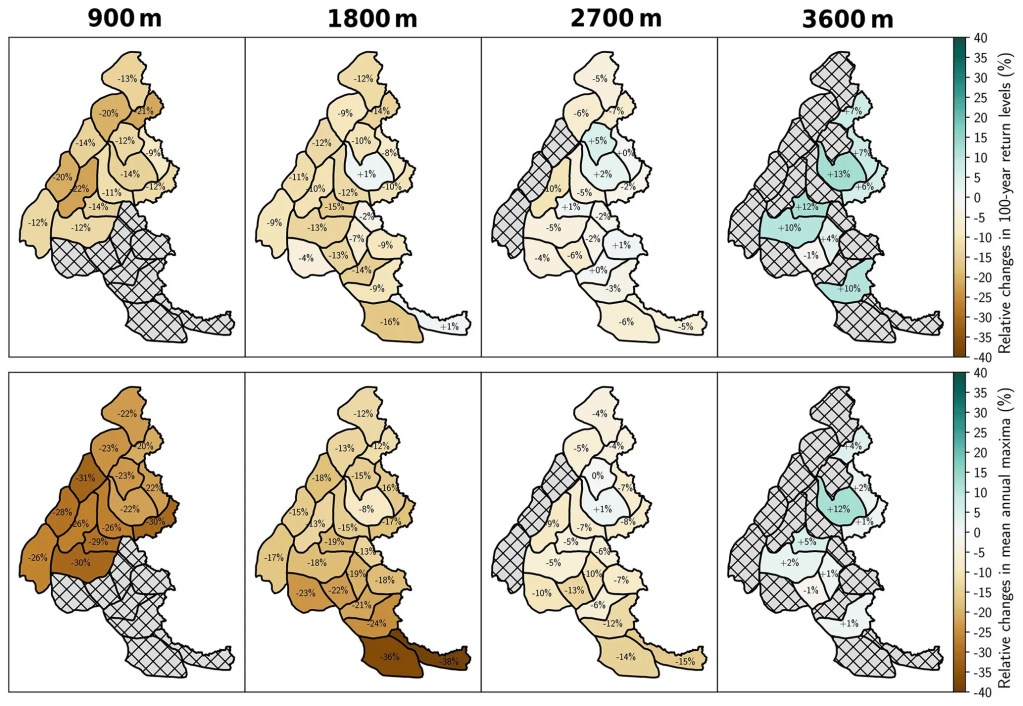
Examining 23 massifs throughout the French Alps, the researchers utilized authentic data derived from ground measurements of temperature, daily precipitation, and meteorological forecasts spanning from 1951 to the present day. This comprehensive dataset was employed to forecast changes expected over the remainder of the century under a +1°C global warming scenario.
Their findings indicate a substantial rise in daily mean annual snowfall at elevations surpassing 3,600 m. Conversely, at elevations below 3,000 m, there was a decline in snowfall, replaced by an increase in overall precipitation. Over the course of a century, the average elevations exhibited a shift, with heightened snowfall noted above 3,300 m but a reduction observed below 2,400 m.
To summarize, the critical point at which the net snowfall balance shifts from below to above 0% undergoes a change, moving from 3,000 m under +1.5°C warming to 3,300 m under +4°C warming for the annual mean. This signifies an elevation increase of 123 m per each additional +1°C of warming, with the most pronounced increase occurring above +3°C.
Many ski resorts in the French Alps, including Chamonix (Extending to 3,275 m) and Les Deux Alpes (Reaching up to 3,600 m), have their upper altitude limits situated beyond 2,400 m. This configuration implies that a decline in snowfall, leading to reduced skiing capacities, could have a significant and potentially detrimental impact on the local economy.
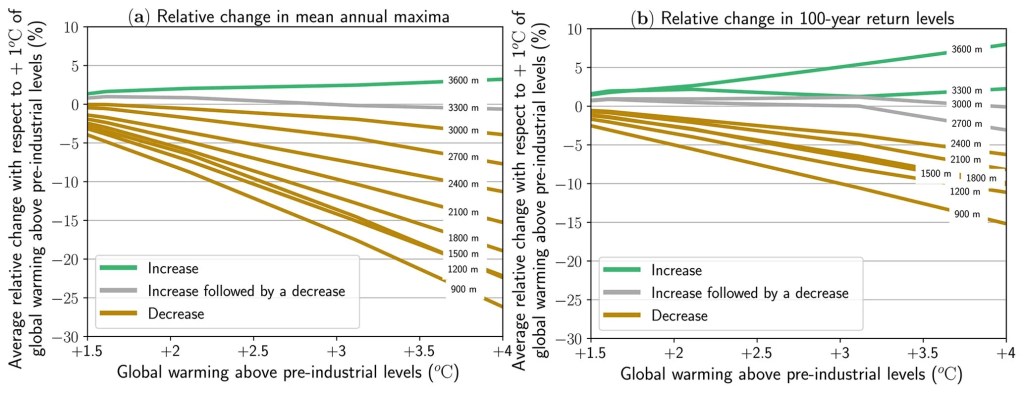
The observed pattern remained consistent until global warming reached +3°C. Beyond this point, elevations undergoing substantial alterations in precipitation and snowfall experienced a decline, reaching as low as 900 m under +4°C of global warming, indicating a 26% reduction in annual snowfall. This trend was particularly pronounced in the southern regions of the French Alps, with the Mercantour massif anticipated to undergo a significant 39% reduction in mean annual snowfall at an elevation of 1,800 m.
In contrast, the most substantial positive shift in mean annual snowfall is forecasted for the northeastern Vanoise massif, indicating a 12% increase at an elevation of 3,600 m. This augmentation is predominantly expected during the boreal winter months of December to February.
The study identified three discernible phase patterns: 1) a rise in intense snowfall attributed to heightened winter precipitation and extreme temperatures at or below freezing; 2) a progression of increased and subsequently decreased snowfall at +3°C and elevations of 3,000 m, arising from temperatures surpassing the optimal range for snow formation; 3) a reduction in snowfall at elevations below 3,000 m, once again stemming from temperatures failing to reach the necessary freezing thresholds.
This study holds crucial significance for extrapolation to other cold mountainous regions, aiding local communities in devising strategic plans for upcoming shifts in snowfall patterns. Implementing both environmental and socioeconomic management strategies becomes imperative, empowering these communities to adapt and thrive amidst the evolving conditions.
Resources
- NEWSPAPER Bird, H. & Phys.org. (2023, November 14). Climate change increasing likelihood of extreme snowfall in the French Alps, research suggests. Phys.org. [Phys.org]
- JOURNAL Roux, E. L., Evin, G., Samacoïts, R., Eckert, N., Blanchet, J., & Morin, S. (2023). Projection of snowfall extremes in the French Alps as a function of elevation and global warming level. The Cryosphere, 17(11), 4691–4704. [The Cryosphere]


