




APA 7: TWs Editor & ChatGPT. (2023, October 30). Innovative Frequency Comb Enables Molecular Identification in 20-Nanosecond Intervals. PerEXP Teamworks. [News Link]
A groundbreaking achievement has been reached by scientists from the National Institute of Standards and Technology (NIST), Toptica Photonics AG, and the University of Colorado Boulder. They have engineered a frequency comb system with the capacity to identify particular molecules within a sample every 20 nanoseconds, equivalent to one billionth of a second.
This latest advancement empowers researchers to potentially employ frequency combs in gaining deeper insights into the split-second transitional stages of swiftly evolving phenomena. These could encompass a wide spectrum, from comprehending the intricacies of hypersonic jet engines to unraveling the chemical reactions governed by enzymes that play a pivotal role in controlling cell growth. The outcomes of this research endeavor have been presented in a paper featured in the journal Nature Photonics.
In their experimental setup, the scientists utilized the well-established dual-frequency comb configuration, incorporating two laser beams that collaborate to analyze the spectrum of colors absorbed by a molecule. Typically, these dual-frequency comb setups incorporate two femtosecond lasers, which emit synchronized pairs of ultrafast pulses.
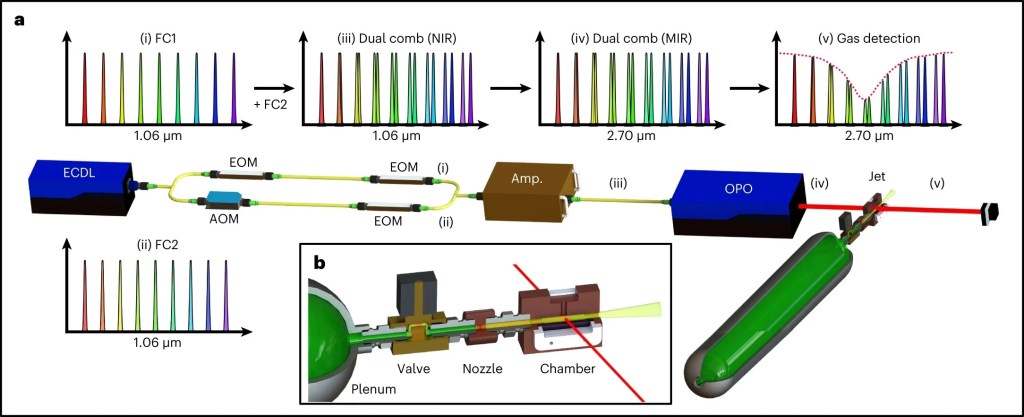
In their latest experiment, the scientists employed a more straightforward and cost-effective configuration referred to as “Electro-optic combs.” This setup initiates with a single continuous light beam, which is subsequently divided into two separate beams. Subsequently, an electronic modulator generates electric fields that induce alterations in each light beam, essentially molding them into the distinct “Teeth” of a frequency comb. Each “Tooth” signifies a precise color or frequency of light, which can be readily absorbed by a molecule of interest.
In contrast to traditional frequency combs that can boast thousands or even millions of teeth, the electro-optic comb utilized by the researchers featured a modest count of just 14 teeth during a typical experimental run. Nevertheless, this limited tooth count translated to significantly higher optical power for each tooth, and these teeth were widely spaced apart in terms of frequency. This unique configuration yielded a distinct and robust signal, facilitating the researchers’ ability to discern alterations in light absorption at the remarkably fast time scale of 20 nanoseconds.
In their experiment, the scientists applied their instrument to gauge the characteristics of supersonic CO2 pulses released from a petite nozzle situated within an air-filled chamber. They focused on quantifying the CO2 mixing ratio, which signifies the proportion of carbon dioxide within the air. The fluctuations in CO2 concentration offered valuable insights into the dynamics of the pulse. Through these measurements, the researchers gained a deeper understanding of how CO2 interplayed with the surrounding air, setting off oscillations in air pressure in its wake. Such intricacies are frequently challenging to capture with precision, even with the most advanced computer simulations.
NIST research chemist David Long explained that in a more intricate system like an aircraft engine, their approach could be employed to focus on a specific substance of interest, like water, fuel, or CO2, to scrutinize its chemical behavior. Additionally, this technique can be utilized to measure factors such as pressure, temperature, or velocity by assessing changes in the signal. The outcomes of these experiments hold the potential to offer valuable insights that may pave the way for enhancements in combustion engine design or an enhanced comprehension of the interactions between greenhouse gases and the Earth’s atmosphere.
The experimental setup incorporated a crucial component called an optical parametric oscillator, which played a pivotal role in adjusting the frequency comb teeth from their initial near-infrared wavelengths to the mid-infrared range, matching the absorption characteristics of CO2. Furthermore, the optical parametric oscillator’s versatility enables it to be fine-tuned to various segments within the mid-infrared spectrum, granting the frequency combs the capability to identify different molecules that absorb light within those specific regions.
The paper provides comprehensive details that can serve as a blueprint for fellow researchers, enabling them to replicate and establish a comparable system within their own laboratories. This opens up the potential for widespread adoption of this innovative technique across a multitude of research domains and industrial applications.
Co-author Greg Rieker, who is a professor at the University of Colorado Boulder and formerly a NIST research associate, emphasized the remarkable aspect of this research. It notably reduces the obstacles that typically impede researchers interested in employing frequency combs to investigate rapid processes. In essence, this work makes the technology more accessible and user-friendly for a broader range of scientific investigations.
David Long highlighted the capabilities of their setup, underscoring its versatility and adaptability. According to him, this approach empowers researchers to create frequency combs tailored to their specific requirements. Its tunability, flexibility, and speed substantially broaden the scope of potential applications, allowing for a diverse array of measurements and investigations.
Resources
- NEWSPAPER Rich Press. (2023, October 30). New frequency comb can identify molecules in 20-nanosecond snapshots. Phys.org. [Phys.org]
- JOURNAL Long, D.A., Cich, M.J., Mathurin, C., et al. (2023). Nanosecond time-resolved dual-comb absorption spectroscopy. Nature Photonics. [Nature Photonics]


