



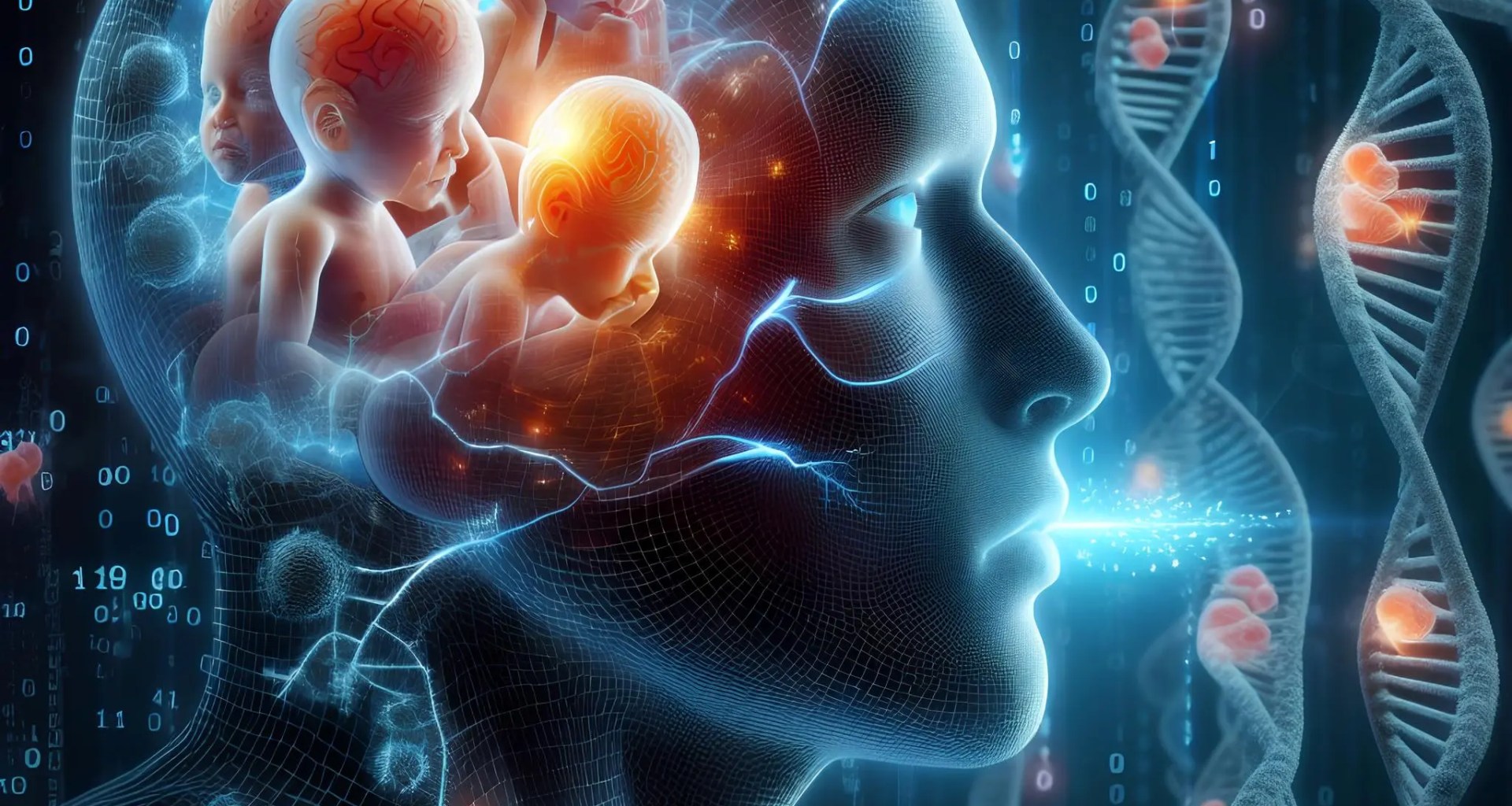
In 1957, evolutionary biologist George Williams postulated a theory suggesting that genetic mutations contributing to aging could be favored by natural selection if they proved advantageous early in life, promoting earlier reproduction or the production of more offspring. At that time, Williams was an assistant professor at Michigan State University.
This concept, now recognized as the antagonistic pleiotropy theory of aging, remains the predominant evolutionary explanation for senescence— the process of aging. Despite individual case studies supporting the theory, comprehensive genome-wide evidence has been lacking.
In a Science Advances publication, University of Michigan evolutionary biologist Jianzhi Zhang and a Chinese colleague tested Williams’ hypothesis. They utilized genetic, reproductive, and death-registry data from 276,406 participants in the United Kingdom’s Biobank database.
Their findings revealed a strong negative genetic correlation between reproduction and lifespan. Essentially, genetic mutations promoting reproduction tended to shorten lifespan. The study also indicated that individuals with mutations predisposing them to higher reproductive rates had lower probabilities of reaching age 76 compared to those with mutations favoring relatively low reproductive rates.
However, the authors caution that both genes and the environment influence reproduction and lifespan. While the study’s genetic factors play a relatively minor role compared to environmental factors—such as the effects of contraception and abortion on reproduction and medical advances on lifespan, according to the authors.
Zhang, the Marshall W. Nirenberg Collegiate Professor in the U-M Department of Ecology and Evolutionary Biology, asserted that the findings offer robust backing for the Williams hypothesis. This theory posits that aging emerges as a byproduct of natural selection favoring earlier and more prolific reproduction. According to Zhang, natural selection places little emphasis on the post-reproductive lifespan, as an individual’s fitness is primarily determined by the conclusion of the reproductive phase.
Biologists employ the concept of fitness to describe the extent to which an organism’s traits contribute to an increase in the number of offspring.
Zhang highlighted an intriguing discovery: when accounting for the genetically predicted quantity and timing of reproduction, having two children aligns with the longest lifespan. Remarkably, having fewer or more children both leads to a reduction in lifespan. This outcome is consistent with the results of several preceding studies.
Erping Long, co-author of the Science Advances paper and affiliated with the Chinese Academy of Medical Sciences and Peking Union Medical College, collaborated with Zhang on the study. Long was a visiting student at U-M during the initiation of the research.
In genetics, the concept of pleiotropy suggests that a single mutation can impact multiple traits. The notion that a mutation can be both advantageous and detrimental, depending on the context, is termed antagonistic pleiotropy. This idea, proposed by Williams, forms the basis for explaining the origin of aging, as detailed in his paper titled “Pleiotropy, natural selection, and the evolution of senescence“
For a biologist, senescence specifically denotes a gradual decline in bodily functions, characterized by a diminishing reproductive performance and an escalating death rate with age.
Utilizing the U.K.’s Biobank database, Zhang and Long conducted a genomic-scale assessment of the genetic relationship between reproduction and lifespan. They analyzed the frequency of 583 genetic variants associated with reproduction in the database. Interestingly, several variants linked to increased reproduction have become more prevalent in recent decades, despite their simultaneous association with a shorter lifespan. The researchers suggest that the heightened frequency of these variants is likely a result of natural selection favoring increased reproduction.
Zhang highlighted the predictions of the antagonistic pleiotropy hypothesis, asserting that mutations increasing reproduction while decreasing lifespan are likely to confer larger fitness advantages than disadvantages, thus being selectively favored.
Despite these predictions, there have been significant shifts in human life expectancy, birth rates, and reproductive behavior over recent decades. The study reports that over half of the global population resides in areas where birth rates have declined, coinciding with increased instances of contraception, abortion, and reproductive disorders.
Contrary to the expectations derived from genetic factors, global human life expectancy at birth has consistently risen from 46.5 years in 1950 to 72.8 years in 2019. Zhang attributes these trends to substantial environmental changes, encompassing shifts in lifestyles and technologies, which stand in opposition to the alterations suggested by natural selection acting on the genetic variants identified in the study.
Zhang emphasizes that this contrast underscores the relatively minor role played by genetic factors, compared to environmental influences, in the observed changes in human phenotypes.
Resources
- ONLINE NEWS University of Michigan. (2023, December 8). Genetic mutations that promote reproduction tend to shorten human lifespan, study shows. Phys.org. [Phys.org]
- JOURNAL Long, E., & Zhang, J. (2023). Evidence for the role of selection for reproductively advantageous alleles in human aging. Science Advances, 9(49), eadh4990. [Science Advances]
Cite this page:
APA 7: TWs Editor. (2023, December 9). Reproductive Success Comes at a Cost: How Genetic Mutations Affect Longevity, According to a Study? PerEXP Teamworks. [News Link]


