




Reality in the distant fringes of our solar system — where the sun appears as just another speck of light among many — a colossal, icy world potentially hides, awaiting humanity’s discovery. (Planet Nine…) The search for this enigmatic celestial body may soon bear fruit, thanks to an advanced telescope set to scan the heavens starting next year.
While our solar system officially boasts eight planets — Mercury, Venus, Earth, Mars, Jupiter, Saturn, Uranus, and Neptune — astronomers speculate about a Planet Nine, playfully dubbed “Planet Nine,” lingering in the distant reaches of our cosmic vicinity.
This isn’t about Pluto, demoted from planetary status to “Dwarf planet” in 2006. Instead, scientists theorize Planet Nine as a gas or ice giant billions of miles farther out than the known planets. If it exists, its presence could revolutionize our understanding of the solar system’s formation and evolution. Experts have projected its potential size, distance from the sun, and even its theoretical orbit. Yet, the actual discovery of Planet Nine, also referred to as Planet X, has evaded scientists for nearly a decade.

(Credit: Wikipedia English)
The quest for our solar system’s elusive ninth planet may soon culminate with the debut of the pioneering Vera C. Rubin Observatory in 2025. Within the coming years, we may either confirm the existence of Planet Nine or dismiss the idea altogether, ushering in a new era of cosmic understanding.
Mike Brown, an astronomer from Caltech who, along with a colleague, proposed the Planet Nine hypothesis, emphasized the pivotal role of Planet Nine in understanding the solar system. He highlighted the challenge in comprehending the solar system’s dynamics without Planet Nine, stressing that certainty about its existence can only come from direct observation.
The Planet Nine Theory
The concept of a ninth planet in our solar system traces its origins back to the discoveries of Uranus in 1781 and Neptune in 1846, which expanded our reality of the solar system’s vastness more than 3,000 years after Babylonian astronomers first observed the initial planets.
Following the demotion of Pluto, no new planets on par with those beyond Neptune or the Kuiper Belt — a vast expanse of asteroids, comets, and dwarf planets orbiting the sun beyond Neptune — had been identified. As astronomers charted more of the outer solar system, the likelihood of overlooking such a significant body as a planet seemed increasingly remote.

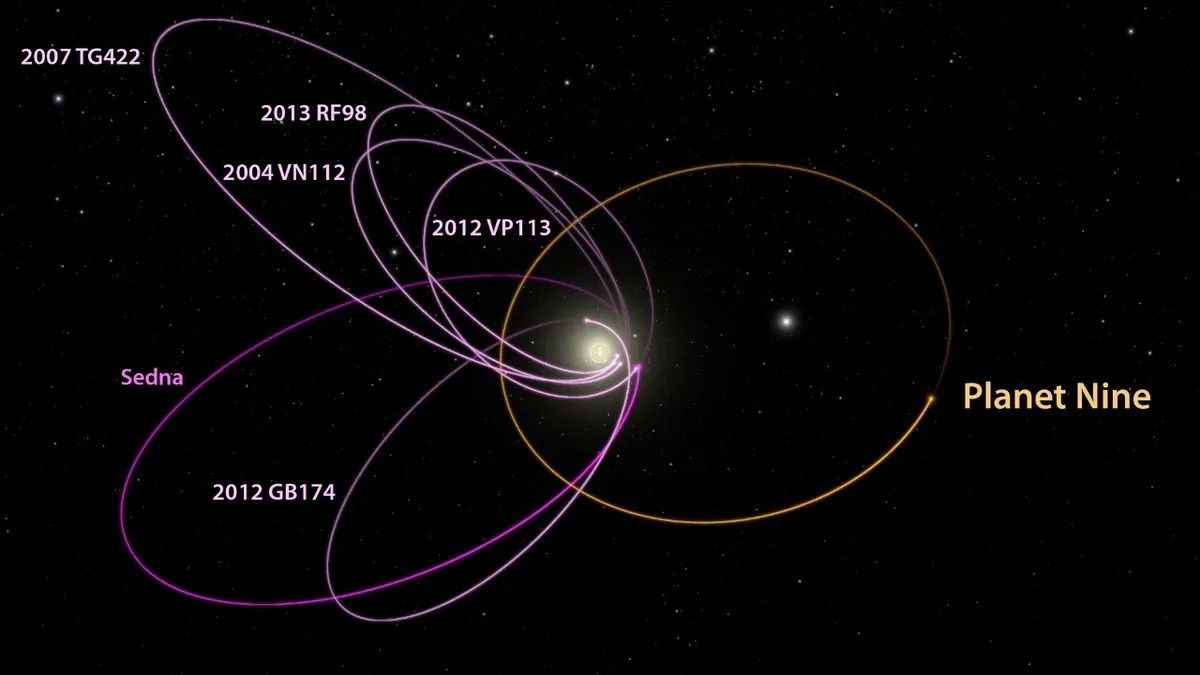
However, a pivotal turning point occurred in 2004 with the discovery of Sedna, a potential dwarf planet situated beyond the Kuiper Belt, exhibiting an unusual orbit around the sun. This peculiar trajectory hinted at the gravitational influence of another substantial mass in the outer reaches of the solar system. Yet, without additional data, confirming this hypothesis remained challenging.
Subsequently, in a 2014 study, astronomers reported detecting 2012 VP113, a smaller object within the Kuiper Belt, displaying a similarly eccentric orbit to Sedna’s. These findings suggested the presence of more eccentric trans-Neptunian objects (TNOs) awaiting discovery.
These revelations captured the attention of Mike Brown and his Caltech colleague Konstantin Batygin. They observed that both Sedna and 2012 VP113 shared a common orbital irregularity — a distinct “kink” causing them to briefly dip below the orbital plane of the known planets. This shared anomaly indicated the gravitational influence of something substantial, potentially an asteroid cluster, a dwarf planet, or even a fully-fledged world, lurking in the outer solar system’s depths.
Initially, Mike Brown, renowned for co-discovering Sedna and influencing Pluto’s reclassification, expressed skepticism about the existence of a ninth planet, considering it implausible. However, extensive attempts to explain observed phenomena yielded no viable alternatives.
Upon recognizing the potential validity of a ninth planet, Brown and his colleague refrained from immediate disclosure, preferring to explore less controversial explanations. Their perspective shifted when they identified four additional TNOs exhibiting similar unusual orbits, suggesting a missing planet as the most plausible scenario.
Their calculations indicated a mere 2% probability that these six TNOs shared their distinctive orbital characteristics by chance alone, compelling them to acknowledge the presence of a significant gravitational influencer — Planet Nine. Subsequently, in 2016, Brown and Batygin formally presented their Planet Nine hypothesis, which has since captivated public interest and scientific inquiry alike.
Completing the puzzle
Since 2016, Mike Brown, Konstantin Batygin, and their colleagues have persisted in their quest for Planet Nine. While direct discovery remains elusive, they have identified additional eccentric TNOs, now totaling 13, bolstering the case for Planet Nine. These discoveries have also refined our understanding of Planet Nine’s potential characteristics — its size, distance from the sun, and orbital path within the solar system.
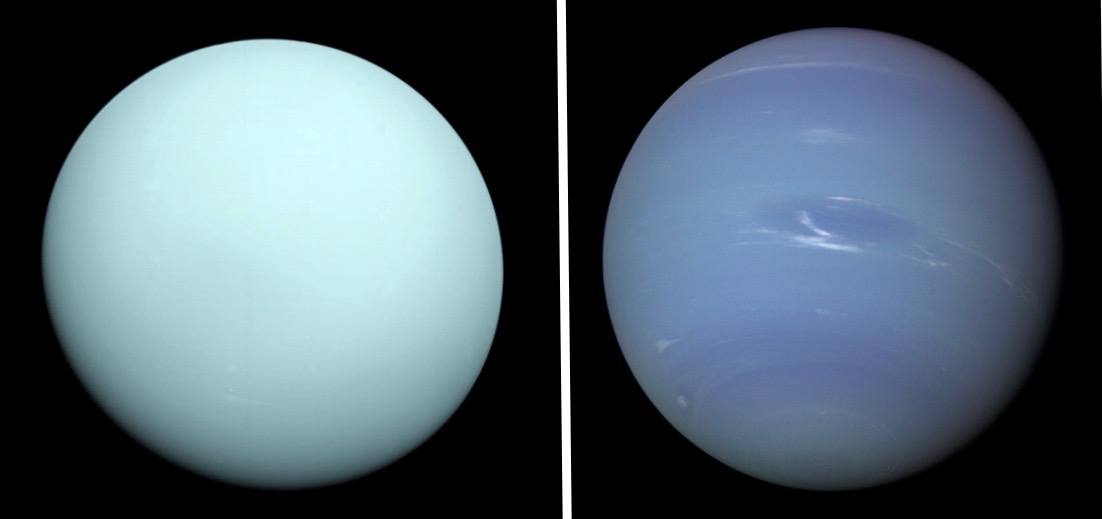
Mike Brown estimates Planet Nine to be approximately seven times more massive than Earth, placing it among the solar system’s largest planets after Jupiter, Saturn, Neptune, and Uranus. Its composition likely resembles that of Neptune, given its distance from the sun, with a diameter approximately twice that of Earth. Some scientists speculate that Planet Nine could host moons akin to the gas giants.
The hypothetical Planet Nine is projected to orbit at an average distance of around 500 astronomical units from the sun — 500 times farther than Earth. Despite its remoteness, similar-sized exoplanets have been observed orbiting distant stars, underscoring the plausibility of such vast distances.
If Planet Nine exists, its orbit is likely highly elliptical, resulting in significant variations in distance from the sun over time. Its trajectory also probably deviates from the orbital plane of the known planets, adding complexity to its detection.
The peculiar orbit and extreme distance from the sun raise intriguing possibilities, including the notion that Planet Nine could be a rogue planet, originally from another star system and captured by the sun. However, Brown and Batygin lean towards the belief that Planet Nine formed concurrently with the other planets in our solar system.
Is Planet Nine just a theory?
Many astronomers approach the existence of Planet Nine with cautious optimism. Alessandro Morbidelli from the Côte d’Azur Observatory in France expressed confidence in Planet Nine’s likelihood, citing several indirect lines of evidence that support its existence. He reviewed and endorsed the findings presented in Brown and Batygin’s 2016 paper.


David Rabinowitz of Yale University agrees that there is strong evidence pointing to something significant beyond Neptune, with Planet Nine being the most compelling explanation thus far. The ongoing discovery of additional eccentric TNOs continues to bolster this hypothesis.
However, skepticism persists among some researchers. Sean Raymond of the Bordeaux Astrophysics Laboratory remains agnostic, fluctuating in his certainty about Planet Nine’s existence despite hopeful anticipation.
Doubts about Planet Nine stem from alternative theories proposing different explanations for the peculiar behaviors observed among TNOs. These include the possibility of a baby black hole, a vast disk of undetected dust, or past gravitational perturbations from rogue planets. Some argue that the observed anomalies could be a result of biases in observational methods favoring closer TNOs over more distant ones.
Samantha Lawler from the University of Regina is skeptical of Planet Nine, attributing the observed TNO behaviors to observational biases rather than the presence of a ninth planet. In contrast, Mike Brown and Konstantin Batygin dismiss the idea of observational bias distorting the evidence for Planet Nine’s existence. Brown remains steadfast in his confidence in Planet Nine, emphasizing the need for direct observation to confirm its presence.
Why is Planet Nine still unfound?
The elusive Planet Nine remains undetected primarily due to its extreme distance from Earth, according to Mike Brown. The planet’s faint reflected light, traveling across vast distances in the solar system, renders it exceedingly difficult to observe directly.
Initially, astronomers lacked precise knowledge of Planet Nine’s exact location along its predicted orbital path. This uncertainty necessitated a broad survey of the sky, akin to searching for a solitary white whale in an ocean, as described by Brown.

To date, researchers have meticulously scrutinized thousands of images from various sky surveys, focusing on detecting objects that exhibit movement over time — a hallmark of celestial bodies like Planet Nine. However, distinguishing the planet amidst the myriad of bright, mobile objects such as comets has proven challenging, requiring them to sift through substantial amounts of data.
In their latest efforts, Mike Brown and Konstantin Batygin utilized data from the Pan-STARRS survey at Haleakala Observatory to eliminate approximately 78% of the suspected orbital pathway where P. Nine could potentially reside. This refined their search to the most distant 22% of its orbital trajectory. Despite these advancements, current telescopes like Pan-STARRS lack the necessary capability to effectively probe this distant region of space.
How soon will we locate Planet Nine?
Finding Planet Nine in its distant orbit demands the use of advanced telescopes capable of peering deep into space, as emphasized by Mike Brown and Konstantin Batygin. Currently, they are analyzing data from Japan’s Subaru Telescope, which offers improved capabilities compared to Pan-STARRS. Should this initial effort fall short, their focus will shift to the upcoming Vera C. Rubin Observatory in Chile.
The Vera C. Rubin Observatory, slated to open in late 2025, boasts the world’s largest digital camera, enhancing astronomers’ ability to survey the outer solar system. This ground-based telescope promises to extend our view farther than ever before, akin to the capabilities of the James Webb Space Telescope in probing the distant cosmos.

Mike Brown expressed optimism about this planet’s potential discovery within the next two years with the aid of the Rubin Observatory. However, he humorously acknowledged repeating similar expectations annually since 2016.
Sean Raymond and David Rabinowitz both anticipate that Planet Nine could be found within a year of the Rubin Observatory’s operation. Raymond cautioned that if the telescope fails to locate the planet within its early years, support for the hypothesis may diminish. Despite uncertainties, Alessandro Morbidelli and David Rabinowitz noted that even if P. Nine eludes immediate detection, continued surveying could reveal additional TNOs, providing valuable insights into the validity of the theory.
The significance of Planet Nine
While opinions among scientists vary regarding the existence of P. Nine, there is unanimous agreement that its discovery would constitute a monumental achievement in solar system exploration.
Sean Raymond described finding Planet Nine as a “remarkable” breakthrough, highlighting its potential to significantly advance our understanding of the solar system’s formation and evolution. Alessandro Morbidelli emphasized that studying P. Nine could offer profound insights into the processes shaping giant planets, not only within our solar system but also across the vast array of exoplanetary systems.
Mike Brown underscored the planet’s potential to unveil hidden aspects of the solar system’s history, suggesting that close-up probes from space agencies like NASA could yield valuable clues. He concluded that P. Nine holds numerous secrets that could be unlocked through detailed study, promising new revelations about our cosmic neighborhood.
- ONLINE NEWS Baker, H. (2024, June 14). Planet Nine: Is the search for this elusive world nearly over? livescience.com. [livescience.com]
- JOURNAL Batygin, K., & Brown, M. E. (2016). EVIDENCE FOR a DISTANT GIANT PLANET IN THE SOLAR SYSTEM. The Astronomical Journal, 151(2), 22. [The Astronomical Journal]
- ONLINE NEWS Lawler, S. (2020, May 25). Why astronomers now doubt there is an undiscovered 9th planet in our solar system. The Conversation. [The Conversation]
- ONLINE NEWS Lea, R. (2024, April 3). The world’s largest digital camera is ready to investigate the dark universe. Space.com. [Space.com]
APA 7: TWs Editor. (2024, July 3). Planet Nine: Myth or Reality? PerEXP Teamworks. [Online News Link]


