



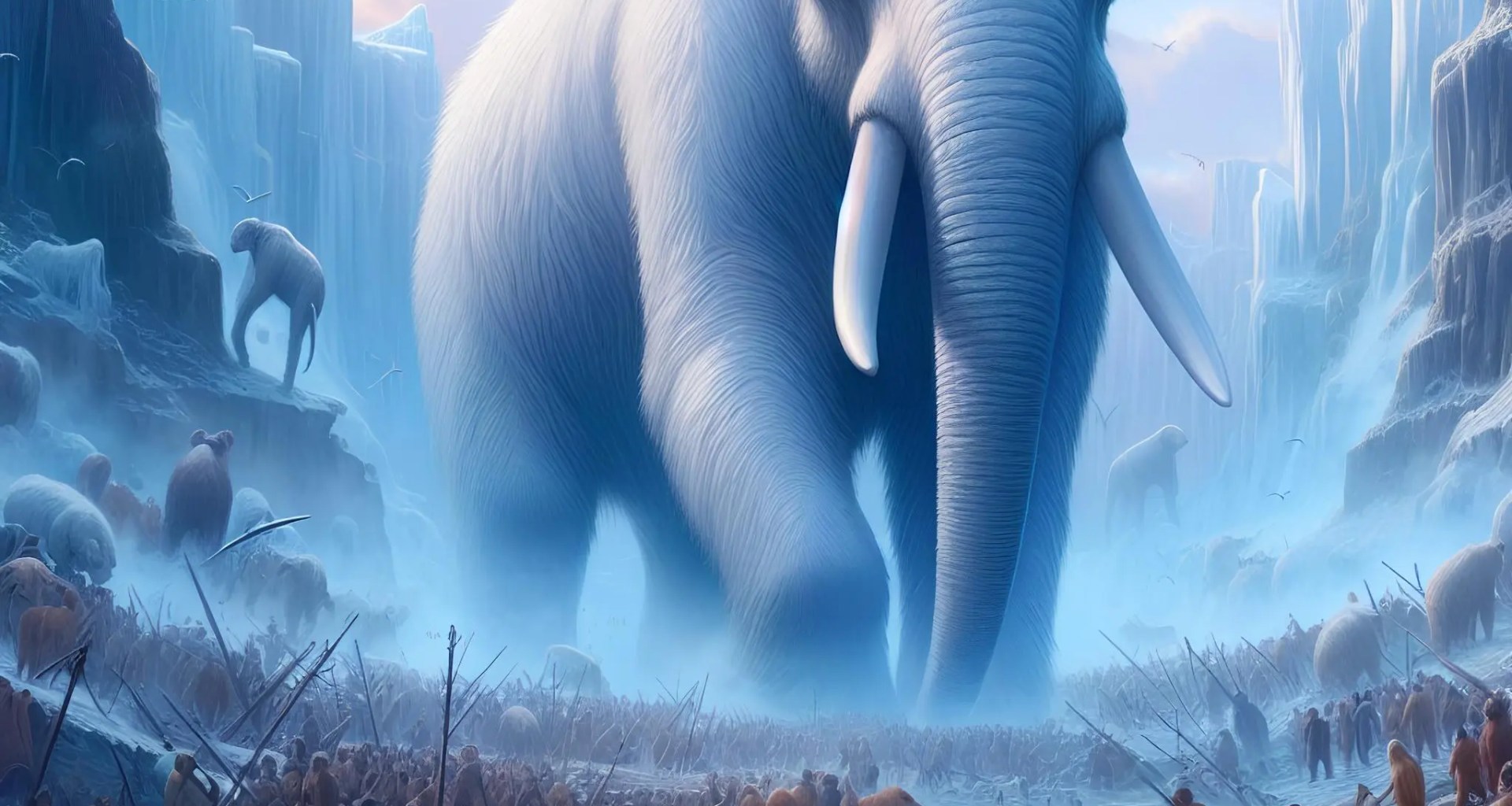
The ongoing debate among scientists regarding the decline in the population of large mammals over the past several thousand years—attributed to either human activities or climate changes—receives new insights from a study conducted by Aarhus University. Contrary to climate being the sole explanation, the research sheds light on the impact of early human migration about 100,000 years ago.
As modern humans ventured out of Africa, showcasing remarkable adaptability to diverse landscapes, they also demonstrated prowess in hunting large animals. Armed with clever hunting techniques and specialized weapons, they succeeded in colonizing various environments, leading to the decline and extinction of numerous large mammal species.
While the extinction of certain species is well-documented during the global colonization by modern humans, the recent study focuses on the survivors. By analyzing the DNA of 139 living species of large mammals, scientists discovered a significant decline in the abundances of almost all species approximately 50,000 years ago. Jens-Christian Svenning, a professor and head of the Danish National Research Foundation’s Center for Ecological Dynamics in a Novel Biosphere (ECONOVO) at Aarhus University, initiated the study, providing valuable insights into the complex interplay between early human activities and the fate of large mammals.
The research, conducted over a span of 750,000 years, focused on the evolution of large mammalian populations. During the first 700,000 years, these populations remained relatively stable. However, a significant turning point occurred approximately 50,000 years ago when the populations experienced a sharp and enduring decline, never fully recovering.
The researcher emphasizes the pattern of climate change over the past 800,000 years, characterized by cycles of ice ages and interglacial periods occurring roughly every 100,000 years. If climate were the primary cause of the population decline, one would expect more pronounced fluctuations in mammalian populations during climatic changes prior to 50,000 years ago. However, the observed stability contradicts this expectation. Therefore, the researcher concludes that humans are the most likely explanation for the drastic decline in large mammal populations, suggesting a correlation with the timing of human migration and colonization.
What caused the death of the giant mammals?
The prolonged debate among scientists about the causes behind the extinction or rapid decline of large mammals over the past 50,000 years has centered on two main theories. On one side, some argue that severe climate fluctuations played a crucial role, pointing to the disappearance of the mammoth steppe as a factor in the extinction of woolly mammoths. On the opposing side, another group attributes the decline to the prevalence of modern humans (Homo sapiens), suggesting that human hunting led to the complete extinction or severe decimation of various large mammal species.
While fossils from the past 50,000 years have provided crucial evidence supporting the link between the selective extinction of large animals and the global spread of modern humans, the debate has persisted. The recent study introduces fresh data to the discussion by examining the DNA of 139 large living mammals that have managed to survive over the past 50,000 years without facing extinction. The findings suggest a decline in the populations of these animals, a trend more closely associated with the spread of humans rather than climate change.

DNA encodes the ancient story of the species
Over the last two decades, the field of DNA sequencing has undergone a transformative revolution, making it easier and more cost-effective to map entire genomes. This advancement has led to the comprehensive mapping of DNA for numerous species globally, and the resulting data is publicly accessible on the internet. The research group from Aarhus University leveraged this wealth of genomic information in their study.
Assistant Professor Juraj Bergman, the lead researcher, explained that they gathered and analyzed data from 139 large living mammals, a process that involved dealing with an immense amount of data—approximately 3 billion data points for each species. This extensive dataset required significant time and computing power to process.
Bergman highlighted the rich information about the past contained within DNA. Much like the well-known tree of life depicting species evolution, the researchers constructed a similar framework using DNA mutations. By grouping mutations and creating a family tree, they could estimate the historical population size of specific species.
The principle behind this estimation lies in the fact that larger animal populations tend to accumulate more mutations due to simple mathematics. Using elephants as an example, every conception introduces the possibility of mutations, which are then passed down through subsequent generations. The study’s approach connects the rate of mutations to population size, offering insights into the historical dynamics of various large mammal populations.
The giants of the mammal world
The study focused on 139 existing large mammal species, encompassing a diverse range such as elephants, bears, kangaroos, and antelopes. While Earth is home to an estimated 6,399 mammal species, this research specifically selected extant megafauna—animals weighing more than 44 kg when fully grown—for analysis. It aimed to investigate how the populations of these megafauna changed over the past 40,000 to 50,000 years, a period marked by the extinction of similar large animals.
The term “megafauna” applies to large mammals, and in this study, it includes species weighing as little as 22 kg to ensure representation from all continents except Antarctica. Notably, humans are also classified as megafauna, highlighting the broad spectrum of species examined in the research.
The neutral parts of the DNA
While the size of the elephant population plays a role in the number of mutations, it’s not the sole factor influencing mutation dynamics. External factors, such as environmental changes, can exert pressure on elephants, impacting the composition of mutations. For instance, if the habitat of elephants undergoes sudden drying, or if isolated groups of elephants meet and gene mixing occurs, it can influence the genetic makeup.
Despite these complexities, the results of the study are not uncertain. Juraj Bergman explains that only 10 percent of mammalian genomes comprise active genes. Mutations in genes are primarily influenced by environmental pressures or migration. The remaining 90 percent of the genome is more neutral and less susceptible to external influences.

In the study, the researchers focused on examining mutations in the parts of the genome least influenced by the environment. These regions offer insights primarily into the historical population size over time, providing a more stable indicator of population dynamics.
The woolly mammoth: A rare and remarkable case study
The debate over the factors leading to the extinction or decline of large mammals, often centered around the woolly mammoth, faces scrutiny in this study, as it’s considered an inadequate example. According to Jens-Christian Svenning, the traditional climate-centric model focuses on the mammoth steppe’s disappearance after the ice melted, impacting species like the woolly mammoth. However, this model falls short as the majority of extinct megafauna lived in warm regions—temperate and tropical forests or savannahs.
The study challenges the climate-driven explanatory model, demonstrating a significant decline in populations of surviving megafauna species from diverse regions and habitats during the same period. While the debate remains ongoing, Svenning finds it difficult to sustain arguments favoring climate as the primary explanation.
He questions the feasibility of a climate model explaining the continuous decline and extinction of megafauna across continents over the past 50,000 years, considering the unique selective loss of megafauna over the past 66 million years amid substantial climate changes. The study’s rich data suggests that human migration from Africa and subsequent population growth are more compelling explanations for the observed patterns. The findings are published in the journal Nature Communications.
Resources
- ONLINE NEWS Aarhus University. (2023, December 14). People, not the climate, found to have caused the decline of the giant mammals. Phys.org. [Phys.org]
- JOURNAL Bergman, J., Pedersen, R. S., Lundgren, E. J., Lemoine, R. T., Monsarrat, S., Pearce, E. A., Schierup, M. H., & Svenning, J. (2023). Worldwide Late Pleistocene and Early Holocene population declines in extant megafauna are associated with Homo sapiens expansion rather than climate change. Nature Communications, 14(1). [Nature Communications]
Cite this page:
APA 7: TWs Editor. (2023, December 16). Giant Mammals Declined Due to Human Impact, Not Climate Change. PerEXP Teamworks. [News Link]


