

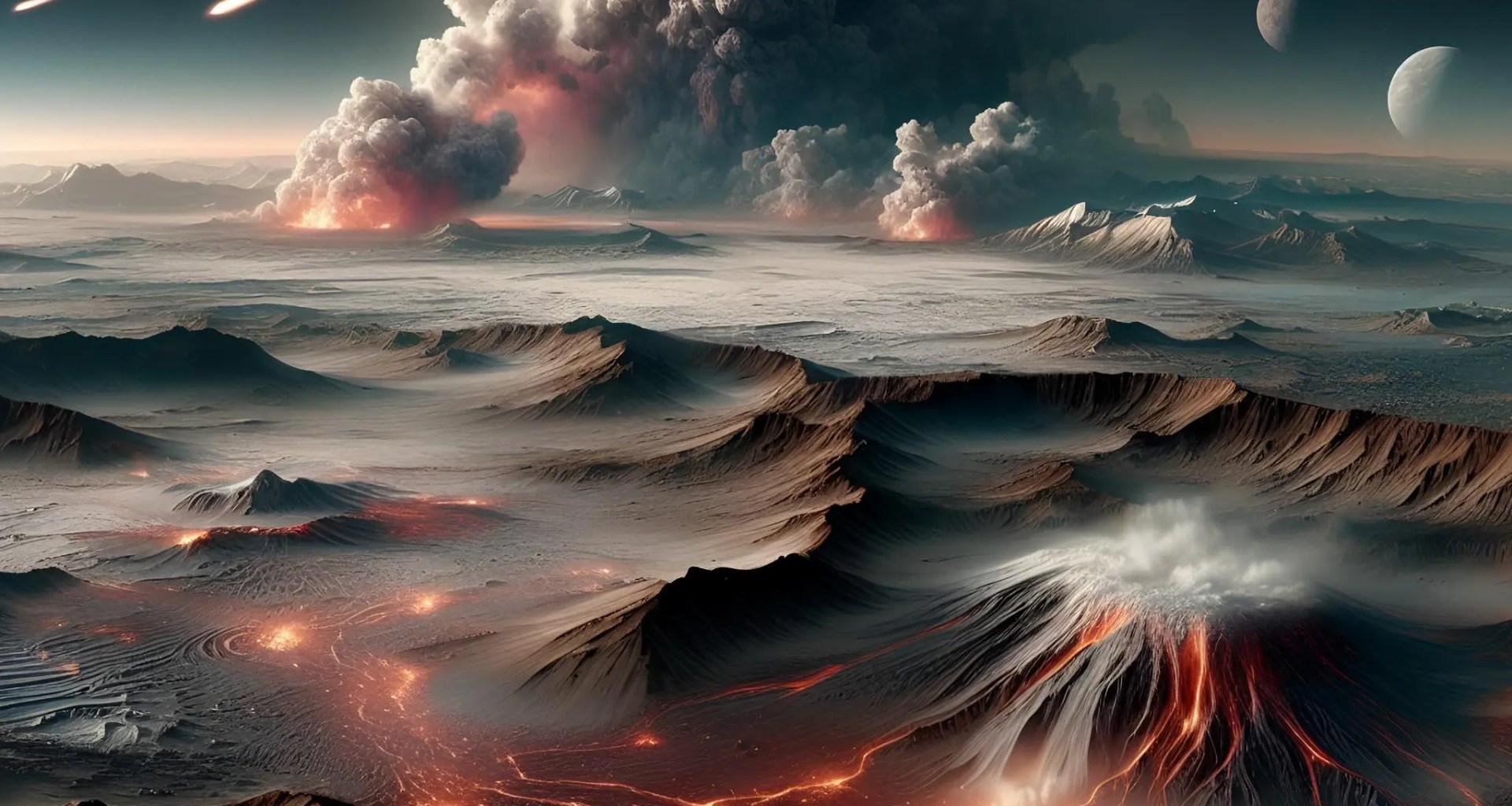
Mars, devoid of plate tectonics that continuously reshape Earth, has long been deemed a geologically inert planet with minimal activity. However, recent revelations have prompted researchers to challenge this perception. A planetary science team at the University of Arizona, led by Joana Voigt and Christopher Hamilton from the Lunar and Planetary Laboratory, utilized spacecraft images and ground-penetrating radar measurements to reconstruct three-dimensional details of every lava flow in Elysium Planitia.
Their extensive survey unveiled over 40 volcanic events, with one of the largest flows filling Athabasca Valles, a valley, with nearly 1,000 cubic miles of basalt. Elysium Planitia, recognized as Mars’ youngest volcanic terrain, offers insights into the planet’s past, recent hydrological activities, and volcanic history. The absence of observable volcanic activity on Mars does not diminish the significance of Elysium Planitia, as the study suggests it was more volcanically active than previously understood and may even exhibit ongoing volcanic activity.
Joana Voigt, the first author of the study published in the Journal of Geophysical Research: Planets, emphasized the potential for current volcanic activity in Elysium Planitia. The study builds on evidence from NASA’s InSight lander, which recorded numerous Marsquakes between 2018 and 2022, revealing the planet’s dynamic subsurface. Christopher Hamilton, an associate professor at LPL, noted that the research provides the most comprehensive account of recent volcanic activity on a planet other than Earth, spanning approximately 120 million years—a period that coincides with the peak of dinosaur existence on Earth to the present day.
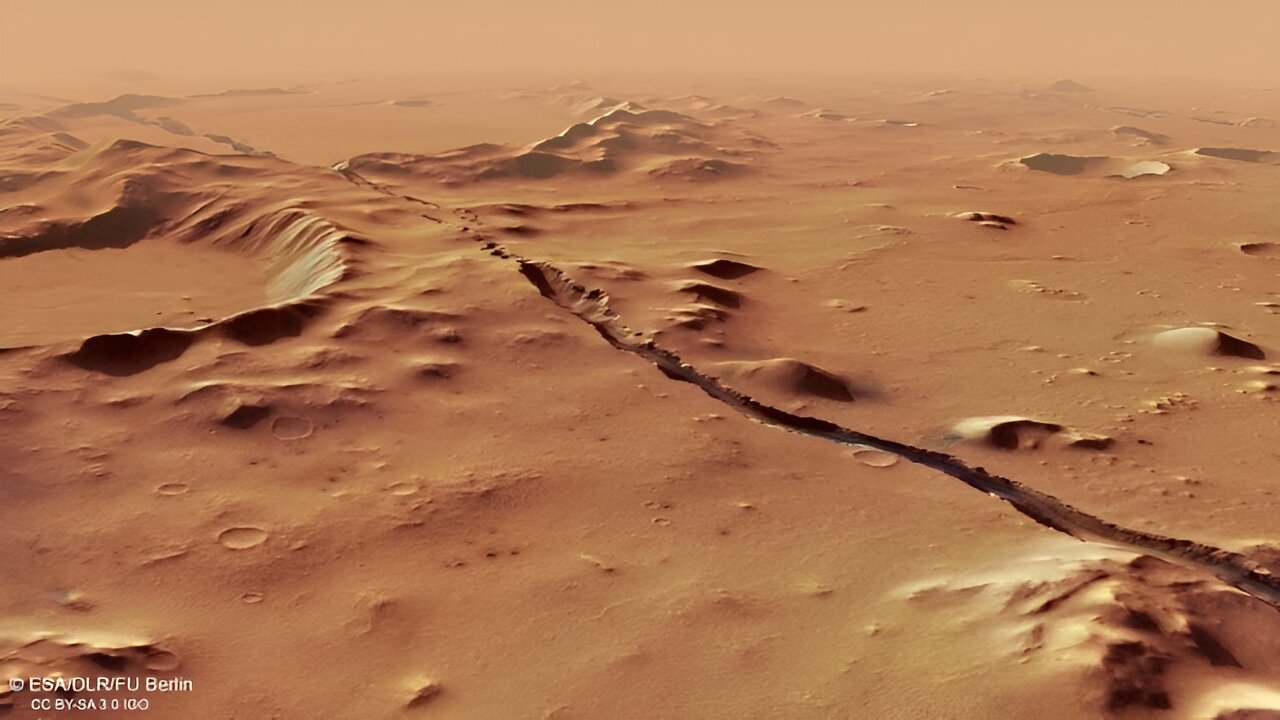
The implications of these findings extend into the realm of Martian habitability throughout its history, as suggested by the study’s authors. Elysium Planitia, having witnessed significant episodes of large water floods, reveals compelling evidence of interactions between outpouring lava and water or ice, resulting in dramatic alterations to the Martian landscape. Across this vast plain, the research team, led by Joana Voigt and her colleagues, identified abundant signs of steam explosions—a phenomenon of particular interest to astrobiologists. Such interactions could have given rise to hydrothermal environments, potentially fostering conditions conducive to microbial life.
To unravel the geological story of Elysium Planitia, the team employed images from NASA’s Reconnaissance Orbiter’s Context camera, complemented by high-resolution images from the HiRISE camera led by the University of Arizona. Topographical information was extracted using data records from the Mars Orbiter Laser Altimeter aboard NASA’s Mars Global Surveyor. Additionally, subsurface radar measurements from NASA’s Shallow Radar (SHARAD) probe contributed to the comprehensive analysis of this intriguing Martian landscape.

Dr. Joana Voigt, currently a postdoctoral researcher at Caltech’s Jet Propulsion Laboratory (JPL) in Pasadena, California, conducted a groundbreaking study during her doctoral research at the University of Arizona, employing the Shallow Radar (SHARAD) instrument to delve into Mars’ subsurface up to an impressive depth of 140 meters (460 feet). The synergy of diverse datasets, carefully integrated, provided the foundation for constructing a detailed three-dimensional representation of the study area within Elysium Planitia.
This comprehensive reconstruction extended beyond the mere depiction of the volcanic features themselves. It unveiled the topography preceding the eruption events, offering a glimpse into the Martian landscape before lava emerged from multiple fissures to fill basins and channels once carved by the flow of water. Dr. Voigt’s work, marked by this intricate mapping, contributes significantly to our understanding of Mars’ geological evolution.
Mars, with its dissimilar interior dynamics compared to Earth, serves as a captivating subject for planetary scientists. The intricate relationship between volcanoes and the structure of the Martian crust serves as a crucial key to deciphering the planet’s paleo-environmental conditions, as emphasized by Dr. Christopher Hamilton. Beyond the intriguing interplay of volcanic activity with Mars’ crust, these geological investigations shed light on broader planetary processes, including the release of water vapor into the Martian atmosphere during volcanic events. This water vapor freezing upon contact with the Martian surface, coupled with the potential for catastrophic groundwater releases onto the surface through crustal cracks, forms a mosaic of processes that have sculpted Mars over geological epochs.
In essence, this research not only provides a deeper understanding of Mars’ geological intricacies but also serves as a testament to the significance of interdisciplinary approaches in unraveling the mysteries of distant planetary landscapes. Dr. Voigt’s contributions, bridging planetary science and geological reconstruction, pave the way for continued exploration and comprehension of Mars’ dynamic past.
The quest to comprehend the historical movement of water on Mars, coupled with the current distribution of this vital resource, stands as a paramount inquiry, often dubbed a “holy grail” question by the authors of the study. Elysium Planitia, situated in the equatorial regions, assumes significance not only due to its geological characteristics but also as a more accessible landing site for future missions compared to Mars’ higher latitudes. The identification and understanding of water presence, as well as the mechanisms governing its release, play a pivotal role in shaping the trajectory of forthcoming human missions, where water availability will be a critical resource.
According to Dr. Joana Voigt, a postdoctoral researcher at Caltech’s Jet Propulsion Laboratory and a key figure in the study, Elysium Planitia provides an ideal location to unravel the intricate connections between surface features and the underlying dynamics that manifested through volcanic eruptions. Paying meticulous attention to lava surfaces, Voigt aimed to decipher distinct eruption events, piecing together a comprehensive history of these geological entities.
The team, having harnessed extensive and diverse datasets from various imaging methods, is poised to continue its exploration. Their objective is to generate highly detailed, three-dimensional insights into the Martian surface and subsurface, crafting a chronological sequence of events for other volcanically active regions on the planet.
Drawing an analogy, Dr. Voigt describes the lava flow surfaces as “open books” rich with information, waiting to be deciphered by those who understand their language. Contrary to the previous perception of areas like Elysium Planitia as featureless and uninteresting, she asserts that these seemingly plain landscapes hold numerous secrets, eager to be unveiled through careful observation and interpretation. In essence, the study unfolds not just as a geological exploration of Mars but as an intricate narrative, where each lava flow and surface feature tells a compelling story about the planet’s dynamic past.
Resources
- ONLINE NEWS Stolte, D. & University of Arizona. (2023, December 19). Recent volcanism on Mars reveals a planet more active than previously thought. Phys.org. [Phys.org]
- JOURNAL Voigt, J. R. C., Hamilton, C. W., Steinbrügge, G., Christoffersen, M. S., Nerozzi, S., Kerber, L., et al. (2023). Revealing Elysium Planitia’s young geologic history: Constraints on lava emplacement, areas, and volumes. Journal of Geophysical Research: Planets, 128, e2023JE007947. [Journal of Geophysical Research: Planets]
Cite this page:
APA 7: TWs Editor. (2023, December 20). Recent Volcanic Eruptions on Mars Show a Planet with More Activity Than Expected. PerEXP Teamworks. [News Link]