



IBM has introduced the inaugural quantum computer surpassing the milestone of 1,000 qubits, equivalent to the digital bits in a standard computer. However, the company is now redirecting its focus toward enhancing the error resistance of its machines rather than further increasing their size.
Historically, IBM has adhered to a quantum computing roadmap that consistently doubled the number of qubits each year. The recently revealed chip, named Condor and disclosed on December 4, boasts 1,121 superconducting qubits arranged in a honeycomb pattern. This follows the lineage of IBM’s previous record-setting machines, which bore bird-inspired names, such as a 127-qubit chip in 2021 and a 433-qubit variant the year before.
Quantum computers hold the promise of executing specific computations beyond the capabilities of classical computers by leveraging quantum phenomena like entanglement and superposition. These phenomena enable multiple qubits to exist in various collective states simultaneously.
However, these quantum states are inherently delicate and prone to errors. In response, physicists have sought solutions by encouraging multiple physical qubits—each encoded in a superconducting circuit or an individual ion—to collaborate in representing a single unit of information, known as a ‘logical qubit.’
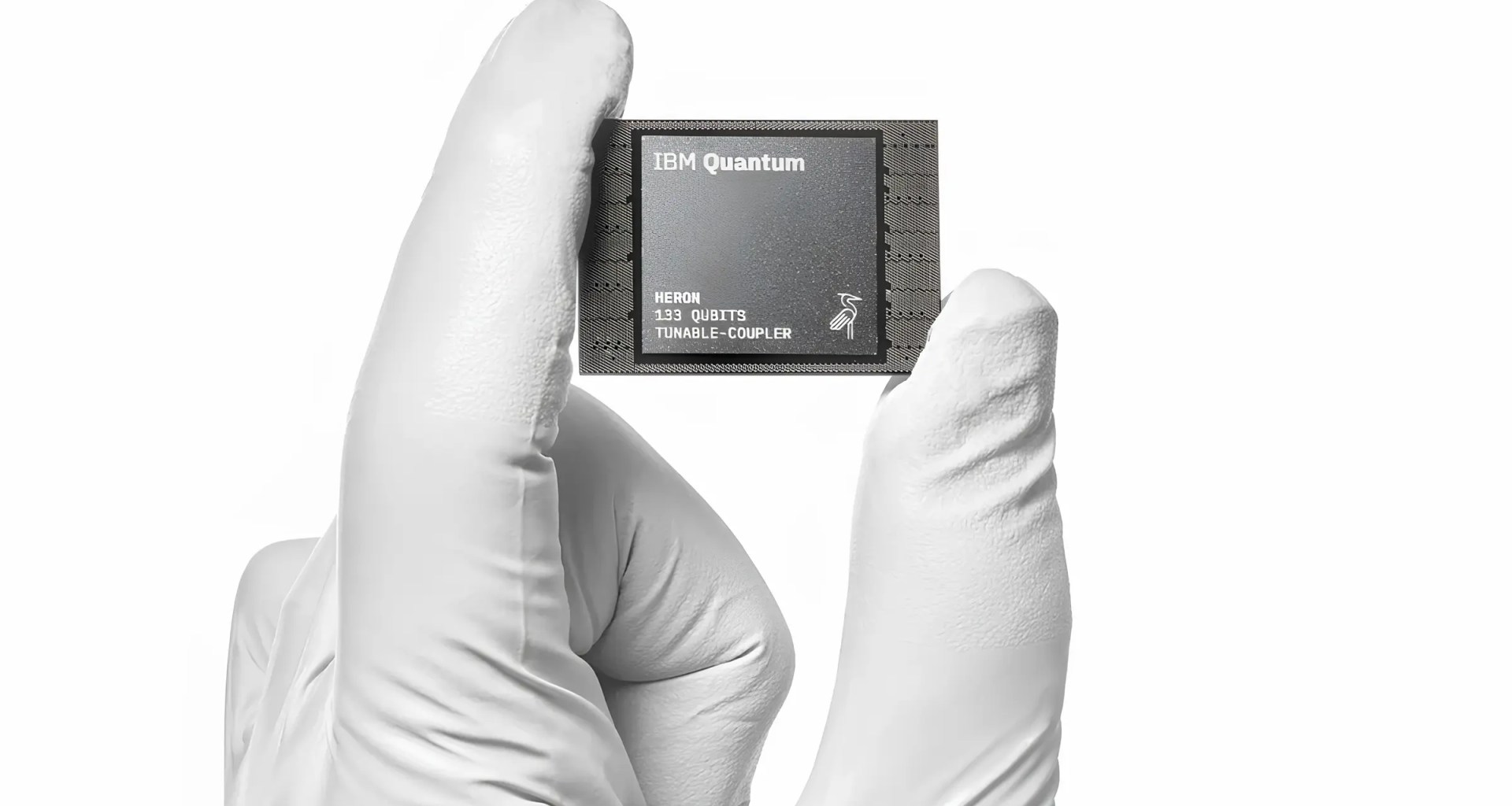
As part of its revised strategy, the company has also introduced a chip named Heron, featuring 133 qubits. Notably, this chip boasts a record-low error rate, which is three times lower than that of its preceding quantum processor.
Traditionally, researchers have asserted that advanced error-correction techniques would necessitate over 1,000 physical qubits for each logical qubit. To achieve practical computational capabilities, a machine would then need millions of physical qubits.
However, in recent months, physicists have shown enthusiasm for an alternative error-correction approach known as quantum low-density parity check (qLDPC). This method holds the promise of reducing the required number of physical qubits by a factor of 10 or more, as indicated in a preprint by IBM researchers. The company has announced its intention to concentrate on constructing chips specifically designed to accommodate a few qLDPC-corrected qubits within approximately 400 physical qubits and subsequently interconnecting these chips.
Mikhail Lukin, a physicist at Harvard University in Cambridge, Massachusetts, praises the IBM preprint as “Excellent theoretical work.” However, he notes that implementing this approach with superconducting qubits appears to be highly challenging, and it is likely to be several years before a proof-of-concept experiment can be attempted on this platform. Lukin and his collaborators have undertaken a similar study exploring the feasibility of implementing qLDPC using individual atoms instead of superconducting loops.
The challenge with the qLDPC technique lies in the necessity for each qubit to have direct connections to at least six others. In conventional superconducting chips, each qubit is typically linked to only two or three neighboring qubits. Oliver Dial, the Chief Technology Officer of IBM Quantum and a condensed-matter physicist at IBM’s Thomas J. Watson Research Center in Yorktown Heights, New York, assures that the company has a strategy to address this issue. IBM plans to enhance the design of its quantum chips by incorporating an additional layer that facilitates the extra connections essential for the qLDPC scheme.
In the latest IBM quantum research roadmap revealed today, the company envisions achieving practical computations, such as simulating the operations of catalyst molecules, by the end of the decade. Oliver Dial expresses his enthusiasm, stating, “It’s always been the dream, and it’s always been a distant dream.” He further emphasizes the significance of witnessing this dream come closer, noting, “Actually having it come close enough that we can see the path from where we are today for me is enormous.”
Resources
- JOURNAL Castelvecchi, D. (2023). IBM releases first-ever 1,000-qubit quantum chip. Nature. [Nature]
- JOURNAL Bravyi, S., Cross, A. W., Gambetta, J., Maslov, D., Rall, P., & Yoder, T. J. (2023). High-threshold and low-overhead fault-tolerant quantum memory. arXiv (Cornell University). [arXiv.org]
- JOURNAL Xu, Q., Ataides, J. P. B., Pattison, C. A., Raveendran, N., Bluvstein, D., Wurtz, J., Vasić, B., Lukin, M. D., Jiang, L., & Zhou, H. (2023). Constant-Overhead Fault-Tolerant Quantum Computation with Reconfigurable Atom Arrays. arXiv (Cornell University). [arXiv.org]
Cite this page:
APA 7: TWs Editor. (2023, December 6). A Quantum Leap: IBM Unveils the First 1,000-Qubit Chip. PerEXP Teamworks. [News Link]


