



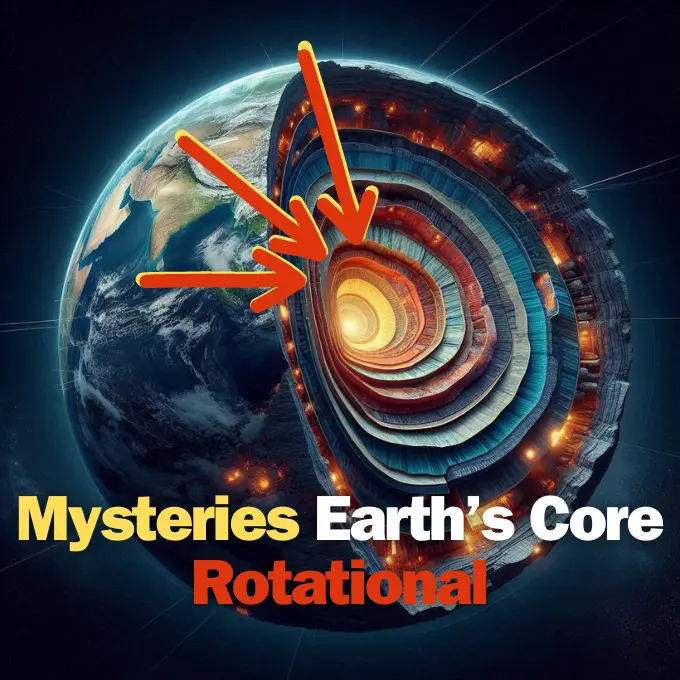
Something unusual is occurring at the center of the earth. Analysis of earthquake data over several decades reveals that since around 2010, the earth‘s inner core has been rotating more slowly than the mantle and surface. This observation was reported by researchers on June 12 in Nature. The findings seem to support a controversial claim made last year that the inner core might have reversed its rotation relative to the mantle and surface, a reversal that might happen approximately every 35 years.
The study also hints that something may be disrupting this latest shift, according to geophysicist John Vidale from the University of Southern California in Los Angeles. The inner core appears to be rotating back more slowly than it was rotating forward.
In an absolute sense, the inner core still rotates in the same direction as the mantle and surface. To illustrate, imagine a bus and a truck traveling side by side in the same direction. If the truck decelerates, the bus moves ahead. From the bus’s perspective, the truck seems to be moving backward. However, to a pedestrian, both vehicles continue to move forward.
Similarly, the new study suggests that if someone standing on the earth‘s surface could observe the inner core—like the bus driver looking at the truck—it would appear to be rotating in the opposite direction compared to a few decades ago.
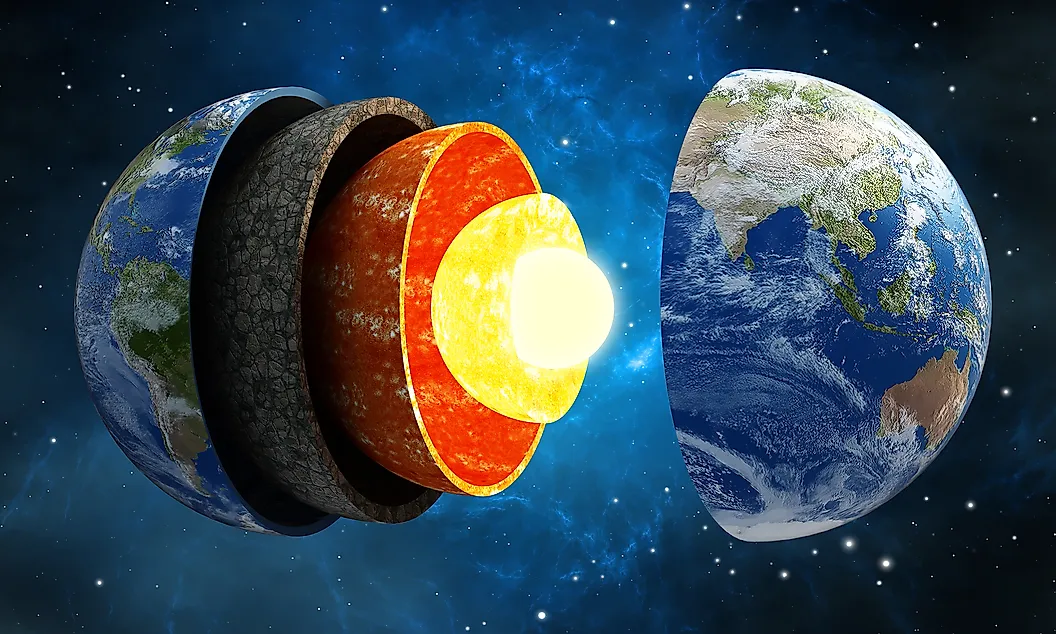
The 2023 study gained significant media attention but received mixed reactions from the scientific community. Researchers like seismologist Lianxing Wen from Stony Brook University in New York argued against the idea that the inner core rotates independently, suggesting instead that the observed data could be attributed to changes in the shape of the inner core‘s surface. Some scientists proposed that the inner core‘s rotation varies over shorter intervals. Another review of the 2023 data indicated a 20-to-30-year oscillation period, differing from a previous study coauthored by John Vidale, which suggested a 6-year oscillation period.
In the latest research, Vidale and his team examined data from repeating earthquakes that occurred in the same location but at different times, specifically from 1991 to 2023 in the South Sandwich Islands near Antarctica. The seismic waves generated by these earthquakes traveled through the earth‘s interior, with some passing through the inner core. Instruments in Alaska captured the resulting ground movements as waveforms, represented by squiggly lines on graphs.
Vidale’s team searched for matching waveforms recorded months or years apart. If the inner core rotates independently of the earth‘s other layers, then waves from these repeated quakes would pass through different regions of the inner core. Given the nonuniform structure of the inner core, these different paths should create distinct waveforms. However, if the 2023 study’s assertion that the inner core had reversed its rotation relative to the surface were accurate, identical waveforms would be observed before and after the rotational shift, indicating that the inner core had returned to a previous rotational pattern.
Out of 200 waveform comparisons, the research team identified 25 matches, suggesting that the inner core reversed its rotation relative to the mantle around 2008. Following this reversal, the inner core began rotating at less than half its previous speed in the new direction.

Vidale theorizes that the slower rotational backtracking may be due to the gravitational influence of the mantle, which comprises approximately 70 percent of the earth‘s mass. He suggests that denser regions of the mantle may be deforming the inner core, affecting its oscillation. Given that the surface of the inner core is at its melting point, it is plausible that the outermost part is relatively soft and susceptible to deformation.
After analyzing the waveform matches over time, Vidale concurs with the 2023 study’s conclusion that the inner core‘s rotation likely oscillates on a roughly 70-year cycle.
On the other hand, Wen maintains his stance that the observed data can be explained by the expansion and contraction of the inner core‘s surface. He suggests that these surface changes, which can vary by a kilometer or more over a few months, are sufficient to alter the waveforms of repeated earthquakes.


Geophysicist Hrvoje Tkalčić believes the truth may lie somewhere in between the conflicting viewpoints. He notes that while seismologists agree that the inner core‘s rotation is distinct and variable, more data is needed to reach a definitive conclusion. Tkalčić emphasizes that assumptions must be made about the earth‘s inaccessible interior, leading to differing interpretations.
Future observations may provide further insights. Vidale anticipates that if the inner core‘s rotation follows the predicted cycle, it might soon enter a more vigorous phase. He points out that around 20 years ago, the inner core experienced a brief period of rapid rotation, which could recur soon. Monitoring the inner core over the next five to ten years may offer a clearer understanding of its rotational dynamics.
- ONLINE NEWS Ogasa, N. (2024, June 25). Something weird is happening to Earth’s inner core. Science News. [Science News]
- JOURNAL Wang, W., Vidale, J. E., Pang, G., Koper, K. D., & Wang, R. (2024). Inner core backtracking by seismic waveform change reversals. Nature. [Nature]
- JOURNAL Tian, D., & Wen, L. (2023). Comment on “Inner core rotation captured by earthquake doublets and twin stations” by Yang and Song. Geophysical Research Letters, 50(15). [Geophysical Research Letters]
- JOURNAL Tkalčić, H., Young, M., Bodin, T., Ngo, S., & Sambridge, M. (2013). The shuffling rotation of the Earth’s inner core revealed by earthquake doublets. Nature Geoscience, 6(6), 497–502. [Nature Geoscience]
- JOURNAL Song, X., & Richards, P. G. (1996). Seismological evidence for differential rotation of the Earth’s inner core. Nature, 382(6588), 221–224. [Nature]
APA 7: TWs Editor. (2024, June 25). Inner Core of Earth: Host of Mysterious Rotation. PerEXP Teamworks. [Online News Link]


