




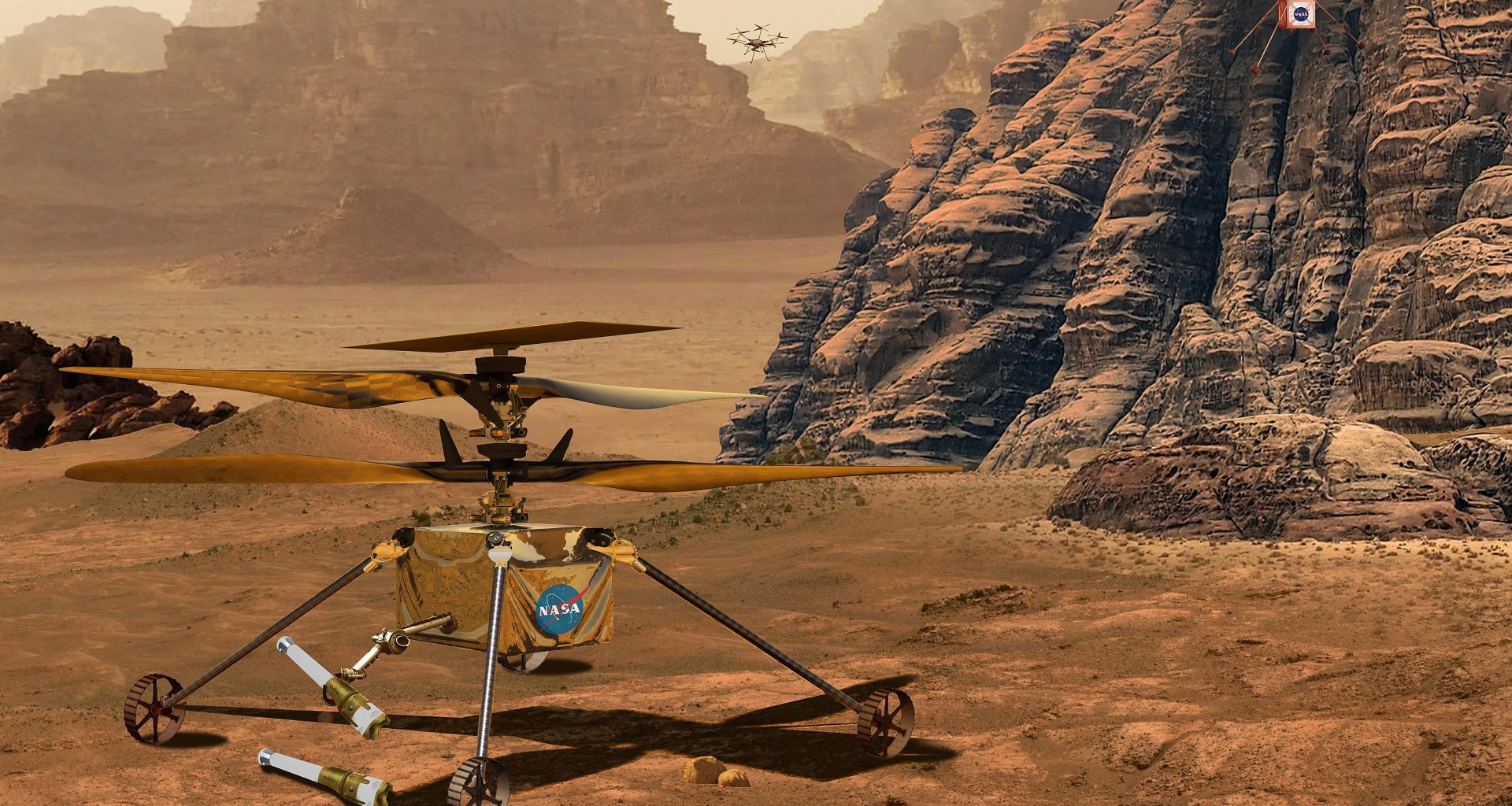
NASA’s groundbreaking Ingenuity Mars Helicopter has completed its mission on the Red Planet, surpassing all expectations by conducting numerous additional flights beyond its original plans. Despite sustaining damage to one or more rotor blades during its Jan. 18 flight, the helicopter remains upright and in contact with ground controllers, though it is no longer capable of flight.
Initially conceived as a technology demonstration for up to five experimental test flights within a 30-day period, Ingenuity defied expectations by operating on the Martian surface for nearly three years. It completed an astonishing 72 flights, covering more than 14 times the distance initially projected, and accumulating over two hours of total flight time.
NASA Administrator Bill Nelson acknowledged Ingenuity’s historic journey, recognizing its significant achievements in pushing the boundaries of exploration. Through missions like Ingenuity, NASA continues to advance the possibilities of flight within our solar system, paving the way for future exploration and enhancing our understanding of Mars and beyond.
Arriving on Mars on February 18, 2021, Ingenuity made history by hitching a ride beneath NASA’s Perseverance rover. It took its inaugural flight on April 19, showcasing the viability of powered, controlled flight in the Martian atmosphere. Following four additional flights, Ingenuity transitioned into a new role as an operational demonstration, providing invaluable aerial reconnaissance for Perseverance’s scientific team and rover operators. In 2023, Ingenuity continued to push boundaries, executing two successful flight tests that deepened our understanding of its aerodynamic capabilities. These flights not only expanded our knowledge of Martian flight but also opened doors to new possibilities for exploration and research on the Red Planet.
NASA JPL’s dedication to innovation underscores every endeavor, according to Leshin, where pushing boundaries defines their daily pursuit. Ingenuity epitomizes this ethos, symbolizing the relentless quest to redefine the realm of possibilities. The team’s triumph in this historic technological feat elicits immense pride, with anticipation brimming for their forthcoming innovations.
Scheduled for a brief vertical flight on Jan. 18, Ingenuity’s mission aimed to recalibrate its position following an emergency landing in its prior excursion. According to data analysis, the helicopter adhered to its planned trajectory, ascending to a maximum altitude of 40 feet (12 meters) and maintaining a 4.5-second hover before initiating descent at a speed of 3.3 feet per second (1 meter per second).
Regrettably, at a mere 3 feet (1 meter) from the Martian surface, Ingenuity lost communication with the rover, its pivotal link to ground control. Communication was eventually reestablished the following day, providing crucial insights into the flight’s dynamics. Subsequent imagery unveiled damage to one of the rotor blades, shedding light on the challenges encountered during the mission. Investigations persist into the cause of the communication disruption and the helicopter’s orientation at touchdown, underscoring the intricacies of operating pioneering technology in extraterrestrial terrain.
Across an extraordinary journey spanning nearly 1,000 Martian days—surpassing its original mission duration by over 33-fold—Ingenuity showcased resilience and adaptability amidst Martian challenges. Evolving capabilities enabled autonomous site selection amidst treacherous terrain, while tackling setbacks such as sensor failures and dust storm aftermaths. With operations extending across 48 different airfields, Ingenuity braved three emergency landings and endured the harsh Martian winter.
Originally designed for spring operations, Ingenuity grappled with the bitter cold of Martian nights, leading to intermittent freezes and resets of its flight computer. These power disruptions prompted a redesign of winter operations to sustain flight amidst adverse conditions.
As the curtain falls on flight operations, the Ingenuity team shifts focus to conducting final assessments of helicopter systems and extracting remaining imagery and data stored onboard. Regrettably, the Perseverance rover’s current distance precludes attempts to capture images of Ingenuity at its final airfield, marking the conclusion of a remarkable chapter in Martian exploration.
Teddy Tzanetos, the project manager for Ingenuity at NASA JPL, expressed profound humility at the helicopter’s remarkable journey. He highlighted the symbolic significance of carrying a piece of the original Wright Flyer, a testament to humanity’s enduring quest for flight. Ingenuity’s pioneering flights not only echoed the achievements of its terrestrial predecessor but also shattered barriers, affirming the possibility of flight on alien terrain.
Tzanetos emphasized that Ingenuity’s 72 successful flights, a feat unimaginable without the unwavering commitment of the dedicated teams behind Ingenuity and Perseverance. Their collective passion and perseverance propelled the Mars helicopter from a mere concept to a trailblazer in space exploration history. The legacy of the first Mars helicopter transcends its individual flights, leaving an indelible imprint on the trajectory of future space endeavors. Its triumphs will serve as a beacon, inspiring the development of fleets of aircraft destined for Mars and beyond, shaping the course of exploration for generations to come.
Unfortunately, NASA’s Ingenuity Helicopter did not successfully complete its mission to Mars. In the meantime, the helicopter carried a piece of the Wright Flyer, history’s first manned airplane, a symbol of humanity’s quest for flight. It was also the most important demonstration of the possibility of flight on untouched planets. Thanks to the unwavering commitment of the Ingenuity and Perseverance spacecraft, 72 successful flights were achieved. These accomplishments took the Mars helicopter from an idea on paper to a pioneer in the history of space exploration. The first Mars helicopter went beyond sorties and left an indelible mark on the trajectory of future space exploration. The helicopter’s accomplishments will serve as a beacon to inspire the development of aircraft fleets for Mars and beyond, shaping the course of exploration for generations to come. This may be the first flight to Mars, but it will not be the last. Ingenuity’s achievements will pave the way for future Mars missions and usher in a new era of space exploration.
Resources
- ONLINE NEWS Fisher, A., Johnson, A., & JPL/NASA. (2024, January 25). After three years on Mars, NASA’s Ingenuity helicopter mission ends. Phys.org. [Phys.org]
Cite this page:
APA 7: TWs Editor. (2024, January 26). NASA’s Ingenuity Helicopter Concludes Three-Year Mars Mission. PerEXP Teamworks. [News Link]


3 comments