



APA 7: TWs Editor & ChatGPT. (2023, November 11). Study finds that wildfire risk is 60% lower with low-intensity fires. PerEXP Teamworks. [News Link]
Published on November 10 in the journal Science Advances, the study highlights that engaging in low-intensity burning practices, such as controlled or prescribed fires, managed wildfires, and tribal cultural burning, can significantly diminish the risk of severe fires for extended periods. These insights, among the initial attempts to rigorously measure the efficacy of low-intensity fires, coincide with Congress reevaluating the wildfire strategy of the U.S. Forest Service in the context of reauthorizing the Farm Bill.
Study co-author Michael Wara, who serves as the director of the Climate and Energy Policy Program at the Stanford Woods Institute for the Environment, expressed optimism that policymakers would use the research as a foundation to advocate and support the expansion of beneficial fire as a pivotal strategy in averting wildfire catastrophes. He acknowledged that while beneficial fire carries its own set of risks, the study underscores the substantial and enduring advantages of this critical risk reduction approach.
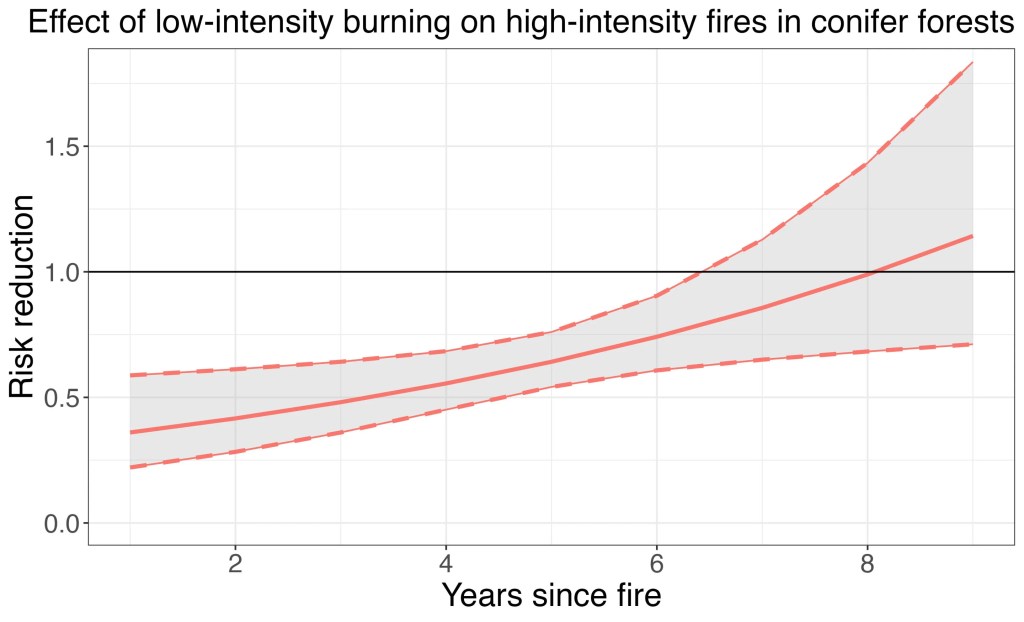
Substantial decrease in risk
Examining California specifically, the study coincides with the almost exact five-year mark since the state endured its most fatal wildfire to date, the Camp Fire. Elevated temperatures coupled with a legacy of suppressing fires have created conditions conducive to the accumulation of highly flammable, dry vegetation like trees and brush, intensifying the severity of wildfires. This current scenario contrasts with historical conditions.
Throughout millennia, Indigenous communities permitted wildfires to naturally occur while purposefully employing controlled fires on the land for various reasons, spanning from ceremonial practices to securing sustenance. Consequently, the forests in pre-colonial California held lower levels of combustible material, enhancing their ability to retain moisture—a crucial factor for resilience against both fire and drought.
The imperative shift in wildfire-prone regions is widely acknowledged—from an exclusive emphasis on suppression to a comprehensive approach encompassing controlled burning and fostering forest resilience. Stanford-led studies in the past have indicated that California, for instance, necessitates fuel treatments—comprising prescribed burns or vegetation thinning—over approximately 80,000 square kilometers, equivalent to nearly 20% of the state’s total land area.
Yet, prior to this, examinations of the advantageous impacts of prescribed and low-intensity fires were confined to relatively compact regions, like a singular wilderness area or watershed. In this paper, the researchers broadened their scope, analyzing two decades of satellite monitoring data covering over 100,000 square kilometers of California forests to provide a more comprehensive understanding.
The group, consisting of experts in fire policy, public health, and statistical and machine learning research, integrated various statewide datasets related to fuel attributes and fire dynamics. This encompassed factors like fire intensity, gauged by the energy released, and fire severity, gauged by the ecosystem impacts arising from large fires.
Earlier research has demonstrated that both planned prescribed fires and spontaneous low-intensity wildfires yield comparable risk-reduction outcomes. In both cases, there is a removal of surface fuels and smaller diameter trees, facilitating the establishment of a more fire-resistant tree composition in forests and hindering the escalation of fire intensity. Additionally, both practices maintain the integrity of tree canopies, thanks to their relatively low flame heights.
The researchers gauged the safeguarding impact of low-intensity fires by employing a technique that constructed a synthetic landscape. This synthetic landscape closely mirrored the characteristics of the burned areas, encompassing factors like weather patterns, elevation, vegetation type, and disturbance history. Through this method, they could evaluate the potential evolution of these burned landscapes if they had not experienced fires in the same year. This enabled them to compare these hypothetical scenarios (counterfactuals) with the actual development of the landscapes over time.
Employing this methodology, the researchers quantified the diminished risk of high-intensity fires following a low-intensity fire in forested areas. Subsequently, they investigated the duration of the protective effect to understand how long it persisted.
In the mixed conifer forests of California, the researchers discovered that a low-intensity fire yields an initial 60% decrease in the risk of catastrophic fires. This risk reduction persists for a minimum of six years but exhibits a gradual decline over time. Moreover, they observed a slightly smaller yet noteworthy reduction in risk in forests dominated by oak vegetation.
Perfect timing
The findings of the study offer policymakers a basis for future assessments of wildland fuel treatments. This involves a comparative analysis of the measured benefits against the potential costs and risks associated with implementing such strategies.
The timing aligns favorably as the U.S. Forest Service has put forth plans to address nearly 200,000 square kilometers (approximately 50 million acres) in the coming decade using a blend of fuel treatment approaches. Concurrently, California has outlined intentions to expand its annual wildfire treatment scope to 2,000 square kilometers (around 500,000 acres).
For wildland fuel treatments, such as prescribed burning, to achieve effectiveness, the researchers emphasize the necessity for continual, periodic maintenance rather than a singular intervention, particularly in forests adjacent to communities or critical infrastructure. The efficacy of risk mitigation through low-intensity burning hinges significantly on meticulous selection and precise targeting of interventions to ensure optimal protection for people, communities, and ecosystems.
The study lead author, Xiao Wu, an assistant professor of biostatistics at Columbia University and former Data Science Fellow at Stanford, emphasized how this research showcases the valuable contribution of data science to climate mitigation. Collaborating across multiple disciplines, the study demonstrates the intersection of scientific fields in addressing the significant challenges posed by wildfires to both ecosystems and human well-being. As scientists, the overarching objective remains to identify practical solutions to mitigate the impact of wildfires.
Resources
- NEWSPAPER Stanford University. (2023, November 10). Low-intensity fires reduce wildfire risk by 60%, according to study. Phys.org. [Phys.org]
- JOURNAL Wu, X., Sverdrup, E., Mastrandrea, M. D., Wara, M. W., & Wager, S. (2023). Low-intensity fires mitigate the risk of high-intensity wildfires in California’s forests. Science Advances, 9(45), eadi4123. [Science Advances]


