



Direct delivery of COVID vaccines to the lungs and nose could potentially halt SARS-CoV-2 infections, as suggested by recent research in monkeys. This development is particularly encouraging for the ongoing development of ‘mucosal’ COVID-19 vaccines, administered through the nose or mouth. The findings offer valuable insights into the effectiveness of mucosal vaccines in preventing infections and highlight possibilities for further improvement.
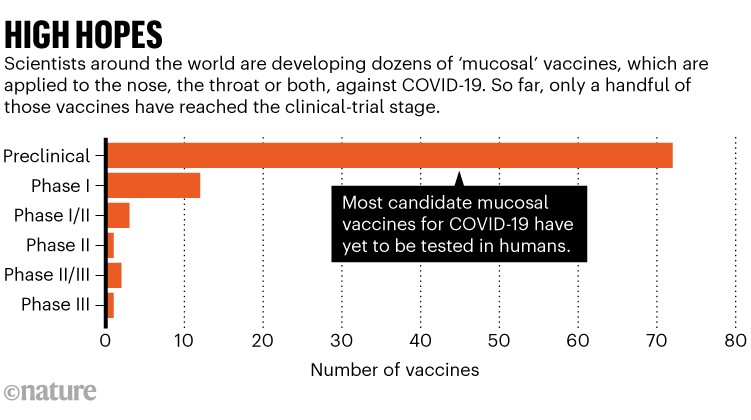
Historically, there has been limited evidence supporting the superior efficacy of mucosal vaccines compared to traditional COVID-19 shots. Nonetheless, some countries have already granted approval for such vaccines, and crucial trials are underway in the United States, with additional studies in the pipeline.
These studies emphasize the significant impact of the method and site of vaccine delivery on the generated immunity and the resulting protection. The latest findings also instill optimism regarding the potential development of mucosal vaccines capable of providing ‘sterilizing’ immunity, implying a complete prevention of infection.
Akiko Iwasaki, an immunologist at the Yale School of Medicine in New Haven, Connecticut, notes, “These studies are demonstrating the possibility of achieving near-sterilizing immunity. It is no longer purely speculative to consider the development of vaccines that could effectively halt transmission and infection.”
Vaccines fail to meet expectations
While COVID-19 vaccines administered through injections have played a crucial role in saving millions of lives and effectively preventing severe illness, there are concerns about their limited and short-lived protection against infection, according to scientists.
The current understanding is that intramuscular vaccines, despite effectively halting the spread of SARS-CoV-2 deep in the lungs, exhibit diminished efficacy in other parts of the airway where infections likely initiate. To address this limitation, mucosal COVID-19 vaccines are being developed with the goal of stimulating the production of antibodies and other immune components in the mucous membranes lining the nose and the respiratory tract. The expectation is that this approach will enhance protection in these crucial areas.
Numerous mucosal COVID-19 vaccines are in various stages of development, and some have received approval in countries such as China and India. However, a report from the London-based data and analytics firm Airfinity on December 8 suggests that the efficacy of existing mucosal COVID-19 vaccines has been underwhelming. The available data indicate that these vaccines may not provide a substantial increase in protection against infection.
Recent studies involving monkeys and other laboratory animals provide insights into potential improvements for mucosal COVID-19 vaccines. Led by Dan Barouch from Beth Israel Deaconess Medical Center in Boston, Massachusetts, researchers experimented with two methods in monkeys previously vaccinated against COVID-19: administering a liquid vaccine into the animals’ noses or directly applying it to their tracheae.
The trachea-delivered vaccine demonstrated a significant enhancement of mucosal immunity and protection against SARS-CoV-2 infection. Barouch suggests that intranasal delivery may be less effective because a substantial portion of the vaccine is either swallowed or expelled through sneezing. These findings, published in Nature on December 14, point towards the potential superiority of vaccines applied more deeply into the respiratory system compared to nasal sprays.
Meanwhile, Wei Wei, a biochemical engineer at the University of Chinese Academy of Sciences in Beijing, and his team developed a nanoparticle vaccine with a fragment of a SARS-CoV-2 protein. Administered as an aerosol into the lungs of mice, hamsters, and monkeys, this approach triggered a robust mucosal immune response. The study, published in Nature on December 13, indicated that such respiratory system delivery could effectively hinder the spread of SARS-CoV-2.
In a separate study led by Robert Seder at the National Institute of Allergy and Infectious Diseases in Bethesda, Maryland, monkeys were given a booster dose of mucosal COVID-19 vaccine through the nose or as an inhaled aerosol. When exposed to SARS-CoV-2, monkeys with either delivery method had lower virus levels in their upper airways compared to those receiving a booster jab. This enduring protection, observed even five months after the booster, is considered noteworthy. The results, posted on the preprint server bioRxiv on November 8, are awaiting peer review.
Lung targeted delivery
According to Zhou Xing, a vaccine immunologist at McMaster University in Hamilton, Canada, delivering aerosolized vaccines to the lungs appears to be the most effective strategy for mucosal COVID-19 vaccines. However, he emphasizes the necessity of developing user-friendly, hand-held delivery devices to facilitate the widespread deployment of such vaccines.
Robert Seder underscores the importance of optimizing the vaccines themselves. While many current injectable vaccines contain SARS-CoV-2 RNA, Seder’s team found that the RNA formulations in these vaccines are not effective when inhaled. Instead, the tested vaccines, including those approved in China and India, rely on bioengineered adenoviruses carrying genetic material snippets from SARS-CoV-2. In the United States, trials are underway for mucosal vaccines based on other viruses, such as Newcastle disease virus and a modified, slow-replicating strain of SARS-CoV-2.
Wei Wei’s team has developed a protein-based vaccine with the advantage of room-temperature stability in a powdered form, reducing storage and transportation costs.
Demonstrating the efficacy of mucosal vaccines, especially in comparison to existing injectable vaccines, poses a significant challenge. Human challenge trials, where participants intentionally get infected with the virus, are being considered as a possible method for testing these vaccines. According to Seder, it may take at least two or three more years to develop successful mucosal vaccines for COVID-19.
Scientists argue that the increased interest in mucosal vaccines has broader implications. If researchers can decipher how to stimulate mucosal immunity against SARS-CoV-2, the same approach could potentially be applied to combat other respiratory viruses, including influenza, respiratory syncytial virus, and emerging infections with pandemic potential. Immunologist Hyon-Xhi Tan at the University of Melbourne, Australia, considers this a worthwhile goal, particularly for addressing future respiratory viruses with pandemic threats.
Resources
- JOURNAL Callaway, E. (2023). Inhaled COVID vaccines stop infection in its tracks in monkey trials. Nature. [Nature]
- JOURNAL McMahan, K., Wegmann, F., Aïd, M., Sciacca, M., Liu, J., Hachmann, N. P., Miller, J., Jacob-Dolan, C., Powers, O., Hope, D., Wu, C., Pereira, J., Murdza, T., Mazurek, C., Hoyt, A. L., Boon, A. C. M., Davis-Gardner, M. E., Suthar, M. S., Martinot, A. J., . . . Barouch, D. H. (2023). Mucosal boosting enhances vaccine protection against SARS-CoV-2 in macaques. Nature. [Nature]
- JOURNAL Ye, T., Jiao, Z., Li, X., He, Z., Li, Y., Yang, F., Zhao, X., Wang, Y., Huang, W., Qin, M., Feng, Y., Qiu, Y., Yang, W., Hu, L., Hu, Y., Zhang, Y., Wang, E., Yu, D., Wang, S., . . . Wei, W. (2023). Inhaled SARS-CoV-2 vaccine for single-dose dry powder aerosol immunization. Nature. [Nature]
- JOURNAL Gagné, M., Flynn, B. J., Andrew, S. F., Flebbe, D. R., Mychalowych, A., Lamb, E., Davis-Gardner, M. E., Burnett, M. R., Serebryannyy, L. A., Lin, B. C., Pessaint, L., Todd, J. M., Ziff, Z. E., Maule, E., Carroll, R. N. P., Naisan, M., Jethmalani, Y., Case, J. B., Dmitriev, I. P., . . . Seder, R. A. (2023). Mucosal adenoviral-vectored vaccine boosting durably prevents XBB.1.16 infection in nonhuman primates. bioRxiv (Cold Spring Harbor Laboratory). [bioRxiv]
Cite this page:
APA 7: TWs Editor. (2023, December 20). Monkeys Protected from COVID by Vaccines Delivered Through Inhalation. PerEXP Teamworks. [News Link]


