



APA 7: TWs Editor & ChatGPT. (2023, November 11). Diverse Microbial Communities Thrive in the Subaqueous Caverns of Yucatán. PerEXP Teamworks. [News Link]
While earlier investigations focused on collecting water and microbial samples from cave entrances and readily accessible sinkholes, the team led by Northwestern University ventured into the profound, light-deprived passageways of the underground realm. Their aim was to gain a deeper understanding of the survival mechanisms within this distinctive subterranean environment.
Following the analysis of the samples, the researchers identified a highly diverse system characterized by distinct organizational patterns. Analogous to a typical high school lunchroom, microbial communities in the cave system tended to form well-defined cliques. Interestingly, one bacterial family, Comamonadaceae, played the role of a social butterfly, appearing at nearly two-thirds of the “cafeteria tables.” These findings suggest that Comamonadaceae functions as a crucial ecological linchpin within the broader microbial community.

The findings of the study, published in the journal Applied and Environmental Microbiology, were emphasized by Magdalena R. Osburn from Northwestern University, who led the research. She highlighted the unique nature of the microbial survey, characterizing it as the most extensive examination in this geographical region. The team obtained samples from challenging locations, specifically underground rivers, and sequenced the genes from the microbial populations residing in these environments. Osburn underscored the significance of these underground rivers, which serve as a crucial source of drinking water for millions of people. As microbial communities play a vital role in such ecosystems, any changes in these communities could potentially impact humans who depend on the water from these underground rivers. Specializing in geobiology, Magdalena R. Osburn holds the position of associate professor within the Department of Earth and Planetary Sciences at Northwestern University’s Weinberg College of Arts and Sciences.
This project, spearheaded by Northwestern alumnus Matthew Selensky, was a significant component of his dissertation during his tenure as a graduate student in Magdalena R. Osburn’s laboratory. Patricia Beddows, a professor of Earth and Planetary Sciences at Weinberg, served as a study co-author, leading the cave-diving expedition. With decades of experience in cave research, Beddows played a pivotal role. Additional co-authors from Northwestern include Andrew Jacobson, a professor of Earth and Planetary Sciences, and former graduate student Karyn DeFranco, who focused on the geochemistry aspects of the study.
Situated predominantly in southeastern Mexico, the expansive Yucatán carbonate aquifer features a multitude of sinkholes that create a intricate network of underwater caves. Within this labyrinth, an often-overlooked microbiome thrives, characterized by its diversity. The submerged network encompasses zones of freshwater, seawater, and blends of both. Ranging from lightless, deep pits devoid of direct openings to the surface to shallower sinkholes illuminated by sunlight, the system exhibits a diverse array of environments.
Osburn described the Yucatan platform as akin to Swiss cheese due to its intricate network of cave conduits. The team’s curiosity was centered on understanding the microbial compositions that coexist across the entire system in contrast to those found within specific localized areas or “Neighborhoods” within the cave structure.
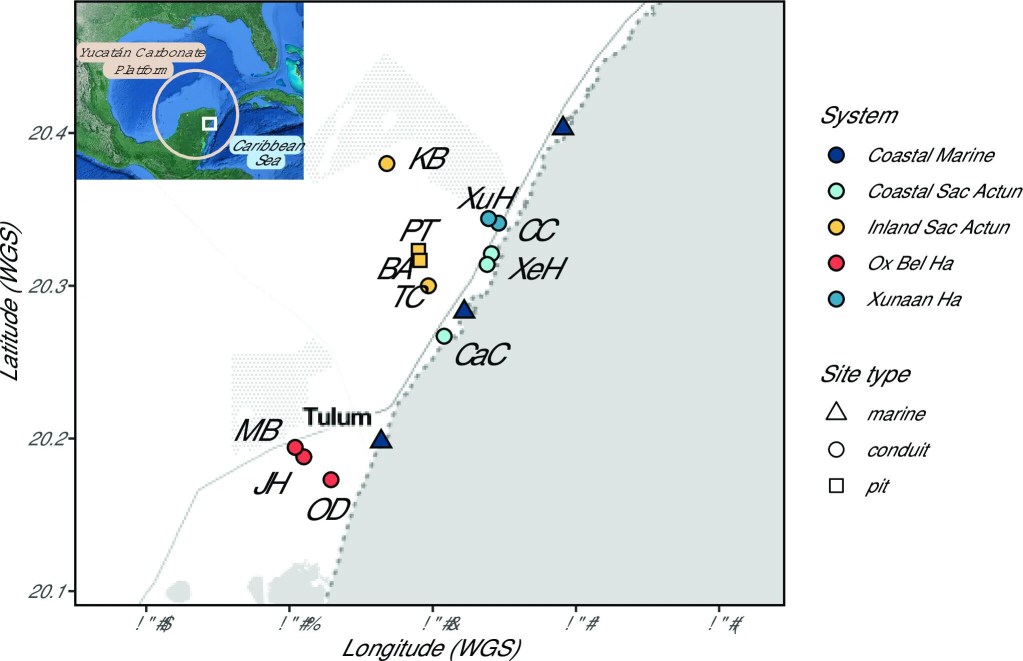
In pursuit of answers to this inquiry, a group of cave divers undertook the collection of 78 water samples from 12 distinct sites within the cave system adjacent to the Caribbean coast in Quintana Roo, Mexico. The sampling initiative extended from the Xunaan Ha system in the north to encompass both inland and coastal sections of the Sac Actun system. This comprehensive effort also included a distinctive 60-meter-deep pit within the Sac Actun system and covered the Ox Bel Ha system to the south.
Returning to a dive-shop repurposed as a scientific laboratory, the researchers meticulously filtered cells from each water sample, subjecting them to thorough chemical analysis. Upon their return to Northwestern University, the team utilized DNA sequencing techniques to identify the microbial communities present. Subsequently, Matthew Selensky pioneered the development of a novel computational program designed specifically for network analysis on the extensive dataset.
The networks derived from the analysis unveiled the species that exhibited a propensity to coexist. For every site, the researchers took into account the environmental factors influencing each microbial community. This encompassed cave type (pit or conduit), the specific cave system, distance from the Caribbean coast, geochemistry, and the position within the water column.
Despite the inflow of water from the Gulf of Mexico into the Yucatán aquifer, the researchers observed significant variations in the microbiome compared to the nearby sea. Moreover, the microbiomes exhibited notable disparities within the cave system, displaying distinctions both from cave to cave and between shallow and deep water environments.
Osburn highlighted that the microbial communities establish distinct niches within the Yucatán aquifer. These niches feature a diverse array of microorganisms that exhibit mobility depending on the specific location. However, when examining the comprehensive dataset, a consistent core set of organisms emerges, indicating their pivotal roles in each ecosystem.
The research team led by Osburn identified the presence of Comamonadaceae, a bacterial family commonly associated with groundwater systems, occupying various niches within the Yucatán aquifer. Additionally, their findings revealed that a deep, pit-like sinkhole with a surface opening, enabling sunlight penetration, hosted the highest concentration of microbial communities. These communities were stratified into layers, each representing distinct niches within the water column.
According to Osburn, the observations indicate that Comamonadaceae plays slightly varied roles in different sections of the aquifer, consistently fulfilling a significant function. Depending on the specific region, Comamonadaceae engages with different microbial partners, suggesting a potential mutualistic metabolism where they might share resources, possibly involving food exchange.
Resources
- NEWSPAPER Morris, A. & Northwestern University. (2023, November 10). Yucatán’s underwater caves host diverse microbial communities. Phys.org. [Phys.org]
- JOURNAL Osburn, M. R., Selensky, M. J., Beddows, P. A., Jacobson, A. D., DeFranco, K., & Merediz-Alonso, G. (2023). Microbial biogeography of the eastern Yucatán carbonate aquifer. Applied and Environmental Microbiology. [Applied and Environmental Microbiology]


