




In a collaborative effort, astronomers from Western Sydney University in Australia, in conjunction with their counterparts, have announced a groundbreaking discovery—the detection of a previously unknown pulsar wind nebula (PWN) and the pulsar energizing it. The findings, unveiled in a research paper published on December 12 and available on the pre-print server arXiv, were facilitated through the utilization of cutting-edge radio telescopes, namely the Australian Square Kilometer Array Pathfinder (ASKAP), MeerKAT, and Parkes.
Pulsar wind nebulae are fascinating cosmic phenomena driven by the energetic winds emanating from pulsars. These winds, comprised of charged particles, collide with the pulsar’s surroundings, particularly interacting with the gradually expanding debris from a supernova. This collision gives rise to the formation of a pulsar wind nebula.
Within pulsar wind nebulae, charged particles undergo a process where they lose energy and emit radiation, resulting in a diminishing energy level as they move away from the central pulsar. Comprehensive studies of these objects, encompassing observations across multiple wavelengths, including crucial X-ray observations, can offer profound insights into the intricate dynamics of particle flow within these nebulae. Analyzing spatially-integrated spectra in the X-ray band holds particular promise for unraveling key information about the nature of pulsar wind nebulae in general.
The recent discovery, led by an astronomer team spearheaded by Sanja Lazarević from Western Sydney University, has identified a new pulsar wind nebula named “Potoroo.” This appellation pays homage to a diminutive marsupial indigenous to Australia.
By leveraging radio-continuum surveys obtained from ASKAP and MeerKAT, the astronomers not only added a new entry to the catalog of pulsar wind nebulae but also set the stage for more in-depth investigations into the behavior and characteristics of these enigmatic cosmic structures. The implications of this discovery extend beyond the confines of our own galaxy, offering a window into the dynamic and captivating realm of pulsar-driven nebulae across the cosmos.
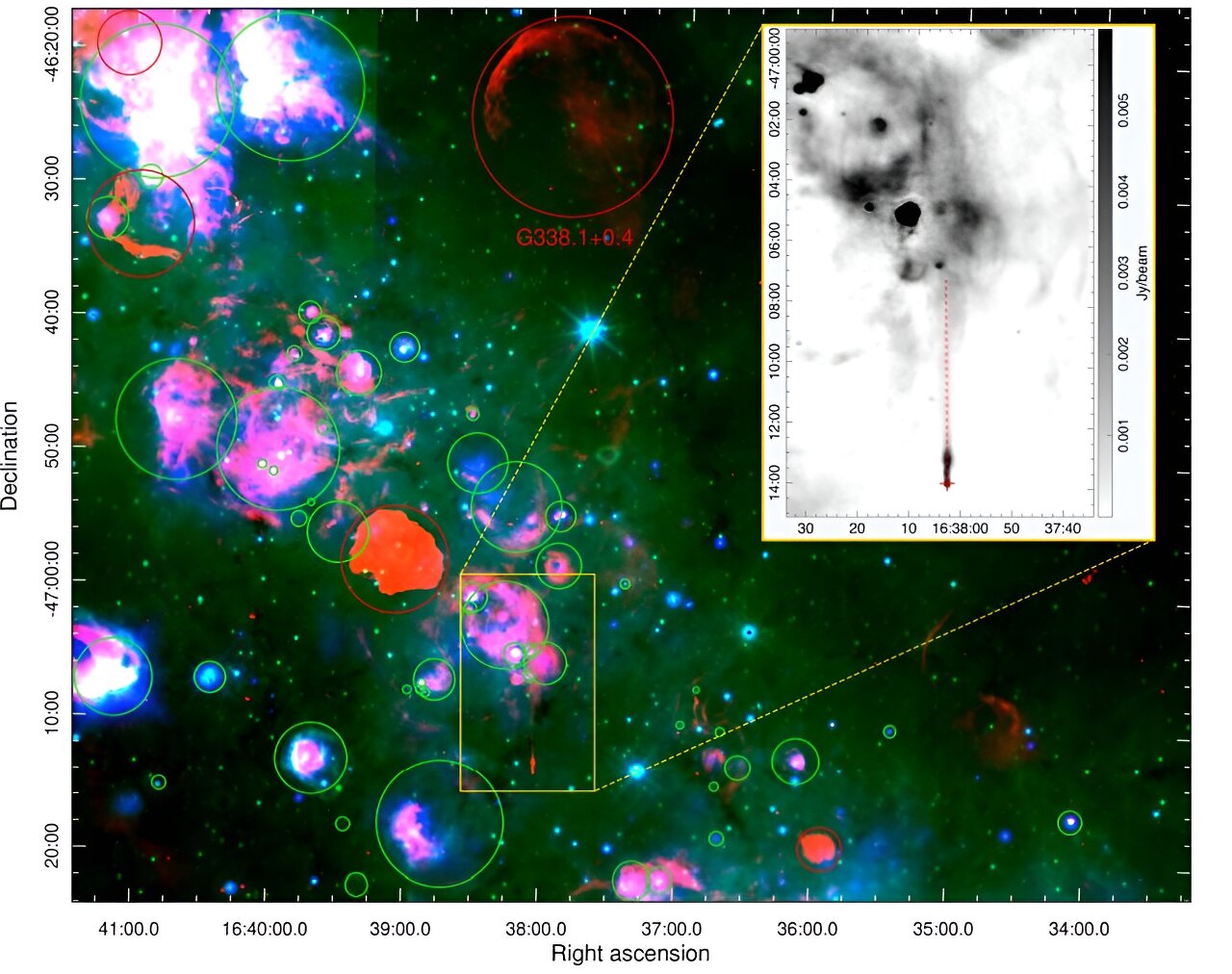
Highlighting areas of scientific interest, red circles denote known Galactic Supernova Remnants (SNRs) based on Green’s research in 2019 and 2022, while green circles pinpoint Galactic HII regions identified by Anderson et al. in 2014. A specific region of deep interest is outlined by a box, inviting further exploration.
A closer look at Potoroo is provided in the inset, utilizing an ASKAP zoomed-in image. The red cross signifies the precise position of the X-ray source associated with Potoroo, while a red dashed line delineates Potoroo’s axis of symmetry. This axis corresponds to the length of the tail under investigation in this research paper, adding a layer of depth to our understanding of this celestial entity.
(arXiv.org)
Utilizing the advanced Parkes Ultra-Wideband Low (UWL) frequency receiver system, researchers have successfully identified a pulsar candidate, now designated as PSR J1638–4713, which plays a pivotal role in powering the enigmatic cosmic entity known as Potoroo. Subsequent in-depth observations of PSR J1638–4713 have substantiated its association with the intricate structures observed in Potoroo.
The comprehensive study reveals that Potoroo exhibits distinctive cometary morphology in both radio and X-ray bands, indicating the dynamic interplay between the pulsar and its surrounding environment. As pulsars propel through the ambient medium at supersonic velocities, the resulting ram pressure transforms the pulsar wind into a bow-shock configuration. This process confines the pulsar wind in the opposite direction to its motion, giving rise to a cometary-like shaped tail—a phenomenon prominently observed in Potoroo.
Positioned at a minimum distance of 32,500 light years from Earth, Potoroo boasts a radio size spanning approximately 68.5 light years, while its X-ray size appears to be remarkably smaller, measuring only one-tenth of the radio dimension. Consequently, Potoroo boasts the longest known Pulsar Wind Nebula (PWN) radio trails, adding a unique dimension to our understanding of celestial phenomena.
The study further highlights an unusually steep overall radio spectrum for Potoroo, recorded at a level of -1.27—below the typical values observed in known Pulsar Wind Nebulae (PWNe). Astronomers posit that this steep spectral index may be attributed to the intricate interaction between the parent supernova’s reverse shock and the PWN.
In focusing on PSR J1638–4713, the pulsar exhibits a spin period of 65.74 milliseconds and a dispersion measure of 1,553 pc/cm3—ranking as the second-highest among all known radio pulsars. The observations unveil PSR J1638–4713 as a young pulsar, with a characteristic age of 24,000 years, displaying a high spin-down luminosity and a substantial projected velocity exceeding 1,000 km/s. These findings contribute significantly to our understanding of the complex dynamics governing pulsar-driven systems in the cosmos.
Resources
- ONLINE NEWS Nowakowski, T. & Phys.org. (2023, December 26). Astronomers detect new pulsar wind nebula and its associated pulsar. Phys.org. [Phys.org]
- JOURNAL Lazarević, S., Filipović, M., Dai, S., Kothes, R., Ahmad, A., Alsaberi, R. Z. E., Balzan, J. C. F., Barnes, L. A., Cotton, W. D., Edwards, P., Gordon, Y. A., Haberl, F., Hopkins, A. M., Koribalski, B. S., Leahy, D. A., Maitra, C., Mićić, M., Rowell, G., Sasaki, M., . . . Velović, V. (2023). Fast as Potoroo: Radio continuum detection of a Bow-Shock pulsar Wind Nebula powered by Pulsar J1638-4713. arXiv (Cornell University). [arXiv.org]
Cite this page:
APA 7: TWs Editor. (2023, December 26). New Discovery: A Pulsar and Its Nebula in the Sky. PerEXP Teamworks. [News Link]