



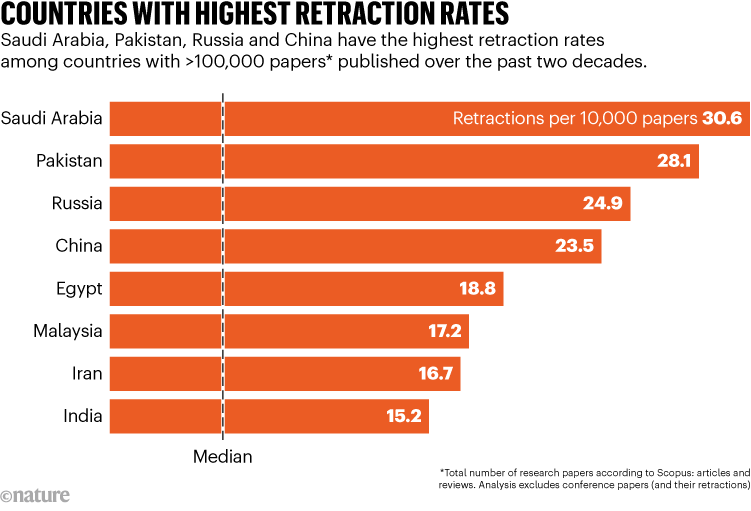
In 2023, the number of retractions for research articles has surpassed 10,000, breaking annual records. This surge is attributed to efforts by publishers to address a plethora of fraudulent papers and peer-review misconduct. Notably, Saudi Arabia, Pakistan, Russia, and China, among major research-producing nations, exhibit the highest retraction rates over the past two decades, according to an analysis by Nature.
The majority of retractions in 2023 are associated with journals owned by Hindawi, a London-based subsidiary of publisher Wiley. Hindawi journals have retracted over 8,000 articles this year, citing concerns about compromised peer-review processes and systematic manipulation of publication and peer-review procedures. Investigations initiated by internal editors and research integrity investigators, who flagged issues such as incoherent text and irrelevant references in numerous papers, prompted these retractions.
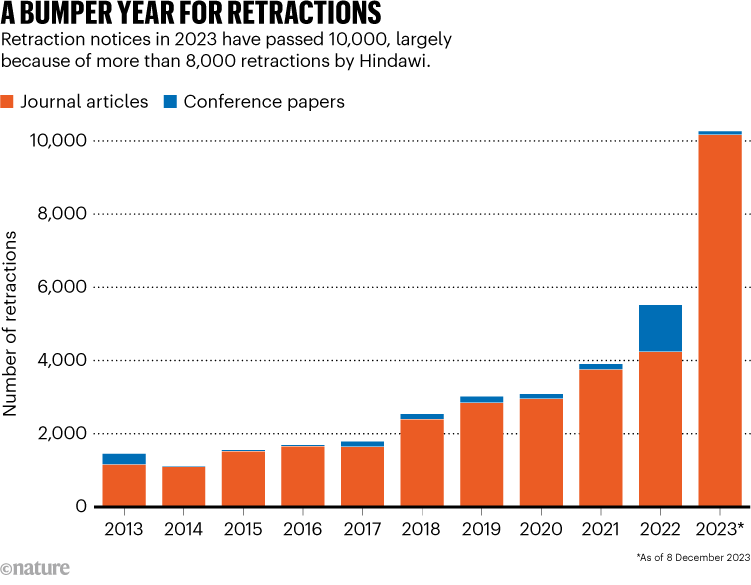
The majority of retractions from Hindawi are linked to special issues, which are collections of articles often overseen by guest editors and have gained notoriety for being exploited by scammers for publishing low-quality or fraudulent papers. In response to these challenges, Wiley announced the cessation of the Hindawi brand name and the integration of existing titles into its own brand. This decision comes after Wiley closed four Hindawi titles and temporarily halted special-issue publications in late 2022.
Wiley anticipates additional retractions, without specifying the number, but emphasizes the continued value of special issues in serving the research community. In response to the issues, Wiley has implemented more rigorous processes to verify the identity of guest editors and oversee manuscripts. The publisher has removed ‘hundreds’ of bad actors, including some holding guest editor roles, from its systems. Wiley has also expanded its research-integrity team and is pursuing legal avenues to share data about these bad actors with other publishers and relevant entities in the research community. The challenges have led to an anticipated revenue loss of $35–40 million for Wiley in the current fiscal year.
Despite the retracted status of many of Hindawi’s papers, they collectively garnered over 35,000 citations, according to Guillaume Cabanac, a computer scientist at the University of Toulouse. Cabanac, who monitors issues in papers, including the use of ‘tortured phrases’ to evade plagiarism detection and indications of undisclosed artificial intelligence usage, highlights that these problematic papers continue to receive citations. This underscores a persistent challenge in the scholarly community where retracted or questionable articles can still influence research and knowledge dissemination.
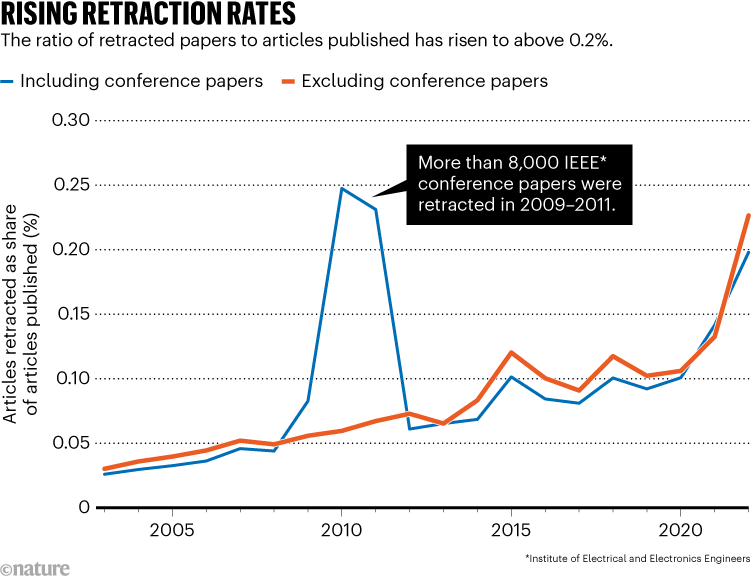
The rate of retractions is increasing at a pace surpassing the growth of scientific papers, leading to a total of over 50,000 retractions issued so far. The analysis, combining data from Retraction Watch and other sources, reveals that retractions are not solely driven by misconduct; some are prompted by authors who identify genuine errors in their work. While the Retraction Watch database, now publicly distributed by Crossref, is extensive, it does not yet include all retractions from 2023. This analysis incorporated approximately 45,000 retractions from the Retraction Watch dataset and an additional 5,000 retractions from various publishers, including Hindawi, using the Dimensions database.
The increase of rates
Nature‘s analysis indicates that the retraction rate, representing the proportion of papers published in a given year that are later retracted, has more than tripled in the past decade, surpassing 0.2% in 2022. Among countries with over 100,000 published articles in the last two decades, Saudi Arabia exhibits the highest retraction rate, reaching 30 per 10,000 articles, excluding retractions based on conference papers. If conference papers are included, China leads when considering withdrawals from the Institute of Electrical and Electronics Engineers (IEEE) in New York City, with a retraction rate exceeding 30 per 10,000 articles.
The analysis reveals that approximately one-quarter of the total retractions are conference papers, with the majority of these withdrawals attributed to the Institute of Electrical and Electronics Engineers (IEEE), which has retracted over 10,000 conference papers in the last two decades. The IEEE holds the record for the highest number of retractions among publishers. While the IEEE does not document when papers are retracted, the majority of the retractions occurred for papers published between 2010 and 2011.
The measures
Monika Stickel, the director of corporate communications at the Institute of Electrical and Electronics Engineers (IEEE), asserts that the institute’s preventive measures and initiatives effectively identify almost all submitted papers that fail to meet their standards. However, concerns have been raised by Monika Cabanac and Kendra Albert, a technology lawyer at Harvard Law School, who identified issues such as ‘tortured phrases,’ citation fraud, and plagiarism in hundreds of IEEE papers published in recent years, as reported by Retraction Watch. Stickel acknowledges the evaluation of these papers by the IEEE, revealing that fewer than 60 did not conform to their publication standards, leading to the retraction of 39 papers.
Integrity sleuths emphasize that the approximately 50,000 retractions recorded worldwide represent only the visible portion of a larger issue. The proliferation of articles from ‘paper mills’—businesses selling fake work and authorships to scientists—is estimated to reach hundreds of thousands. This figure doesn’t account for genuine papers that might be scientifically flawed. David Bimler, a New Zealand-based research-integrity sleuth known by the pseudonym Smut Clyde, emphasizes the broader impact of paper-mill products, noting that even if unread, they contribute to review articles and become part of mainstream literature.
Resources
- JOURNAL Van Noorden, R. (2023). More than 10,000 research papers were retracted in 2023 — a new record. Nature. [Nature]
Cite this page:
APA 7: TWs Editor. (2023, December 13). A New Record of Research Paper Retractions: Over 10,000 in 2023. PerEXP Teamworks. [News Link]


