




A potential substitute reservoir for carbon exists within marine sediments, particularly those situated on marginal continental shelves. Despite constituting merely 8% of the global ocean area, these shelves possess the remarkable ability to sequester 80% of the Earth’s organic carbon, amounting to 126.2 teragrams annually. Organic carbon in marine environments originates from phytoplankton and microbial metabolic processes within sediments. Additionally, inputs from terrestrial sources, facilitated by riverine transport and coastal erosion, contribute carbon-rich materials to the ocean floor.
Recent findings, disclosed in the journal Frontiers in Marine Science, have conducted a comprehensive analysis of carbon storage in the western Pacific Ocean dating back to 1855. The study specifically highlights the adverse effects of reservoir construction on carbon stocks in the region.
Dr. Haili Ma, from the Ocean University of China, along with fellow researchers, gathered 17 sediment cores extracted from the South Yellow Sea and East China Sea. These cores were analyzed for total organic carbon, representing the concentration of organic carbon in samples, originating from natural sources such as plants.

The data reveals several significant patterns: 1) a decrease in carbon stocks from 1855 to 1950, linked to severe flooding during 1851-1855 that altered the course of the Yellow River, relocating its terminating estuary; 2) a subsequent rise in carbon stocks after 1950, attributed to increased sediment transport facilitated by the winter monsoons and the South Shandong Coastal Current; and 3) a decline in carbon stocks since 1990, associated with diminished sediment transport along the Yangtze River, influenced by the construction of reservoirs and dams upstream.
The global average carbon stocks in marine sediments, as computed by the research team, stand at 66.6 tons per hectare (t/ha). In contrast, the South Yellow Sea exhibits a reduction of 32%, resulting in a carbon stock of 45.2 t/ha. However, despite this decrease, the region displays notably higher sediment accumulation rates at 2.7 mm/yr, contributing to a carbon stock accumulation rate of 0.31 t/ha/yr.
In conjunction with the expansive extent of the continental shelf’s marginal marine area in this region, covering 4.7 million km2, scientists project a substantial storage potential of 0.75 petagrams of carbon. However, this figure represents only a fraction of the annual atmospheric carbon growth rate, estimated at 5.4 ± 0.2 petagrams per year, with oceans having the capacity to absorb only 40% of this influx.
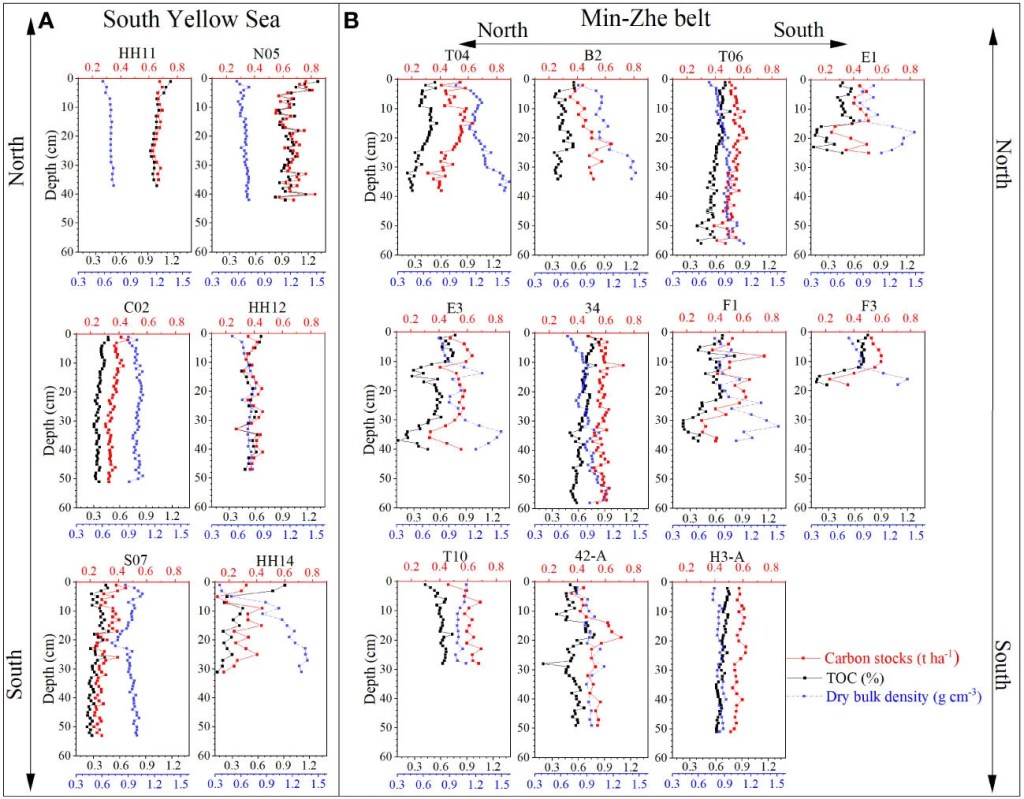
Across the 17 sediment cores examined, the total organic carbon content exhibited a range of 0.12% to 1.31%. Generally, a subtle decrease was observed downcore, accompanied by a negative correlation with dry bulk density. This correlation reflects the compaction of sediments, with grain size influencing the weight and volume. Notably, a discernible pattern emerged, showcasing a gradual decline in total organic carbon content from the northern to the southern regions of the study area, corresponding to an augmentation in sediment grain size.
Simultaneously, carbon reservoir stocks demonstrated a range of 0.12 to 0.83 t/ha throughout the study region. Notably, a conspicuous decrease has been observed since the early 1990s, coinciding with the construction of reservoirs in the Ou River basin in 1988 and 1989. This river’s course culminates in the seas under examination. Subsequent construction activities include the completion of the Three Gorges Dam in 2003 along the Yangtze River, leading to a 63% reduction in sediment transport compared to 1950. Consequently, this reduction diminishes the capacity for carbon transportation to the marginal marine shelf for burial.
This study underscores the significance of recognizing the unintended consequences of human interventions in diverse environmental realms, particularly their repercussions on the carbon cycle. Future decisions regarding the placement of dams and reservoirs must conscientiously weigh the potential adverse effects on carbon stocks. Such considerations are crucial not only for mitigating global warming by preventing the release of organic carbon into the atmosphere but also for addressing more localized impacts on ecosystems.
Resources
- ONLINE NEWS Bird, H. & Phys.org. (2023, November 26). Reservoir construction may be reducing carbon storage in ocean sediments. Phys.org. [Phys.org]
- JOURNAL Ma, H., Xiao, X., Ding, Y., Feng, X., Chen, W., Sun, L., Bao, X., Duan, S., & Zhao, M. (2023). Carbon stocks in the mud areas of the Chinese marginal seas. Frontiers in Marine Science, 10. [Frontiers in Marine Science]
Cite this page:
APA 7: TWs Editor. (2023, November 27). How Reservoirs Might Affect the Carbon Sequestration Potential of Marine Sediments? PerEXP Teamworks. [News Link]