




A collaborative effort between researchers at the University of Chicago’s Pritzker School of Molecular Engineering (PME), Argonne National Laboratory, and the University of Modena and Reggio Emilia has yielded a groundbreaking computational tool. This tool, integrated into the open-source software package WEST (developed within the Midwest Integrated Center for Computational Materials, or MICCoM), holds significant implications for the study and engineering of quantum materials concerning their interaction with light—specifically, the absorption and emission of photons.
The novel computational tool, known as WEST-TDDFT (Without Empty States—Time-Dependent Density Functional Theory), is designed to expand scientists’ capabilities in investigating quantum materials for applications in quantum technologies. Led by Prof. Marco Govoni, the team has demonstrated the tool’s accuracy by applying it to the study of three semiconductor-based materials. The tool’s versatility suggests its applicability to a broad range of related materials, and its scalable software design enables operation on various high-performance computing architectures. According to Giulia Galli, Liew Family Professor of Molecular Engineering and senior author of the published paper in the Journal of Chemical Theory and Computation, this advancement allows researchers to explore systems and properties that were previously inaccessible on a large scale.
Foundations of quantum information
At the heart of revolutionary quantum technologies lie qubits, the fundamental units of quantum information. Unlike classical computing bits confined to the binary language of 0s and 1s, qubits possess the unique ability to exist in superposition, embodying both 0 and 1 simultaneously.
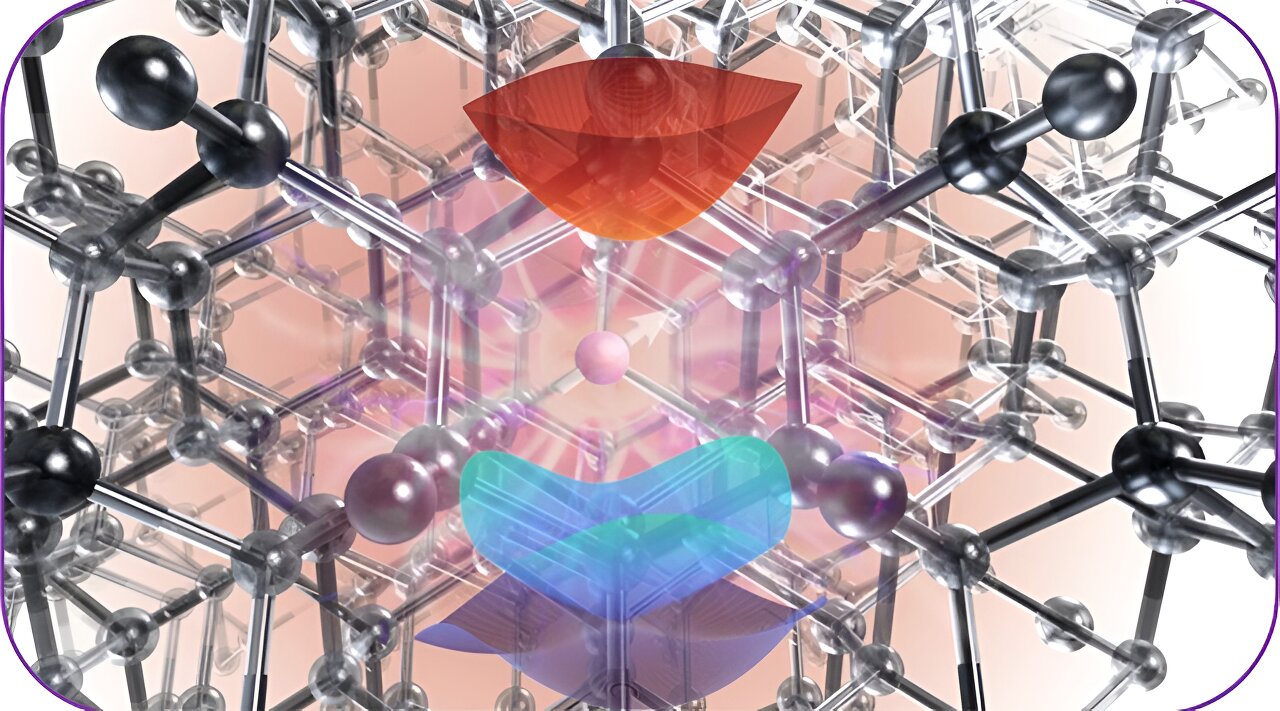
Within the intricate landscape of materials, even the most minuscule defects can assume quantum states and function as qubits. These imperfections, known as “point defects,” arise from factors such as missing or substituted atoms within the structured lattice of a crystal. What sets qubits apart is their remarkable sensitivity to the electric, optical, and magnetic properties of their environment, endowing them with the versatility to function as highly responsive sensors.
Remarkably, researchers have discovered that by scrutinizing the interaction between these point defects and photons of light—how they alter their energy states—there emerges a pathway to more effectively manipulate them. This deeper understanding also opens the door to designing materials that leverage these qubits, either as advanced sensors or cutting-edge data-storage units.
Dr. Galli, a prominent figure in quantum research, underscores the pivotal role of comprehending how these materials absorb and emit light. He emphasizes that light serves as the key to interrogating and unraveling the secrets of quantum functionalities. This intricate dance between materials and photons is crucial for unraveling their functioning in quantum applications.
While researchers have made significant strides in predicting both the absorption and emission of light by point defects, a lingering challenge persists. The intricate atomic processes that unfold within the material’s excited state, particularly in the realm of large and complex systems, have eluded a comprehensive explanation until now. This knowledge gap presents a frontier for further exploration and breakthroughs in the quest to harness the full potential of quantum information technologies.
Simplifying complicated calculations
In the realm of quantum mechanics, deciphering the intricate equations governing the atomic properties of materials poses a formidable challenge, demanding substantial computing power. However, a recent breakthrough by Galli’s research team introduces an innovative method to tackle these complex equations with enhanced efficiency without compromising accuracy.
This groundbreaking approach not only accelerates the computational speed but also optimizes the resource-intensive process, opening up new avenues for the analysis of larger systems. Historically, the formidable computational demands have rendered the examination of such expansive systems impractical. Yet, the newfound expeditious and efficient resolution of these equations paves the way for their application to more extensive systems, bringing the theoretical computations closer to the experimental realities observed in laboratories.
Yu Jin, the primary author of the research, underscores the significance of these advancements by highlighting the expanded scope enabled by the novel methodology. “With these methods, we can study the interaction of light with materials in systems that are quite large, meaning that these systems are closer to the experimental systems actually being used in the laboratory,” Jin explains.
The versatility of the devised approach is particularly noteworthy, as it can seamlessly operate on two distinct computer architectures: central processing units (CPUs) and graphics processing units (GPUs). This adaptability broadens the accessibility of the method across various computational platforms.
The practical application of this novel technique is exemplified through the team’s exploration of the excited state properties of point defects within three distinct materials: diamond, 4H silicon carbide, and magnesium oxide. Remarkably, the researchers observed that their tool effectively calculated the properties of these systems, even when dealing with configurations consisting of hundreds or thousands of atoms.
In essence, this breakthrough not only revolutionizes the efficiency of solving complex quantum mechanical equations but also extends the realm of theoretical exploration to encompass larger and more realistic material systems. The dual compatibility with CPUs and GPUs, coupled with successful applications in diverse materials, positions this method as a significant stride forward in the pursuit of understanding the intricate atomic properties that govern material behavior.
A more comprehensive objective
Within the MICCoM team, spearheading the development of WEST (Wavefunctions and Electrons in Strong Fields and Time-domain) is a collaborative effort led by Dr. Victor Yu, Yu Jin, and Prof. Marco Govoni. Their relentless pursuit involves the continual refinement and application of sophisticated algorithms encapsulated in the WEST package, with a particular emphasis on WEST-TDDFT. This powerful toolkit is not only geared towards unraveling the mysteries of quantum technologies but also holds promise for applications in low power and energy domains.
A noteworthy achievement of the team lies in their adeptness at solving the intricate equations governing light emission and absorption. Prof. Marco Govoni emphasizes the significance of their work, stating, “We’ve found a way to solve the equations describing light emission and absorption more efficiently so that they can be applicable to realistic systems.” This breakthrough not only enhances efficiency but also ensures a high level of accuracy in the calculations, a critical aspect in the realm of quantum materials research.
This innovative tool aligns seamlessly with the overarching objective of the Galli lab, which is dedicated to the exploration and design of new quantum materials. Their recent publication sheds light on the behavior of spin defects near the surface of materials, revealing distinct characteristics compared to those located deeper within the material. The observed variations, contingent upon the termination of the material’s surface, carry implications for the design and optimization of quantum sensors relying on spin defects.
In a complementary endeavor, the team has contributed to the scientific discourse with a recent paper published in npj Computational Materials. This particular study delves into the properties of ferroelectric materials, a class of materials finding applications in neuromorphic computing. By scrutinizing and understanding the intricate behaviors of these materials, the team contributes valuable insights that may pave the way for advancements in the burgeoning field of neuromorphic computing.
In essence, the collaborative efforts of the MICCoM team underscore their commitment to advancing the frontiers of computational materials science. Through the refinement of algorithms and the development of novel tools, they not only address the challenges posed by complex quantum equations but also contribute substantively to diverse applications, ranging from quantum technologies to materials crucial for emerging paradigms like neuromorphic computing.
Resources
- ONLINE NEWS Williams, S. C. & University of Chicago. (2023, December 21). An advanced computational tool for understanding quantum materials. Phys.org. [Phys.org]
- JOURNAL Yu, J., Yu, V., Govoni, M., Xu, A., & Galli, G. (2023). Excited state properties of point defects in semiconductors and insulators investigated with time-dependent density functional theory. arXiv (Cornell University). [arXiv.org]
Cite this page:
APA 7: TWs Editor. (2023, December 22). A Sophisticated Computational Instrument Designed for Unraveling the Mysteries of Quantum Materials. PerEXP Teamworks. [News Link]


