



Heterocyclic compounds, essential organic entities characterized by a ring structure incorporating at least two diverse elements, stand at the forefront of chemical and pharmaceutical innovation. Typically, these molecular rings boast carbon atoms, interwoven with additional elements such as nitrogen, oxygen, or sulfur. Their intrinsic value as raw materials within the chemical and pharmaceutical industry stems from their versatility and remarkable physiological activities.
Despite their significance, the conventional synthesis of heterocyclic compounds often involves methodologies demanding high temperature, elevated pressure conditions, or the reliance on precious metal catalysts. These factors contribute not only to the economic expenses but also to the environmental toll associated with their production.
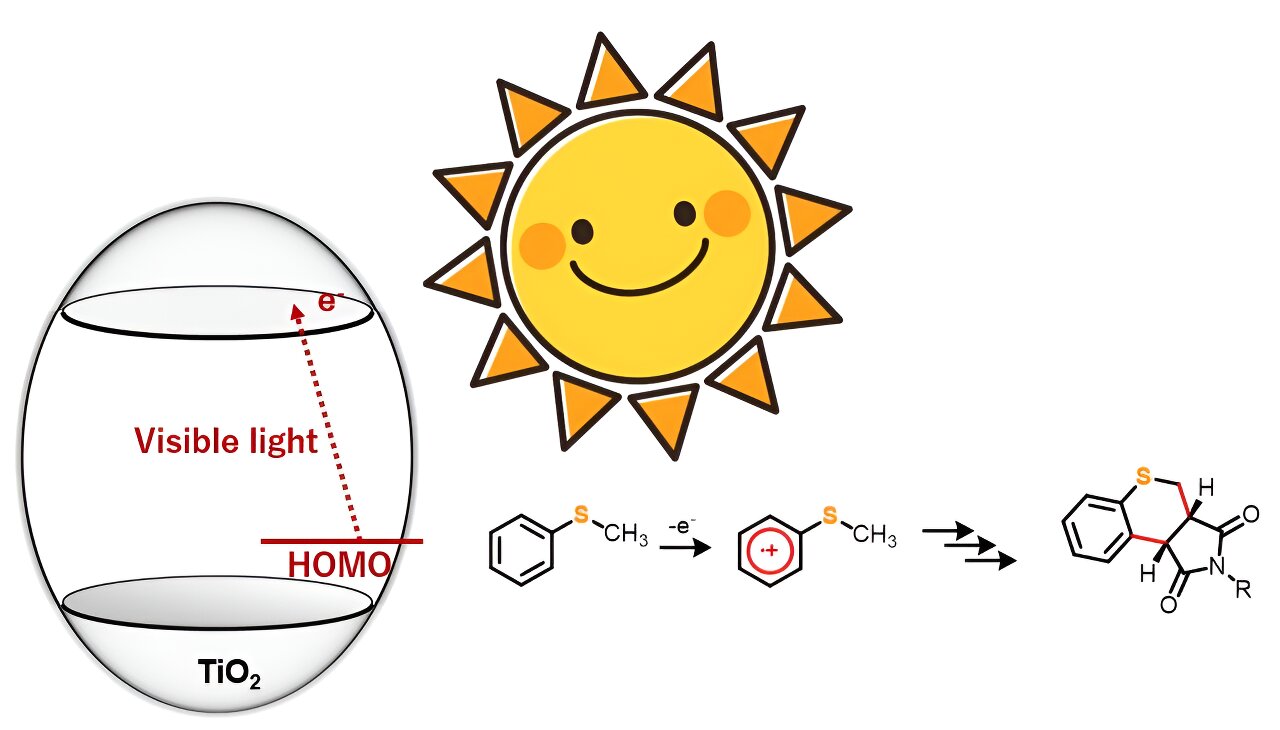
In a groundbreaking initiative, a collaborative effort between researchers from Japan and Bangladesh has proposed a novel and pragmatic approach to address these challenges. This innovative methodology, detailed in a recent publication in the esteemed journal Advanced Synthesis & Catalysis, introduces a simplified yet highly effective technique. The researchers successfully demonstrated the synthesis of 20 distinct sulfur-containing heterocyclic compounds employing a photocatalyst, specifically titanium dioxide (TiO2), and harnessing the power of visible light.
This pioneering method not only offers a streamlined approach to synthesizing heterocyclic compounds but also presents an eco-friendly alternative, circumventing the need for high-energy inputs or precious metal catalysts. The application of visible light as an integral component of the process not only enhances the efficiency of the synthesis but also aligns with sustainable practices.
The collaborative efforts of the Japanese and Bangladeshi researchers signify a significant stride towards advancing the field of heterocyclic compound synthesis, opening avenues for more sustainable and accessible production methods in the chemical and pharmaceutical realms.
Professor Yutaka Hitomi, leading the study from the Department of Applied Chemistry at the Graduate School of Science and Engineering, Doshisha University, collaborated with a team including Ph.D. candidate Pijush Kanti Roy from Doshisha University, Associate Professor Sayuri Okunaka from Tokyo City University, and Dr. Hiromasa Tokudome from Research Institute, TOTO Ltd.
The utilization of titanium dioxide (TiO2) as a photocatalyst for steering organic reactions has been a focal point of interest among synthetic chemists. Traditionally, these processes necessitate ultraviolet (UV) light to initiate reactions. However, the research team, under the leadership of Professor Hitomi, made a significant breakthrough by discovering that, under anaerobic conditions, sulfur-containing organic compounds, specifically thioanisole derivatives, can undergo reactions with maleimide derivatives when exposed to blue light. This interaction results in the formation of dual carbon–carbon bonds, yielding a novel heterocyclic organic compound.
Professor Hitomi elucidates, “We observed that while ultraviolet light generates highly oxidative holes, our approach allows for the selective one-electron oxidation of the substrate molecules using visible light. This approach can thus be employed in various organic chemical reactions,” This innovative approach not only enables diverse organic chemical reactions but also provides a more sustainable alternative by utilizing visible light rather than the energy-intensive ultraviolet light.
The research team meticulously selected five 4-substituted thioanisoles and four N-substituted maleimides for annulation or ring formation reactions. Initially, blue light with a wavelength greater than 420 nm failed to induce any reaction in the starting material. However, with the introduction of TiO2 into the reaction system, the synthesis of 20 distinct thiochromenopyrroledione derivatives was achieved with moderate-to-high yield. Notably, within a 12-hour exposure to blue light, the reaction between thioanisole and N-benzylmaleimide produced a thiochromenopyrroledione derivative with a yield of 43%, approaching the theoretical maximum yield of 50%.
This groundbreaking research not only expands the possibilities for utilizing TiO2 as a photocatalyst but also introduces a more environmentally friendly and energy-efficient method for driving organic reactions through the innovative use of visible light. The successful synthesis of diverse heterocyclic compounds underscores the potential impact of this study on advancing the field of organic chemistry.
In addition to the successful synthesis of thiochromenopyrroledione derivatives, the research team conducted a comprehensive analysis of substituent effects during the reactions to unravel the underlying mechanistic intricacies. Through these investigations, they formulated a postulation suggesting that the reaction unfolds via charge transfer from thioanisole to the conduction band of TiO2. Moreover, the team proposed that blue light irradiation initiates the one-electron oxidation of thioanisole, consequently triggering the formation of α-thioalkyl radicals through deprotonation.
In essence, this refined approach not only showcases the potential of titanium dioxide (TiO2) as a visible light photocatalyst for organic synthesis but also offers valuable insights into the complex mechanistic aspects of synthesizing heterocyclic compounds. The elucidation of these intricate details contributes to advancing the understanding of chemical reactions at the molecular level.
The implications of this breakthrough extend beyond the laboratory, as the new approach holds promise for fostering a more sustainable chemical industry. Professor Hitomi emphasizes the motivation behind their study, stating, “What drove our study was the desire to aid in the development of a sustainable chemical industry, and our findings appear to be a positive step in this direction.” This underscores a commitment to transitioning from resource-intensive processes to more energy-efficient and environmentally conscious systems.
Looking ahead, the visible light-driven technology pioneered by Professor Hitomi and his team stands poised to introduce transformative possibilities for organic synthesis. By potentially replacing current industrial chemical processes with more accessible and energy-efficient alternatives, this approach could pave the way for the cost-effective synthesis of pharmaceuticals. The profound impact on global health and well-being, as well as the potential to revolutionize multiple chemical industries, underscores the significance of this innovative research. The efforts of Professor Hitomi and his team not only contribute to scientific knowledge but also hold the promise of practical applications with far-reaching positive consequences.
Resources
- ONLINE NEWS Doshisha University. (2024, January 1). Chemical synthesis using titanium dioxide: An eco-friendly and innovative approach. Phys.org. [Phys.org]
- JOURNAL Roy, P. K., Okunaka, S., Tokudome, H., & Hitomi, Y. (2023). Blue Light‐Promoted Synthesis of Thiochromenopyrroledione Derivatives via Titanium Dioxide‐Catalyzed Dual Carbon–Carbon Bond Formation with Thioanisole and Maleimide Derivatives. Advanced Synthesis & Catalysis, 365(24), 4556–4561. [Advanced Synthesis & Catalysis]
Cite this page:
APA 7: TWs Editor. (2024, January 1). Titanium Dioxide as an Eco-Friendly and Innovative Agent for Chemical Synthesis. PerEXP Teamworks. [News Link]


