



On the upcoming Saturday, December 30, NASA’s Juno spacecraft is poised to execute an unprecedented close encounter with Jupiter’s moon Io, marking the nearest flyby undertaken by any spacecraft in over two decades. The spacecraft will traverse a distance of approximately 930 miles (1,500 kilometers) from the surface of Io, renowned as the most volcanic world within our solar system. This close approach is not only a remarkable feat but is also anticipated to facilitate the collection of an extensive array of data by Juno’s scientific instruments.
Juno’s principal investigator, Scott Bolton of the Southwest Research Institute in San Antonio, Texas, emphasized the significance of this endeavor, stating, “By combining data from this flyby with our previous observations, the Juno science team is studying how Io’s volcanoes vary.” Bolton further elaborated on the team’s objectives, including the investigation of eruption frequency, the intensity and temperature of volcanic activity, alterations in the lava flow’s structure, and the interconnection between Io’s dynamic behavior and the flux of charged particles within Jupiter’s magnetosphere.
This upcoming close flyby is part of a strategic plan, with a second ultra-close encounter scheduled for February 3, 2024, during which Juno will once again approach within an approximate distance of 930 miles (1,500 kilometers) from Io’s surface. These maneuvers aim to enhance our understanding of the moon’s intricate volcanic processes.
Juno’s extensive monitoring of Io’s volcanic activity has been ongoing from varying distances, ranging from approximately 6,830 miles (11,000 kilometers) to well beyond 62,100 miles (100,000 kilometers). Notably, the spacecraft has delivered groundbreaking views of both the north and south poles of Io, shedding light on regions previously unexplored. Additionally, Juno has undertaken close flybys of other significant celestial bodies within Jupiter’s domain, including the icy moons Ganymede and Europa, enriching our comprehension of the diverse phenomena occurring within this intriguing planetary system.
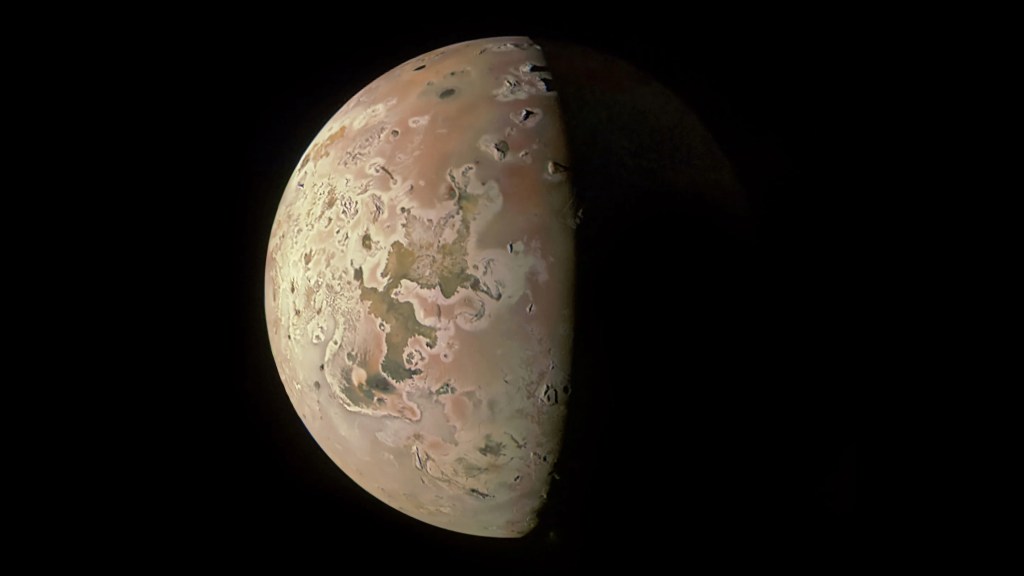
The upcoming tandem of close flybys in December and February by NASA’s Juno spacecraft holds the promise of unraveling the mysteries behind Io’s colossal volcanic activity. Led by Juno’s principal investigator, Scott Bolton, the scientific mission aims to delve into the potential existence of a magma ocean beneath Io’s crust and to comprehend the influential role of Jupiter’s tidal forces, which continuously exert pressure on this tumultuous moon.
As the spacecraft embarks on the third year of its extended mission dedicated to unraveling the intricacies of Jupiter’s origins, Juno is set to extend its exploration to the ring system encompassing some of the gas giant’s inner moons. The solar-powered spacecraft, equipped with advanced instruments, will scrutinize the dynamic interactions within this celestial neighborhood, shedding light on the fundamental processes shaping the Jovian system. This multifaceted mission underscores the significance of Juno’s ongoing endeavors in expanding our knowledge of the complex and captivating dynamics that define Jupiter and its enigmatic moons.

As Juno embarks on its 57th orbit around Jupiter during the upcoming flyby of Io, all three of its cameras are set to play integral roles in unraveling the mysteries of the Jovian moon. Among them, the Jovian Infrared Auroral Mapper (JIRAM) will take center stage, capturing infrared images to unveil the heat signatures emanating from the numerous volcanoes and calderas that dot Io’s surface. This mission-critical data promises to deepen our understanding of the moon’s geothermal dynamics.
Simultaneously, the Stellar Reference Unit, originally a navigational star camera, will assume an additional scientific role during this flyby. Set to deliver the highest-resolution image of Io’s surface to date, it expands its utility beyond navigation, offering unprecedented visual clarity for scientific analysis.
Adding a vivid visual component to this scientific venture is JunoCam, an instrument intentionally included for public engagement. Designed to operate for up to eight flybys of Jupiter, JunoCam will capture visible-light color images, bringing the captivating landscapes of Io closer to Earth-bound enthusiasts.
However, this prolonged exposure to Jupiter’s harsh radiation environment has taken a toll on JunoCam. Ed Hirst, the project manager of Juno at NASA’s Jet Propulsion Laboratory, notes that the cumulative effects of radiation are becoming evident in recent images. Signs of reduced dynamic range and the emergence of ‘striping’ noise indicate the impact of the challenging radiation conditions on the imager.
Addressing these challenges, the engineering team is actively working on solutions to mitigate radiation damage and prolong the operational life of JunoCam. This ongoing effort underscores the commitment to maintaining the scientific capabilities of Juno’s instruments, even as they brave the formidable radiation challenges posed by Jupiter’s orbit.
Io: A closer look
Following months of meticulous study and evaluation, the Juno team has recalibrated the spacecraft’s projected trajectory, introducing an additional seven distant flybys of Jupiter’s moon Io to the extended mission plan. This strategic adjustment brings the total number of Io flybys to 18, an expansion aimed at extracting valuable insights from the enigmatic moon.
After the close encounter with Io on February 3, Juno’s future orbits will orbit the moon every other revolution, gradually increasing the distance. The initial flyby will position Juno at an altitude of approximately 10,250 miles (16,500 kilometers) above Io, culminating in the last pass at about 71,450 miles (115,000 kilometers). This orchestrated series of flybys not only promises a comprehensive examination of Io but also serves to modify Juno’s orbit around Jupiter. The gravitational influence of Io during the December 30 flyby will reduce the spacecraft’s orbital period from 38 days to 35 days, further shortening to 33 days after the subsequent flyby on February 3.
As Juno progresses on this modified trajectory, a noteworthy occurrence awaits. Jupiter will momentarily eclipse the sun from Juno’s perspective for about five minutes during each perijove – the closest point of the orbiter’s orbit to the planet. This marks the first instance of darkness encountered by the solar-powered spacecraft since its Earth flyby in October 2013. However, the brief duration of this eclipse is anticipated to have negligible effects on Juno’s overall functionality.
Subsequent to the February 3 perijove, the spacecraft is slated to experience similar solar eclipses during each close Jupiter flyby throughout the remainder of its extended mission, concluding in late 2025. Embracing these solar events, Juno will embark on a series of occultation experiments commencing in April 2024. Leveraging the Gravity Science experiment, these experiments aim to delve into Jupiter’s upper atmospheric composition, furnishing critical information on the planet’s shape and internal structure. This proactive approach showcases Juno’s adaptability and commitment to extracting maximum scientific value from its extended mission.
Resources
- ONLINE NEWS NASA. (2023, December 29). NASA’s Juno to get close look at Jupiter’s volcanic moon Io on Dec. 30. Phys.org. [Phys.org]
Cite this page:
APA 7: TWs Editor. (2024, January 1). Volcanic Moon Io Awaits Juno’s Visit on Dec. 30. PerEXP Teamworks. [News Link]


