



A team of researchers from Nagoya University in Japan has unearthed a correlation between the advancement of amyotrophic lateral sclerosis (ALS), or Lou Gehrig’s disease, and the disruption of mitochondria-associated membranes (MAM). These membranes act as crucial contact points linking the mitochondria with the endoplasmic reticulum (ER) within the cell.
Published in the Proceedings of the National Academy of Sciences, this discovery offers pivotal insights into the underlying mechanisms of this neurodegenerative condition.
ALS, a complex disease impacting motor neurons, has been previously associated with abnormalities in both mitochondria, the body’s energy-generating cells, and the ER, a multifaceted membrane network vital for protein synthesis, metabolism, and calcium storage. The MAM serves as the interface between the ER and mitochondria. While it’s established that abnormalities in both mitochondria and the ER, particularly at the MAM, contribute to the disease’s progression, the precise interplay between these factors remains elusive.
TANK-binding kinase 1 (TBK1), a pivotal enzyme with roles in inflammation and cellular clearance of damaged proteins, emerges as a potential factor in the development of amyotrophic lateral sclerosis (ALS), although the precise mechanism has remained elusive. Mutations in the TBK1 gene have been linked to ALS, prompting investigations into how TBK1 malfunctions contribute to the disease.
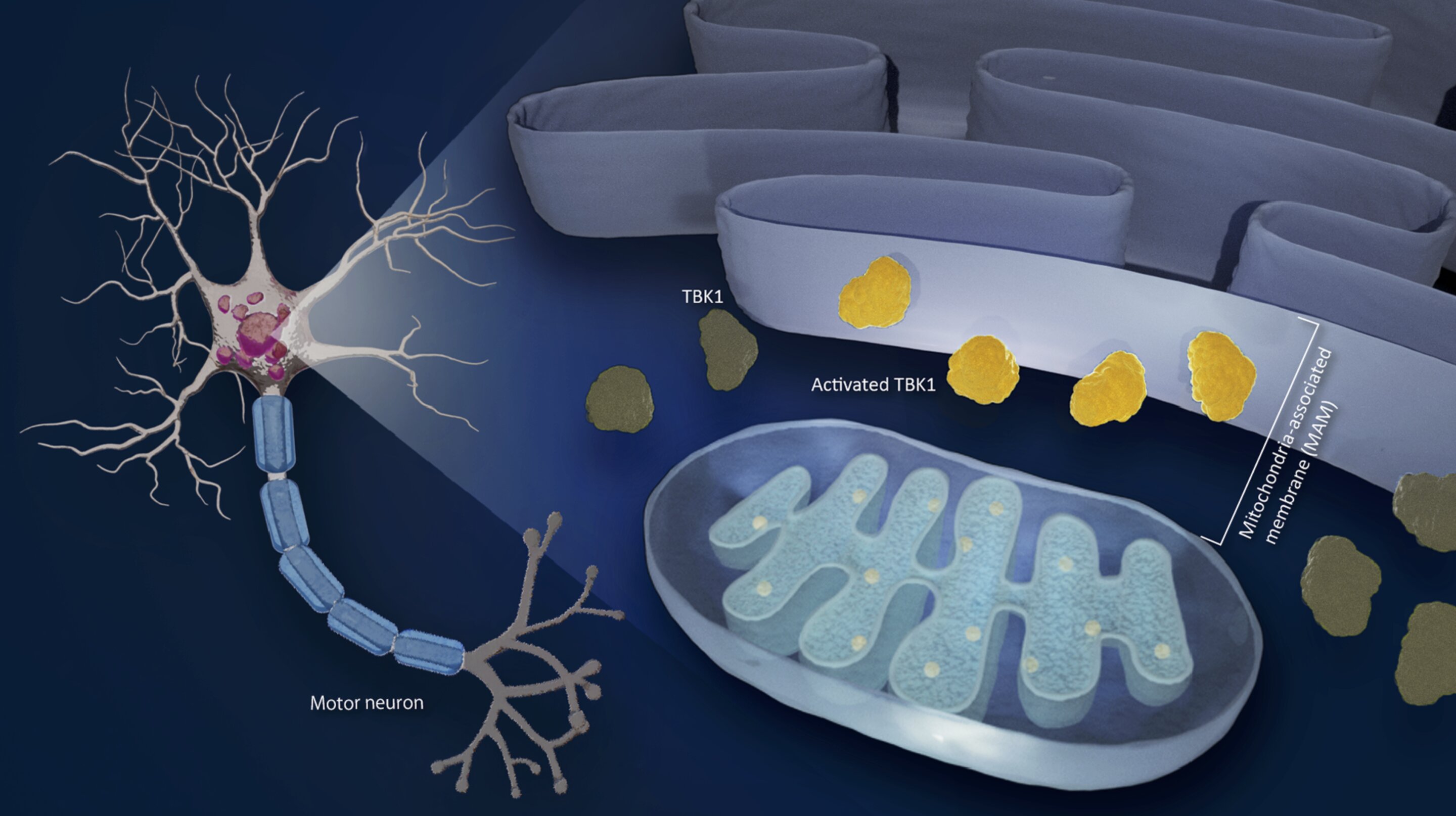
Led by Koji Yamanaka at Nagoya University’s Research Institute of Environmental Medicine, in collaboration with Masahisa Katsuno of the Graduate School of Medicine, a research team delved into this intricate relationship. Their findings revealed that brain and spinal cord tissues in ALS patients, as well as mice with disrupted mitochondria-associated membranes (MAM), exhibited decreased activation of TBK1.
Seiji Watanabe, the study’s first author, elucidated, “TBK1 is crucial for stress response in motor neurons. If we reduce its activity, it will result in reduced tolerance to stressors, leading to neurotoxicity and eventual motor neuron death. This finding is particularly significant because abnormal protein accumulation and the resulting stress cause ALS and other neurodegenerative diseases.”
When the mitochondria-associated membrane (MAM) is disrupted in the context of ALS, the activity of the enzyme TBK1 decreases. In a notable experiment, the researchers administered arsenite, a substance known to lower TBK1 activity and disrupt MAM, to mice. The outcome revealed that these mice displayed motor problems akin to those observed in ALS.
Koji Yamanaka emphasizes the significance of their findings, stating that the study strongly indicates the substantial impact of MAM on the stress response of motor neurons through the activation of TBK1. This observation aligns with human genetic studies that have identified TBK1 mutations as a causative factor in ALS. In light of these insights, restoring TBK1 activity emerges as a promising therapeutic avenue for countering ALS, offering a hopeful trajectory for future research.
The researchers’ focus on the TBK1 pathway provides a pivotal foundation for the development of novel treatments not only for ALS but potentially for other brain disorders as well. Yamanaka underscores the potential impact of these results on the future development of therapeutic strategies for ALS, highlighting the prospect of targeting TBK1 activity as a promising avenue in upcoming research initiatives.
Resources
- ONLINE NEWS Nagoya University. (2024, January 17). Research links progression of amyotrophic lateral sclerosis to disruption of mitochondria-associated membranes. Medical Xpress. [Medical Xpress]
- JOURNAL Watanabe, S., Murata, Y., Oka, Y., Oiwa, K., Horiuchi, M., Iguchi, Y., Komine, O., Sobue, A., Katsuno, M., Ogi, T., & Yamanaka, K. (2023). Mitochondria-associated membrane collapse impairs TBK1-mediated proteostatic stress response in ALS. Proceedings of the National Academy of Sciences of the United States of America, 120(47). [PNAS]
Cite this page:
APA 7: TWs Editor. (2024, January 17). ALS Development Linked to Disruption of Mitochondria-Associated Membranes. PerEXP Teamworks. [News Link]


