





APA 7: TWs Editor & ChatGPT. (2023, November 12). Revolutionizing Materials through Innovative Atomic Sheet Modifications. PerEXP Teamworks. [News Link]
Metamaterials consist of arrays of “Meta-atoms,” meticulously engineered structures at the scale of approximately a hundred nanometers. These arrays enable intricate interactions between light and matter. Nevertheless, the practical utility of metamaterials has been constrained by the relatively larger size of meta-atoms compared to conventional atoms, which are smaller than a nanometer.
A team of researchers, led by Bo Zhen from the University of Pennsylvania, has introduced an innovative method for engineering atomic structures in materials. This involves stacking two-dimensional arrays into spiral formations, opening up unprecedented possibilities for unique light-matter interactions. By employing this approach, metamaterials can surpass existing technical constraints, heralding advancements in next-generation lasers, imaging, and quantum technologies. The outcomes of their study have been documented in the journal Nature Photonics.
The analogy employed by Bo Zhen, a senior author of the study and an assistant professor in the School of Arts & Sciences at the University of Pennsylvania, describes the process akin to stacking a deck of cards but introducing a slight twist to each card before adding it to the pile. This twist imparts a transformative effect on how the entire ‘deck’ interacts with light, bestowing upon it novel properties that are not present in individual layers or conventional stacks.
Bumho Kim, the first author of the paper and a postdoctoral researcher in the Zhen Lab, elucidates that they created screw symmetries by stacking and twisting layers of a material known as tungsten disulfide (WS2) at specific angles.
Kim emphasizes the significance of manipulating the twist in the layers, clarifying that by twisting them at specific angles, the symmetry of the stack is altered. In this context, symmetry pertains to how the spatial arrangement of materials dictates certain properties, such as their interactions with light.
Through precise adjustments to the atomic-scale arrangement, the researchers have defied conventional expectations regarding the capabilities of these materials. The deliberate control of the twist across numerous layers of WS2 has resulted in the development of three-dimensional nonlinear optical materials.
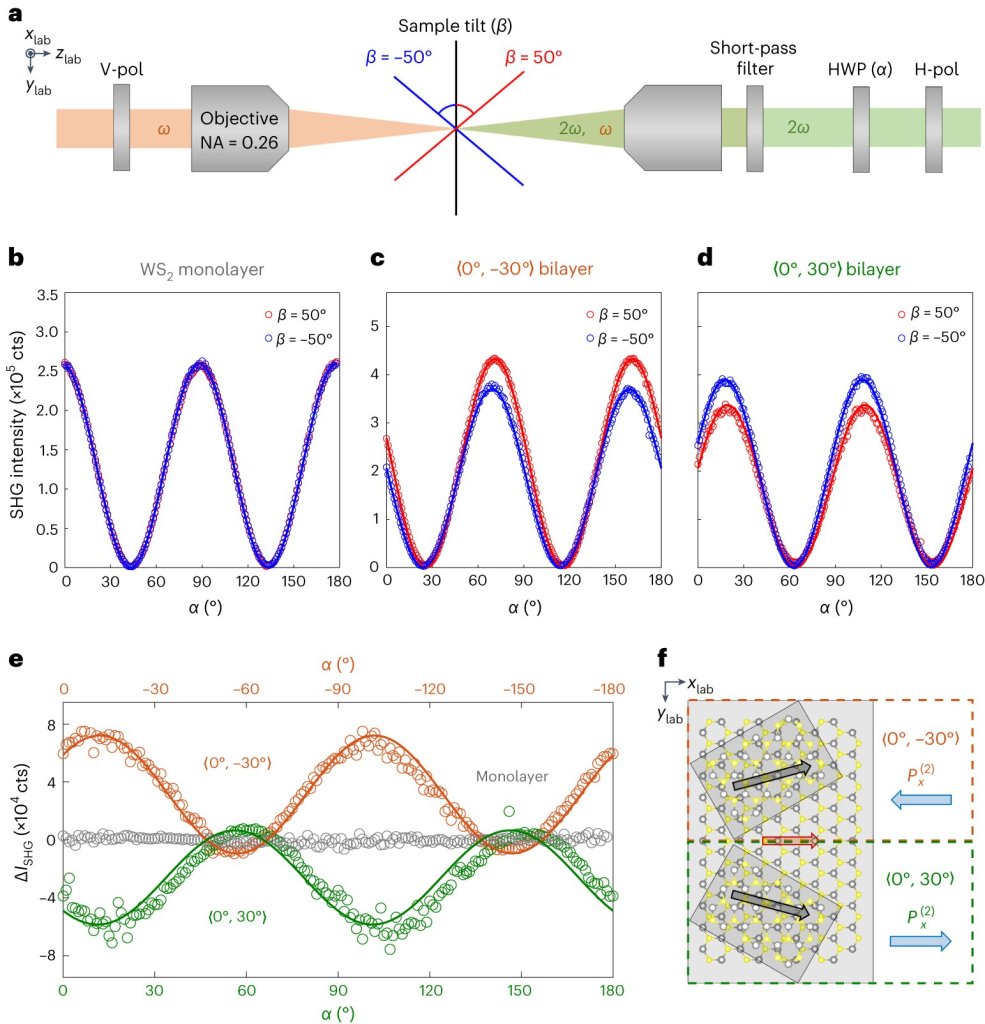
Kim clarifies that a singular layer of WS2 possesses specific symmetries, enabling distinct interactions with light. In this context, two photons at a designated frequency can engage with the material, giving rise to a new photon at twice the frequency—an occurrence referred to as second-harmonic generation (SHG).
Kim highlights that when two layers of WS2 are stacked with a twist angle deviating from the conventional 0° or 180°, the previously existing mirror symmetries in the single layer are disrupted. This disruption of mirror symmetry is pivotal as it gives rise to a chiral response—a novel characteristic not observed in the individual layers.
The researchers elaborate on the importance of the chiral response, emphasizing that it stems from a cooperative effect originating from the coupling of electronic wavefunctions between the two layers. This phenomenon is unique to twisted interfaces, underscoring its significance.
Zhen introduces an intriguing feature, noting that the sign of the chiral nonlinear response undergoes a reversal when the twist angle is inverted. This showcases the ability to directly manipulate nonlinear properties by a straightforward adjustment of the twist angle between layers—an unprecedented level of tunability that holds revolutionary potential for crafting optical materials with tailored responses.
Transitioning from bilayers to trilayers and beyond, the researchers witnessed the interplay of interfacial second-harmonic generation (SHG) responses, observing constructive or destructive interference patterns contingent upon the twist angles between the layers.
In a stack comprising layers in multiples of four, Kim explains that the chiral responses originating from all interfaces accumulate, whereas the in-plane responses nullify each other. This gives rise to a novel material that exclusively manifests chiral nonlinear susceptibilities. Achieving this outcome relies on the meticulous stacking and twisting of the layers, showcasing the indispensability of precision in this process.
The research team discovered that the introduction of screw symmetry imparts a unique selectivity to the electric field of light within the material. This component of light, responsible for determining its direction and intensity, exhibits a novel behavior. Kim highlights their findings, specifically in twisted stacks of four and eight layers, where counter-circularly polarized third harmonic generation occurs—a phenomenon where light travels in the opposite spiral direction. This distinctive quality is absent in the individual WS2 monolayers.
Kim underscores that the incorporation of an artificial screw symmetry provides the capability to manage nonlinear optical circular selectivity at the nanoscale.
In experimental validation of this technique, the researchers confirmed the anticipated nonlinearities across diverse setups of twisted WS2 stacks. The team documented novel nonlinear responses and circular selectivity in these twisted WS2 stacks, characteristics absent in naturally occurring WS2. This discovery holds significant implications for the realm of nonlinear optics.
Resources
- NEWSPAPER Magubane, N. & University of Pennsylvania. (2023, November 10). A twist on atomic sheets to create new materials. Phys.org. [Phys.org]
- JOURNAL Kim, B., Jin, J., Wang, Z., Li, H., Christensen, T., Mele, E. J., & Zhen, B. (2023). Three-dimensional nonlinear optical materials from twisted two-dimensional van der Waals interfaces. Nature Photonics. [Nature Photonics]


