



The research, detailed in the Proceedings of the National Academy of Sciences, unveils a unique method for exploring changes in Earth’s magnetic field by examining iron oxide grains within ancient clay bricks. The study demonstrates how scientists were able to reconstruct these magnetic field changes by analyzing the names of Mesopotamian kings engraved on the bricks.
This innovative approach, known as “archaeomagnetism,” involves seeking signatures of Earth’s magnetic field in archaeological items. The researchers anticipate that this technique will enhance the understanding of Earth’s magnetic field history and contribute to more accurate dating of artifacts that were previously challenging to date.
Co-author Professor Mark Altaweel from the UCL Institute of Archaeology highlights the significance of this work in establishing a crucial dating baseline, particularly for common cultural remains like bricks and ceramics that lack organic material for traditional dating methods such as radiocarbon dating.
Earth’s magnetic field undergoes fluctuations in strength over time, leaving distinctive signatures on heat-sensitive minerals. The research team examined the latent magnetic signatures in iron oxide grains within 32 clay bricks sourced from various archaeological sites in Mesopotamia (modern-day Iraq). These grains retained the imprint of the Earth’s magnetic field strength when the bricks were initially fired by ancient brickmakers.
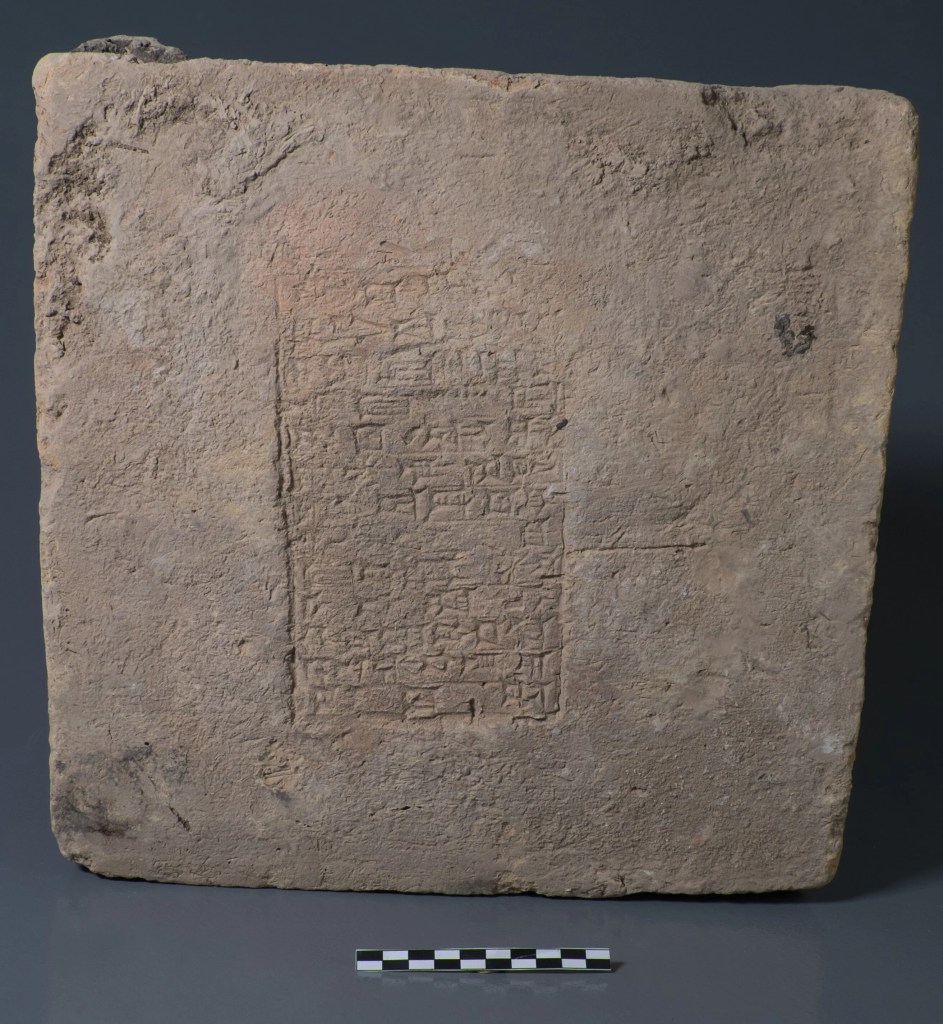
Each brick, bearing the inscribed name of the ruling king, provided a historical snapshot of the Earth’s magnetic field strength during its creation. The combination of the imprinted royal name and the measured magnetic strength in the iron oxide grains offered a unique and detailed historical map of changes in the Earth’s magnetic field over the millennia.
In a breakthrough discovery, researchers confirmed the existence of the “Levantine Iron Age geomagnetic Anomaly,” a mysterious period between 1050 to 550 BCE when Earth’s magnetic field exhibited an unusually strong intensity around modern-day Iraq. This anomaly, previously identified in regions as distant as China, Bulgaria, and the Azores, lacked comprehensive data from the southern part of the Middle East.
Lead author Professor Matthew Howland from Wichita State University emphasized the significance of comparing ancient artifacts with knowledge about the ancient magnetic field. This comparative analysis allows for the estimation of artifact dates based on the conditions of the Earth’s magnetic field during their creation.
To measure iron oxide grains, the team delicately extracted tiny fragments from the bricks and employed a magnetometer for precise measurements. The data not only unveiled changes in Earth’s magnetic field over time but also introduced a novel tool for archaeologists to more accurately date certain ancient artifacts. The magnetic strength of iron oxide grains within fired items can be matched to the known strengths of Earth’s historic magnetic field, offering a dating method with better resolution than radiocarbon dating.
The archaeomagnetic dating technique not only aids in dating artifacts but also contributes to refining historical timelines. It enables a more precise determination of the reigns of some ancient kings, resolving ambiguities in historical records. The researchers found alignment with the “Low Chronology,” an archaeological understanding of the order and duration of kings’ reigns.
Moreover, the study revealed that during the reign of Nebuchadnezzar II (604 to 562 BCE), the Earth’s magnetic field exhibited dramatic changes in five samples over a relatively short period. This observation supports the hypothesis that rapid spikes in magnetic field intensity are indeed possible.
In reference to the co-author Professor Lisa Tauxe of the Scripps Institution of Oceanography, she emphasized the complexity of the geomagnetic field as one of the most intriguing phenomena in Earth sciences. The well-preserved and accurately dated archaeological remains, particularly bricks inscribed with the names of specific kings from Mesopotamian cultures, present a unique and unparalleled opportunity. This archaeological material allows for an in-depth study of changes in the Earth’s magnetic field strength with high temporal resolution. The inscribed bricks provide a means to track magnetic field variations occurring over relatively short periods, spanning several decades or even less, offering valuable insights into the dynamic nature of Earth’s magnetic field.
Resources
- ONLINE NEWS University College London. (2023, December 18). Mesopotamian bricks unveil the strength of Earth’s ancient magnetic field. Phys.org. [Phys.org]
- JOURNAL Howland, M. D., Tauxe, L., Gordin, S., Altaweel, M., Cych, B., & Ben-Yosef, E. (2023). Exploring geomagnetic variations in ancient Mesopotamia: Archaeomagnetic study of inscribed bricks from the 3rd–1st millennia BCE. Proceedings of the National Academy of Sciences, 120(52), e2313361120. [PNAS]
Cite this page:
APA 7: TWs Editor. (2023, December 19). Ancient Bricks from Mesopotamia Uncover the Force of Earth’s Past Magnetism. PerEXP Teamworks. [News Link]


