



The formidable gravitational forces of black holes possess the ability to consume vast amounts of matter, often leading to the violent expulsion of particle streams at near-light speeds, known as jets. While scientists acknowledge that these high-speed jets can accelerate cosmic rays, the precise mechanisms behind this process remain largely elusive.
Recent discoveries, leveraging data from NASA’s Imaging X-ray Polarimetry Explorer (IXPE) spacecraft, provide fresh insights into the enigmatic realm of particle acceleration within such extreme environments. The focal point of these observations is a microquasar—a system where a black hole draws material from a companion star. The findings, outlined in a new paper featured in The Astrophysical Journal, shed light on the intricacies of particle acceleration.
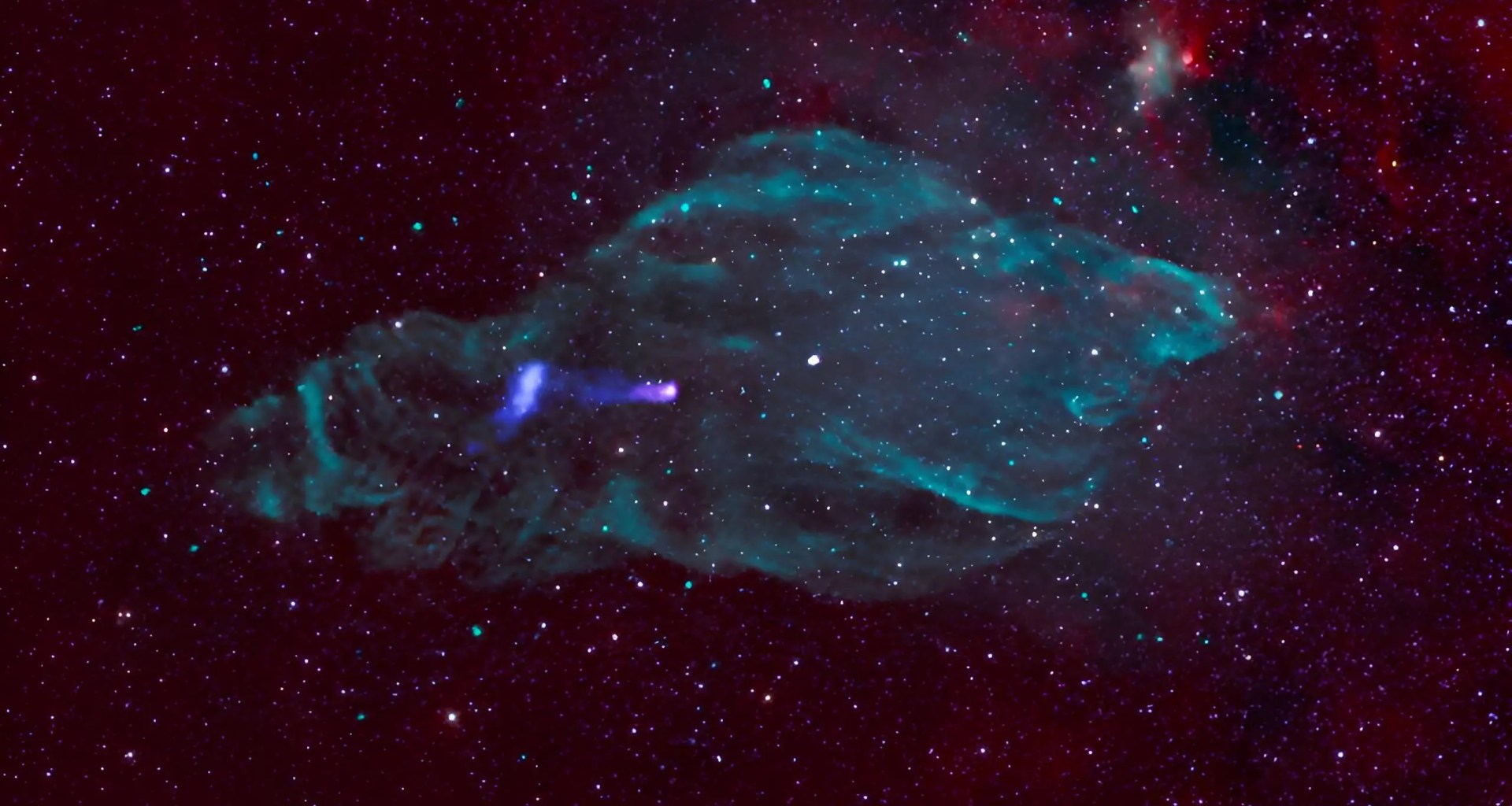
The microquasar under scrutiny, Stephenson and Sanduleak 433 (SS 433), resides at the heart of the supernova remnant W50 in the constellation Aquila, situated approximately 18,000 light-years away from Earth. Notably, the potent jets emanating from SS 433, responsible for distorting the remnant’s shape and earning it the moniker “Manatee Nebula,” have been measured at around 26% of the speed of light—equivalent to over 48,000 miles per second. Discovered in the late 1970s, SS 433 stands as the inaugural microquasar ever identified, contributing significantly to our understanding of these fascinating cosmic phenomena.
Equipped with three onboard telescopes, NASA’s Imaging X-ray Polarimetry Explorer (IXPE) focuses on measuring a distinctive property of X-ray light known as polarization. This property provides valuable insights into the organization and alignment of electromagnetic waves at X-ray frequencies. The study of X-ray polarization is crucial for unraveling the intricate physical processes occurring in extreme cosmic environments, such as those surrounding black holes, and comprehending the mechanisms behind particle acceleration in these regions.
During an intensive observational period spanning 18 days in April and May of 2023, IXPE delved into the exploration of a specific site of particle acceleration. This investigation was centered on the eastern lobe of SS 433, where emissions emanate from energetic electrons engaged in a mesmerizing dance within a magnetic field—a phenomenon referred to as synchrotron radiation. By honing in on this acceleration site, IXPE aims to contribute to our understanding of the fascinating interplay between magnetic fields, energetic particles, and the dynamic processes occurring in the vicinity of cosmic entities like SS 433.
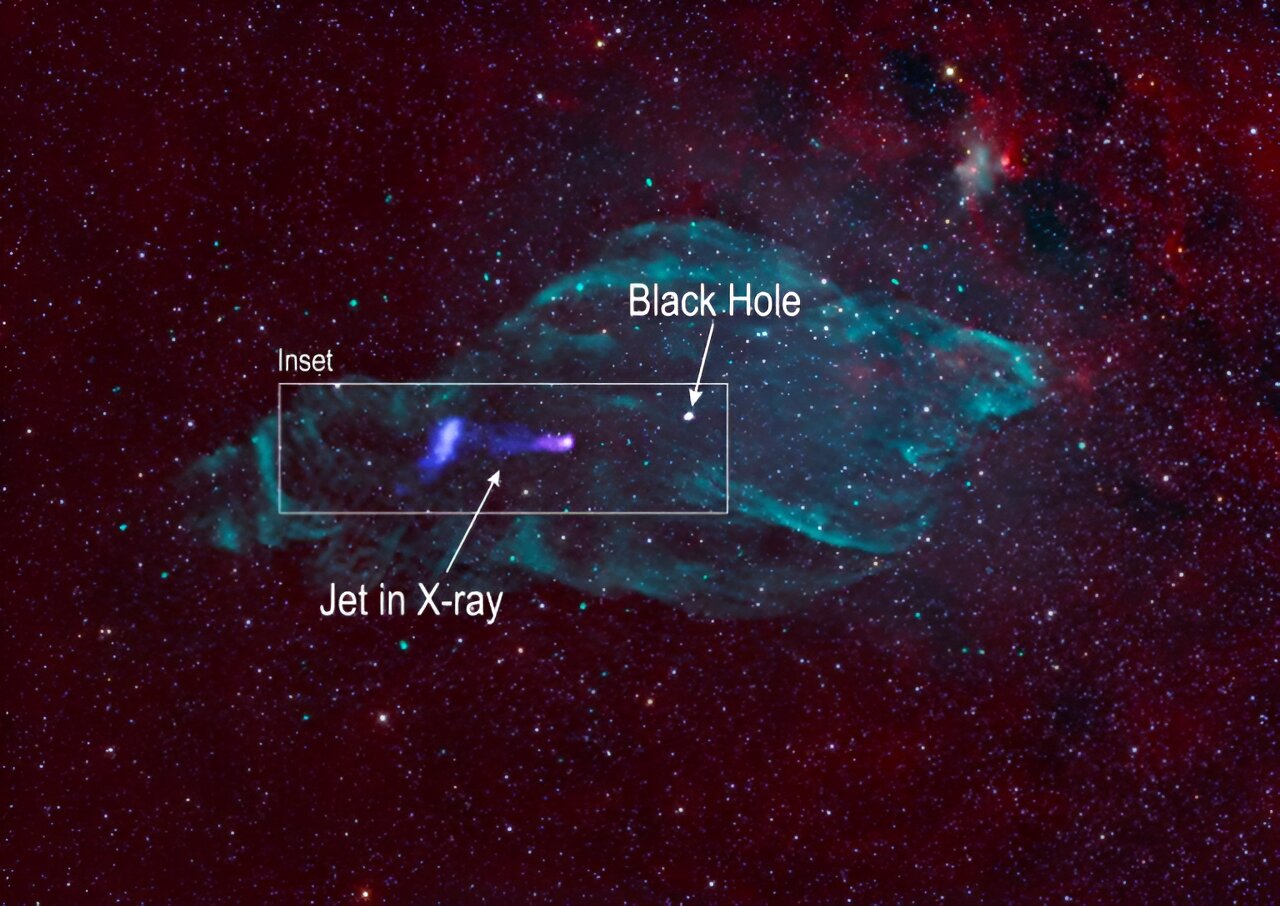
Astrophysicist Philip Kaaret, who serves as the principal investigator of NASA’s IXPE mission and is based at NASA’s Marshall Space Flight Center in Huntsville, Alabama, has presented intriguing findings regarding SS 433 in a recently published paper. The IXPE data has revealed an unexpected alignment of the magnetic field near the particle acceleration region, coinciding with the direction of the jets’ movement.
This revelation challenges prior assumptions, as scientists had long speculated that the interaction between the powerful jets and the interstellar medium—a space filled with gas and dust between stars—would result in a disordered magnetic field due to shock effects. However, the high level of polarization observed with IXPE indicates a well-organized magnetic field, with at least half of it aligned in the same direction.
Kaaret proposes a novel interpretation of these results, suggesting the possibility that the magnetic fields within the potent jets might become “trapped” and elongated as they collide with interstellar matter. This interaction directly influences the alignment of the magnetic fields in the region where particle acceleration occurs.
The historical context of SS 433’s jets acting as particle accelerators dates back to the 1980s. The confirmation of this acceleration effect came in 2018 when observations from the High-Altitude Water Cherenkov Observatory in Puebla, Mexico, provided validation. Subsequently, NASA’s NuSTAR (Nuclear Spectroscopic Telescope Array) and the European Space Agency’s XMM-Newton observatories were employed in 2018 to precisely identify the region of particle acceleration within SS 433.
As scientists delve into the wealth of data provided by IXPE and explore new cosmic targets, there is a broader ambition to discern whether the observed mechanism influencing the alignment of magnetic fields near particle acceleration regions extends to various cosmic phenomena. This includes phenomena such as black hole jets emanating from supernova remnants and the ejected debris from exploded stars like blazars.
The advanced imaging capabilities of IXPE’s X-ray polarimeters have played a pivotal role in facilitating this intricate exploration. The delicate measurements carried out by IXPE have enabled the detection of subtle signals within a confined region of the jet, positioned 95 light-years away from the central black hole. Paolo Soffitta, the Italian principal investigator for the IXPE mission, underscores the significance of these capabilities, emphasizing that they have made it possible to capture and analyze the faint signals that contribute to our understanding of magnetic field alignment in these distant cosmic outflows.
Resources
- ONLINE NEWS Ridgeway, B. & NASA. (2024, January 17). NASA’s IXPE helps researchers maximize “microquasar” findings. Phys.org. [Phys.org]
- JOURNAL Ricciardelli, E., Cava, A., Varela, J., & Tamone, A. (2017). Morphological segregation in the surroundings of cosmic voids. arXiv (Cornell University). [arXiv.org]
Cite this page:
APA 7: TWs Editor. (2024, January 17). Unlocking the Secrets of “Microquasars”: NASA’s IXPE Enhances Research Opportunities. PerEXP Teamworks. [News Link]


I have been surfing online more than 3 hours today yet I never found any interesting article like yours It is pretty worth enough for me In my opinion if all web owners and bloggers made good content as you did the web will be much more useful than ever before
Thank you : )