





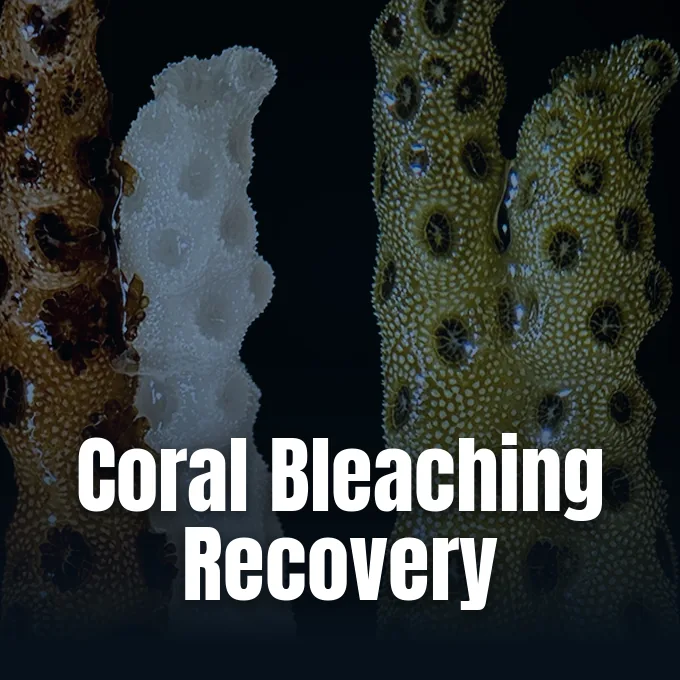
Can a dying reef animal regain its health simply by touching a colorful neighbor in the water? Marine biologists from Stanford University discovered that bleached corals can mount a rapid coral bleaching recovery when placed in direct contact with a healthy fragment from the same genetic colony. The research, published in the journal Science Advances, shows that microscopic algae move across a fused tissue bridge between touching branches to replenish lost photosynthetic nutrients [1, 2]. While earlier work documented the stress legacy of ocean acidification on marine invertebrates, this laboratory contact process restored depleted algal populations within five days [2, 3].
- Can Bleached Corals Recover with Neighbor Support?
- How Algal Symbionts Drive Coral Bleaching Recovery
- Why Do Bleached Corals Need Direct Tissue Contact?
- Can Different Coral Colonies Share Symbiont Cells?
- Laboratory Evidence for Bleached Coral Recovery
- Translating Coral Bleaching Recovery into Reef Restoration
Can Bleached Corals Recover with Neighbor Support?
Bleached corals can recover with neighbor support if healthy fragments from the same genetic colony remain in direct contact for several consecutive days in seawater tanks [1]. In early 2025, marine scientist Stephen Palumbi at Hopkins Marine Station in Pacific Grove, California, noticed an accident inside a laboratory tank. Two fragments of the cauliflower coral species Pocillopora damicornis had fallen over and were touching [1, 3]. Palumbi saw that brown color had begun to seep into the pale branch right where the two pieces met. “I’d never seen that before,” Palumbi said. The white skeleton was not dead [3].
Doctoral student Daniel Collins, who was studying how disease spreads between coral fragments at Stanford University, turned that accidental observation into a structured laboratory experiment [2, 3]. Collins realized that if infectious pathogens could pass between touching corals, helpful biological material and live photosynthetic algae might travel across the same living tissue junction. When initial trials produced visible healing in pale branches, Collins hurried to his supervisor’s office to share the news. “It’s stunning,” Collins said when describing that early breakthrough to AFP. Bleached corals had long been written off by conservationists because high mortality rates make wild restoration difficult, but Collins noted that damaged colonies “really shouldn’t be thought of as a lost cause” during marine heatwaves [2]. The paper appeared on October 14, 2026, in Science Advances [1, 3].
How Algal Symbionts Drive Coral Bleaching Recovery
Understanding how coral bleaching recovery occurs requires examining the partnership between coral polyps and the microscopic photosynthetic algae living within their tissues [1, 2]. Corals are marine invertebrates built from thousands of tiny, soft-bodied organisms called polyps (the basic structural units of a colony) [2]. In healthy seawater, polyps maintain a mutualistic bond with single-celled algae from the family Symbiodiniaceae, commonly referred to as symbionts [1, 3]. Corals can’t survive alone [2].
These internal photosynthetic partners produce the vast majority of the organic food that corals require by converting sunlight into vital nutrients through photosynthesis, receiving shelter, water, and carbon dioxide in return. When ocean temperatures rise above normal limits, this relationship breaks down. Climate change and strong El Niño warming events cause marine heatwaves that place coral polyps under intense thermal stress. Under prolonged heat, the algae produce harmful toxins instead of helpful nutrients, forcing the host polyps to expel them into open water [2].
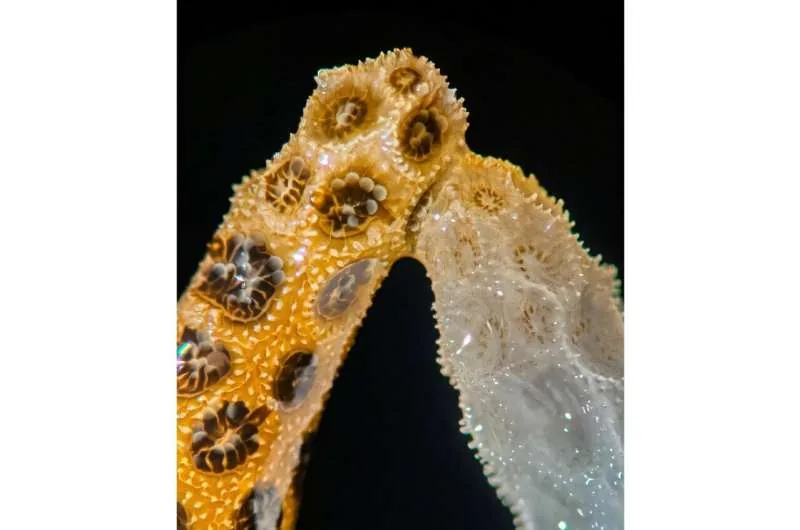
This expulsion leaves behind a translucent animal tissue layer through which the bright white calcium carbonate skeleton shines, a state marine ecologists define as bleaching [2, 3]. Without photosynthetic symbionts, polyps begin to starve and face high mortality within weeks [1, 3]. In related marine research, scientists deployed a deep-sea sensor tracking reactive oxygen species produced by corals to measure how chemical stress escalates inside stressed tissues during elevated water temperatures [1].
Why Do Bleached Corals Need Direct Tissue Contact?
Bleached corals need direct tissue contact because algal symbionts can’t swim freely through open water in quantities sufficient to rescue starving polyps; they require a physical bridge [1, 2]. To test how physical proximity influences recovery, the Stanford team set up controlled experiments with ten pairs of cauliflower coral fragments [1, 3]. In each pair, one fragment was healthy and colorful, while the other was pale and bleached [3].
Five pairs were placed in direct contact, while five pairs were positioned only a few millimeters apart in the same tank water. In the separated pairs, nothing significant happened, and all five separated fragments died within 20 weeks [2, 3]. Proximity alone did not save polyps [2].
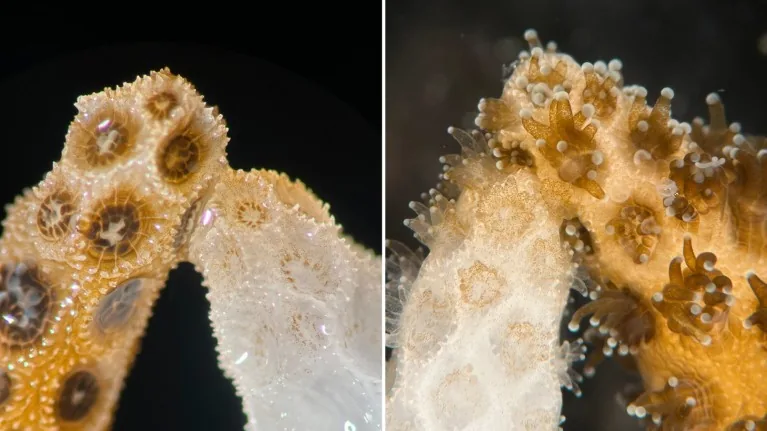
High-powered laser microscopy revealed the biological mechanism behind this contact requirement [1, 2]. After a day or two of contact, the outer living tissues of the two coral branches began fusing together. This fusion created a living tissue bridge that researchers described as a nutrient highway, allowing photosynthetic algae to migrate straight into the depleted coral [2, 3]. The team, who informally dubbed the technique “helping hands,” found that three days of contact was the minimum needed for recovery to start. Five days of contact ensured full recovery, at which point the fragments could be safely pried apart while the previously bleached branch continued to thrive independently [1, 2].


Can Different Coral Colonies Share Symbiont Cells?
Different coral colonies can’t share symbiont cells through contact because host tissues recognize foreign genetic markers and trigger a defensive immune rejection. When the Stanford researchers paired coral fragments from different individual colonies—known as mixed-genet pairings—the pieces refused to fuse their outer tissues [1, 2]. Instead of building a cooperative tissue bridge, the contacting polyps deployed stinging cells called nematocysts against one another. Collins likened this hostile cellular clash to organ rejection in human medicine, where a patient’s immune system attacks transplanted tissues that lack matching biological signatures. Host polyps do not accept strangers. Without cellular fusion, no algal transfer took place, and the bleached partner remained without food [1, 2].
This genetic constraint means that healing only occurred between fragments derived from the exact same genetic individual, or genet. Coral fragments taken from different species, or even from different parent colonies of Pocillopora damicornis, failed to nurse dying neighbors back to health [1, 3]. Clones did not fight each other. Genets do not merge. The incompatibility highlights a clear biological rule governing coral bleaching recovery in natural environments: the barrier to symbiont sharing is not the algae themselves, but the territorial boundaries of the animal hosts [1, 2].
Laboratory Evidence for Bleached Coral Recovery
The pace of recovery observed during the Stanford laboratory trials surprised the researchers [2, 3]. In the touching pairs, bleached coral fragments mounted an undeniable revival, regaining their typical brown pigmentation within eight weeks as algal cells repopulated pale branches [1, 3]. Collins recalled how the team watched the transfer unfold in real time [2, 3]. “We were blown away when we watched the colour of the algal symbionts transfer over to the bleached coral, reviving it in a very short period of time,” Collins said [3].
Microscopic tracking confirmed that the transferred algae quickly settled into their new host’s endodermal cells [1, 3]. Cellular proliferation accelerated once symbiont colonies took root inside the recovering polyps. By the second week of direct contact, the symbiont population was doubling every four days, far outpacing the recovery rates documented in wild ocean ecosystems. Field surveys of wild reefs recovering on their own show that repopulation often takes many months or years, during which weakened corals remain vulnerable to disease and starvation [2, 3].
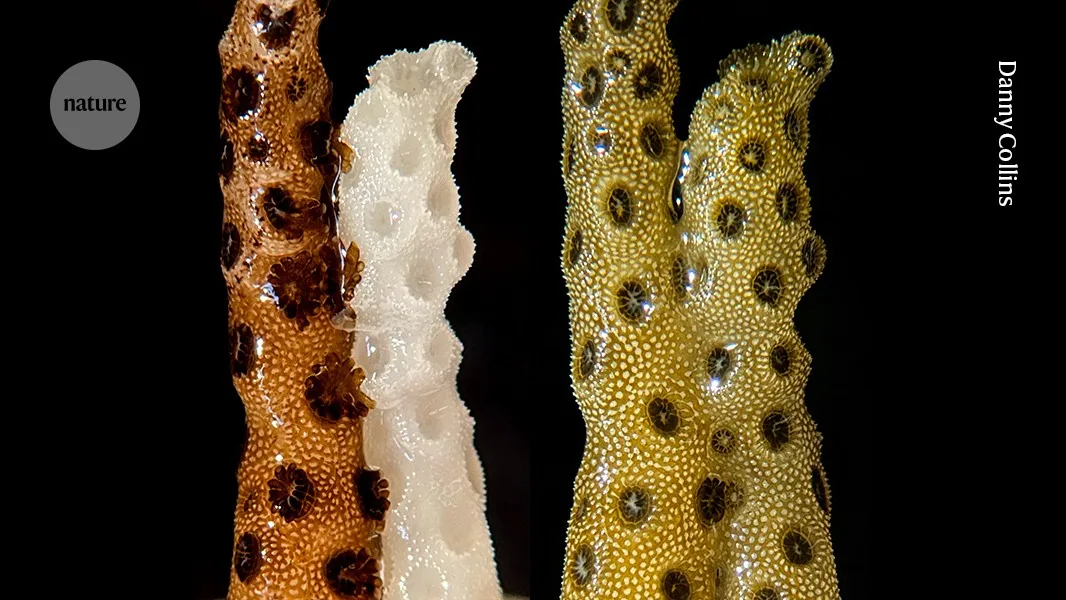
Researchers discovered that after touching a healthy partner for one week, a bleached branch could continue its full recovery independently even after being separated from the healthy donor. This self-sustaining momentum proved that corals only need an initial booster of live cells to rebuild their internal food supply [1, 3].
Translating Coral Bleaching Recovery into Reef Restoration
The central challenge facing marine scientists is translating these laboratory results into practical interventions for wild ocean ecosystems [2, 3]. Coral reefs span hundreds of square kilometers, making contact methods impossible to execute by hand in open water. “We likely will not be touching corals to each other on reefs,” Collins said, pointing out that the vast geographic scale of marine habitats requires different approaches. Large reefs can’t be touched by hand [2].
Instead of moving colonies together, the Stanford team is exploring ways to extract healthy symbionts from heat-tolerant fragments, culture those algal strains in laboratory facilities, and reintroduce them en masse to bleached reefs during thermal events [1, 2]. This culturing strategy offers a biological advantage by bypassing the genetic compatibility barrier. Microalgae carry no territorial bias. While coral animal hosts reject tissues from different genets, microalgae do not carry colony-specific restrictions and can populate diverse hosts without triggering stinging nematocysts [1, 2].
Marine ecologist Fiorenza Micheli, a study co-author at the Stanford University Center for Ocean Solutions, pointed to the broader potential for conservation [1, 3]. “This incredible new result — that fast and full recovery is possible in bleached coral — can inspire solutions that eventually may be scalable,” Micheli said [3]. Collins noted that the experiment was partly inspired by research showing how toxicity levels from ocean plastic debris spread pathogens through touch, prompting his team to test whether contact could transfer health instead of disease. If researchers can deliver cultured symbionts to heat-stressed colonies, wild reefs may recover before starvation sets in [1, 2].
- ACADEMIC JOURNAL Collins, D. S., Sipkova, J., Mollica, N. R., Rolander, T., Klepac, C. N., Calistro, G. F., Barone, V., Micheli, F., & Palumbi, S. R. (2026). Rapid coral bleaching recovery via symbiont transfer from healthy corals. Science Advances, 12(42). [Article Link]
- ONLINE NEWS Ahmed, I. (2026, October 14). Healthy corals restore bleached neighbors’ color after five days of contact. Phys.org. [Article Link]
- ONLINE NEWS Wild, S. (2026, October 14). ‘Incredible’: bleached corals thrive within days when touching healthy neighbour. Nature. [Article Link]
APA 7: TWs Editor. (2026, October 15). Healthy Corals Accelerate Coral Bleaching Recovery in Lab Trials. PerEXP Teamworks. https://perexpteamworks.com/en/coral-bleaching-recovery-touching-neighbors/


