




APA 7: TWs Editor & ChatGPT. (2023, November 5). Correlation Discovered: Hot Jupiters’ Occurrence Tied to Stellar Age. PerEXP Teamworks. [News Link]
In their latest endeavor, the research team aimed to gain a deeper understanding of star systems that harbor exoplanets of Jupiter’s size. Their primary focus was to investigate whether the age of a star system could be linked to the probability of hosting Jupiter-sized planets with orbital periods of fewer than 10 days. These specific exoplanets have earned the moniker “Hot Jupiters” due to their characteristic of closely orbiting their host stars.
Previous studies have indicated that these exoplanets tend to be hotter compared to others with similar compositions, primarily because of the intense heat they receive from their parent stars. Additionally, hot Jupiter exoplanets are characterized by significantly stronger winds, driven by the extreme temperature variations between their night and day sides.
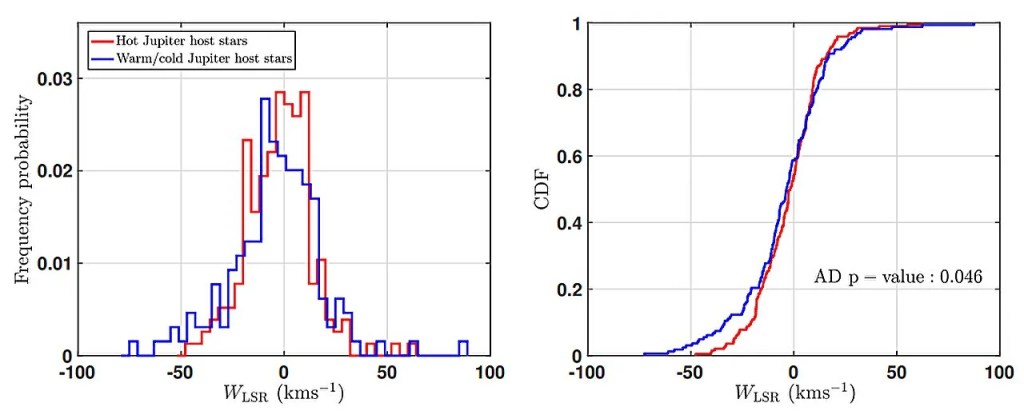
In their quest to uncover the connection between star age and hot Jupiters, the research team gathered and scrutinized data pertaining to 383 Jupiter-sized planets. These exoplanets revolve around stars that closely resemble the sun in size and attributes. Their analysis revealed that hot Jupiters exhibited a higher prevalence around relatively youthful stars, and as star systems aged, the frequency of hot Jupiter exoplanets decreased. Importantly, the researchers did not observe analogous correlations concerning cold or warm Jupiters.
Additionally, the research team observed a decrease in the occurrence of hot Jupiters as their orbits experienced decay, which is thought to result from tidal effects and may ultimately lead to the demise of these planets. Notably, they found that the frequency of hot Jupiters was correlated with the metal content in the host star. This discovery sheds light on disparities in the count of hot Jupiters identified through planetary transit versus exoplanet surveys relying on radial velocity measurements.
Resources
- NEWSPAPER Yirka, B. (2023, November 3). Link found between age of stars and frequency of hot Jupiters. Phys.org. [Phys.org]
- JOURNAL Chen, D., Xie, J., Zhou, J., Dong, S., Yang, J., Zhu, W., Liu, C., Huang, Y., Xiang, M., Wang, H., Zhang, Z., Luo, A., Zhang, J., & Zhu, Z. (2023). The evolution of hot Jupiters revealed by the age distribution of their host stars. Proceedings of the National Academy of Sciences of the United States of America, 120(45). [PNAS]


