



APA 7: TWs Editor & ChatGPT. (2023, October 23). Research Reveals Female Frogs’ Strategies for Fending Off Unwanted Mating. PerEXP Teamworks. [News Link]
Explosive breeding species, exemplified by the European common frog (Rana temporaria), engage in brief and highly concentrated reproductive seasons characterized by fierce competition among males. Conversely, prolonged breeders have extended reproductive periods. In this strategy, males tend to establish and protect their own territories, warding off rival males, and employ mating calls to attract potential female mates.
In the case of Rana temporaria, previous research has produced conflicting findings regarding the ability of unreceptive females to resist unwanted male advances. These advances encompass various behaviors such as harassment, intimidation, and instances of forced copulation, sometimes involving multiple males simultaneously. Recent studies have suggested that females may lack effective means to defend against such aggression, depicting their reproductive behavior as passive. However, earlier research offers a contrasting perspective.

A new study titled “Drop dead! Female mate avoidance in an explosively breeding frog” explores female mate avoidance tactics in Rana temporaria, conducted by researchers from the University of Jyväskylä in Finland and Germany’s Leibniz Institute for Evolution and Biodiversity Science and Berlin–Brandenburg Institute of Advanced Biodiversity Research. This study has been published in the journal Royal Society Open Science.
Building upon their previous research on mate selection in male R. temporaria during breeding seasons, the scientists recorded the mating behaviors of the frogs using video. Their observations and detailed measurements of female avoidance strategies formed the basis for this follow-up investigation.
The researchers discovered that uninterested female frogs employed three strategies to avoid mating:
- Rotating: This involves the female attempting to rotate around her own body axis as the male tries to initiate amplexus by using his hind feet to hinder her movements.
- Release calls: These are vocalizations described as grunts and squeaks produced by females while in amplexus.
- Tonic immobility (Feigning of death): In this tactic, the female stiffens, extending her arms and legs after being in amplexus with a male.
The researchers witnessed all three behaviors in aquatic settings. Interestingly, in one instance, a female displayed tonic immobility during a mating attempt on land.
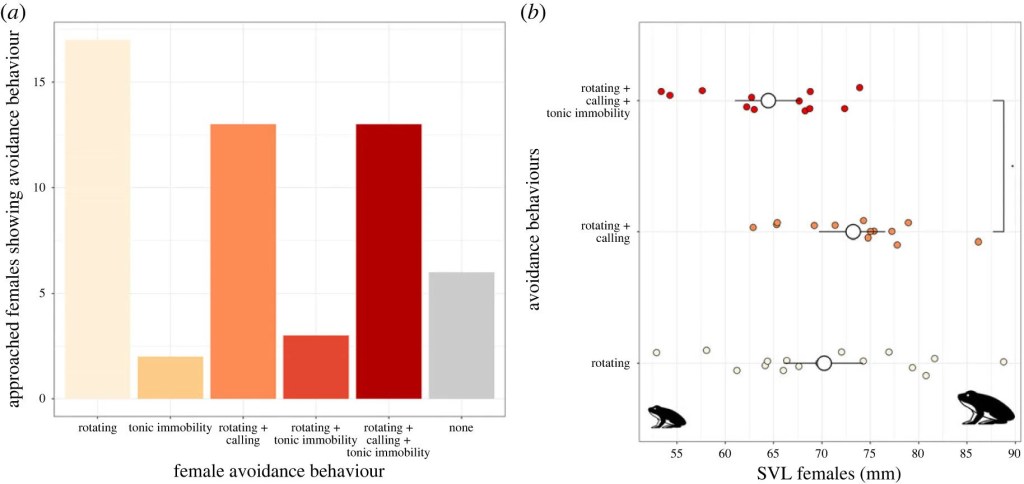
Out of the 54 amplexed females, the study found that 83% of them engaged in rotating either by itself or in conjunction with one or both of the other avoidance tactics. Approximately 48% of these females emitted release calls, but always alongside the act of rotating. Additionally, one-third (33%) of all clasped females exhibited tonic immobility, and within this group, 13 out of 18 cases combined this behavior with rotating and calling.
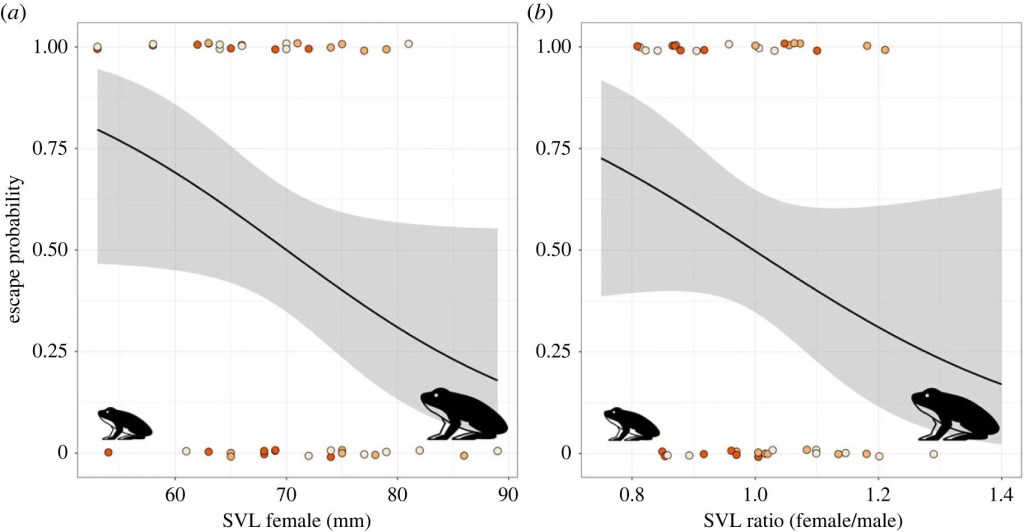
Interestingly, the study revealed that smaller females employed all three avoidance tactics, whereas larger females primarily resorted to rotating paired with calling. Out of the amplexed females who exhibited these behaviors, 46% – a total of 25 frogs – successfully escaped. It’s important to note that smaller females exhibited a greater likelihood of successful evasion.
The researchers offer explanations for the prevalence of rotating as a female mating avoidance tactic, which include:
- Female survival: It’s possible that by spinning, females can push the male underwater, compelling him to release the female to prevent drowning.
- Assessment of male endurance and strength: Rotating could serve as a test of male endurance and physical prowess. This may enhance a female’s chances of surviving the mating season by ensuring that only stronger males eliminate rival suitors attempting simultaneous amplexus.
(b) This graph displays the female-to-male SVL ratio and its correlation with different female avoidance behaviors. In the graph, individual females are represented by dots, with their respective avoidance behaviors color-coded: light orange for rotating, orange for rotating and calling, and red for rotating, calling, and tonic immobility. The dots are slightly jittered for improved visibility.
The researchers propose that the mechanical grip attributes could shed light on why smaller female frogs had an easier time breaking free from amplexus through rotating compared to larger ones. In essence, it might be challenging for a significantly larger male to maintain a secure hold on a smaller female during this maneuver.
Concurrently, tonic immobility, observed in various species across the animal kingdom, might be connected to stress. Previous studies have indicated that increased corticosterone levels in the blood, stemming from stress, could disrupt breeding activities and potentially result in extended periods of tonic immobility.
The researchers noted that smaller females displayed all three behaviors more frequently than their larger counterparts, indicating that factors such as age or experience might contribute to this behavior.
They also highlight that the frequency of multiple males forming “mating balls” with a single female, creating a potentially stressful situation, might induce tonic immobility as a response. Such “mating balls” can be fatal, leading to the drowning of both males and females.
The broader mystery of why female frogs might select or reject particular males as mates remains unanswered.
The research highlights the need to identify the specific traits, whether they are phenotypic or genotypic, that drive mate acceptance or rejection in female R. temporaria. It remains a mystery what advantages and disadvantages, if any, are linked to the females’ choices, as male frogs don’t offer parental care or protect resources that could be of direct benefit to females.
Direct advantages, including the idea that larger or size-matched males might lead to higher fertilization success, have been debunked. Surprisingly, it has been observed that the success of fertilization is not influenced by size assortments.
Nonetheless, it’s evident that the mating dynamics in R. temporaria are far from straightforward, with females actively engaging in the process. The researchers propose that future studies delve into comparing females’ stress corticosterone levels concerning age and sex ratios. Furthermore, investigating how age ratios, sex ratios, and varying frog densities impact mate selection and the associated reproductive risks could provide valuable insights.
Resources
- NEWSPAPER Baum, S. (2023, October 21). New study with video shows how female frogs defend themselves against unwanted mating. Phys.org. [Phys.org]
- JOURNAL Dittrich, C., & Rödel, M. (2023). Drop dead! Female mate avoidance in an explosively breeding frog. Royal Society Open Science, 10(10). [Royal Society Open Science]


great post – thanks !!
Great Read Can i leave my thoughts ?! –
Thanks for reading , Love The Blog !!
Hey there! Came across your post on the WordPress feed and couldn’t resist saying hello. I’m already hooked and eagerly anticipating more captivating posts. Can’t seem to find the follow button, haha! Guess I’ll have to bookmark your blog instead. But rest assured, I’ll be keeping an eye out for your updates!
may i leave a link to my blog here? feel free to post a comment on my site and leave your link 🙂 helps both our sites !!
Hope to see your comment soon 🙂 Pomeranian Puppy Development: What to Expect in the First Year
I reviewed your post, hoping for both of us to improve. Good luck!
hey
lovely blog hope all is well
happy blogging.
Hey there! We absolutely love reading people’s blogs and the thoughtful content that creators like you share . Your authentic experiences contributes to the vibrant online community that we all cherish . Keep sharing and inspiring your audience, because your words can make a significant impact on the world. We can’t wait to see what you’ll create next!
Thanks- Jason http://www.pomeranianpuppies.uk
Thanks Jason : )