





APA 7: TWs Editor. (2023, November 17). Ocean Heat Transfer in North Atlantic Tempers Historical Climate Fluctuations. PerEXP Teamworks. [News Link]
Published in the journal Science, the paper showcases findings derived from North Atlantic sediment records. These records enabled researchers to examine temperature variations in both the surface and deep ocean over the last 1,200 years. By analyzing this data, the team inferred the ocean’s role in facilitating the transfer of heat from the surface to the deep ocean, contributing to the attenuation of historical surface climate changes.
Professor David Thornalley, a co-author from UCL Geography, emphasizes the limitation in direct measurements of deep ocean temperature to the last few decades. These measurements suggest that the deep ocean has been absorbing a substantial amount of heat due to global warming. One crucial mechanism for this heat transfer is through pathways where water sinks from the surface to the deep.
The researchers aimed to explore whether this heat transmission through specific pathways in the North Atlantic has been consistent over the past millennium. This study marks the first instance in which deep ocean temperature during this extended period was measured indirectly. The measurements were taken at a location along the pathway where waters descend to the deep sea.
The research team utilized samples obtained from 11 sediment cores sourced from the region south of Iceland. In this area, cold and dense waters from the Nordic seas experience overflows, sinking and replenishing the deep North Atlantic. These overflow events are integral components of the deep limb of the Atlantic Meridional Ocean Circulation (AMOC), which functions akin to a conveyor belt. The AMOC transports warm surface water northward from the equator and circulates cool deep water in the opposite direction.
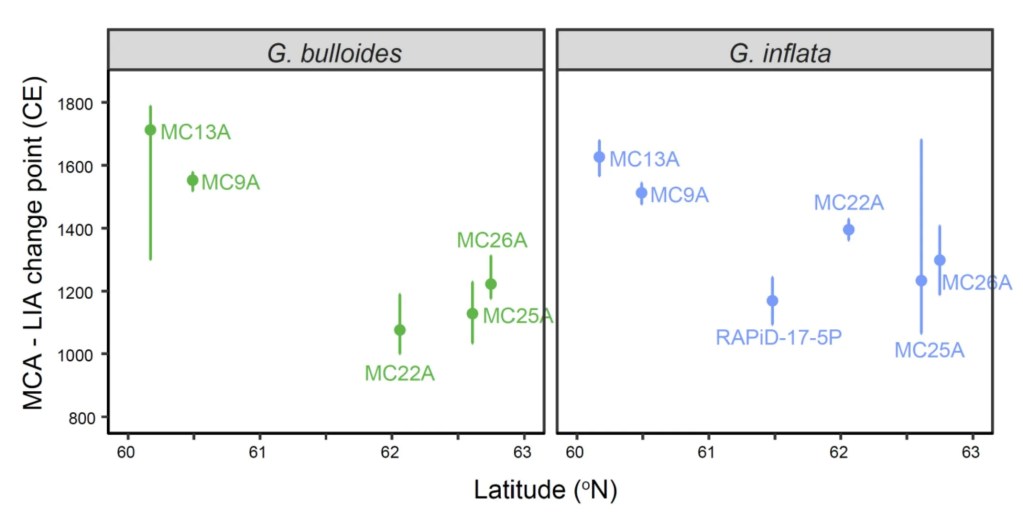
By analyzing sediment cores, the scientists examined the chemical composition of minuscule shell fossils derived from foraminifera. Foraminifera are single-celled organisms that inhabit both surface and deep waters. The examination of these shells provided valuable insights into the environmental conditions of the ocean during the periods when the foraminifera lived and developed their shells.
The sediment data align with recent observations of warming in both surface and deep ocean areas. Importantly, the researcher’s findings indicate a consistent link between the surface and deep ocean over the past 1,200 years.
Dr. Wanyi Lu, the lead author and a post-doctoral scientist at WHOI, asserts that the data obtained strongly substantiates the concept that overflows have consistently facilitated the transmission of surface climate changes to the deep ocean over the course of the past 1,200 years.
Throughout the past 1,200 years, the Earth’s surface climate experienced a transition from the warmth of the Medieval Climate Anomaly (approximately 850-1250 Common Era, CE) to the colder conditions of the Little Ice Age (spanning roughly 1400-1850 CE). The renowned Little Ice Age is characterized by events such as frost fairs on the River Thames and exceptionally cold winters across Europe, which were associated with crop failures.
Nevertheless, the recent study illustrates the mitigating impact of the deep North Atlantic, preventing these climate changes from becoming significantly more severe.
According to Dr. Lu, the research offers substantiating evidence indicating that the deep ocean experienced a cooling trend from the Medieval Climate Anomaly to the Little Ice Age. This implies that the deep ocean released heat back to the atmosphere during this period, thereby mitigating the extent of surface cooling during the Little Ice Age. Importantly, this process mirrors the mechanism, albeit in reverse, that has led the ocean to alleviate contemporary surface warming.
Over the last century, the Earth’s surface has experienced an increase in temperature. Nevertheless, the ocean has played a moderating role in this warming trend by absorbing and retaining over 90% of the surplus heat.
Dr. Delia Oppo, a senior scientist and paleoceanographer at WHOI, emphasizes the critical role of the ocean in influencing climate. Her statement underscores the significance of the ocean’s capacity to absorb heat. She points out that without the ocean’s uptake of heat, the impact of global warming would be more severe than the current situation.
Nevertheless, there are apprehensions regarding the potential deceleration of the conveyor-like circulation of the Atlantic Meridional Ocean Circulation (AMOC).
Professor Thornalley, in his statement, discusses the findings of their recent study in relation to the Atlantic Meridional Ocean Circulation (AMOC). Their prior research at UCL indicated a potential weakening of the AMOC during the 20th century. The current study suggests that if the AMOC was more robust in the past, it likely played a more significant role in transferring heat from the ocean surface to depth. He notes that a potential future weakening of the AMOC could impact how heat is absorbed by the ocean as the climate warms. The study specifically focuses on one aspect, the transmission of heat through the overflow pathway of the AMOC from the surface to the deep ocean. Professor Thornalley acknowledges that as the AMOC weakens, other processes will occur, leading to increased heat storage. The future balance of these various processes will determine the extent of heat transfer and storage in the deep Atlantic.
Resources
- NEWSPAPER Lucibella, M. & University College London. (2023, November 17). North Atlantic circulation found to have reduced historical changes in climate. Phys.org. [Phys.org]
- JOURNAL Lu, W., Oppo, D. W., Gebbie, G., & Thornalley, D. (2023). Surface climate signals transmitted rapidly to deep North Atlantic throughout last millennium. Science, 382(6672), 834–839. [Science]


