




Employing the advanced capabilities of the Karl G. Jansky Very Large Array (VLA), a group of astronomers has unveiled the presence of a millisecond pulsar within the confines of the globular cluster GLIMPSE-C01. This discovery is a pivotal outcome of the VLA Low-band Ionosphere and Transient Experiment (VLITE) and stands out as the inaugural detection of a pulsar in this specific cluster. The details of this groundbreaking observation were unveiled in a paper published on December 18, accessible on the pre-print server arXiv.
Pulsars, celestial objects characterized by highly magnetized, rapidly rotating neutron stars, emit beams of electromagnetic radiation, typically in the form of radio waves, from their poles. Those with the most rapid rotation periods, dipping below 30 milliseconds, earn the classification of millisecond pulsars (MSPs). The prevailing astronomical hypothesis suggests that MSPs are forged in binary systems, originating when the initially more massive stellar component transforms into a neutron star. Subsequently, the neutron star undergoes acceleration through the accretion of matter from its secondary star.
Globular clusters (GCs), owing to their high stellar densities, emerge as ideal locales for the birth of MSPs. The compact nature of these clusters facilitates numerous neutron stars acquiring companions through binary exchange encounters. Such intricate astronomical processes, occurring within the vast stellar tapestry of GLIMPSE-C01, have now come to light thanks to the unprecedented capabilities of the VLA.
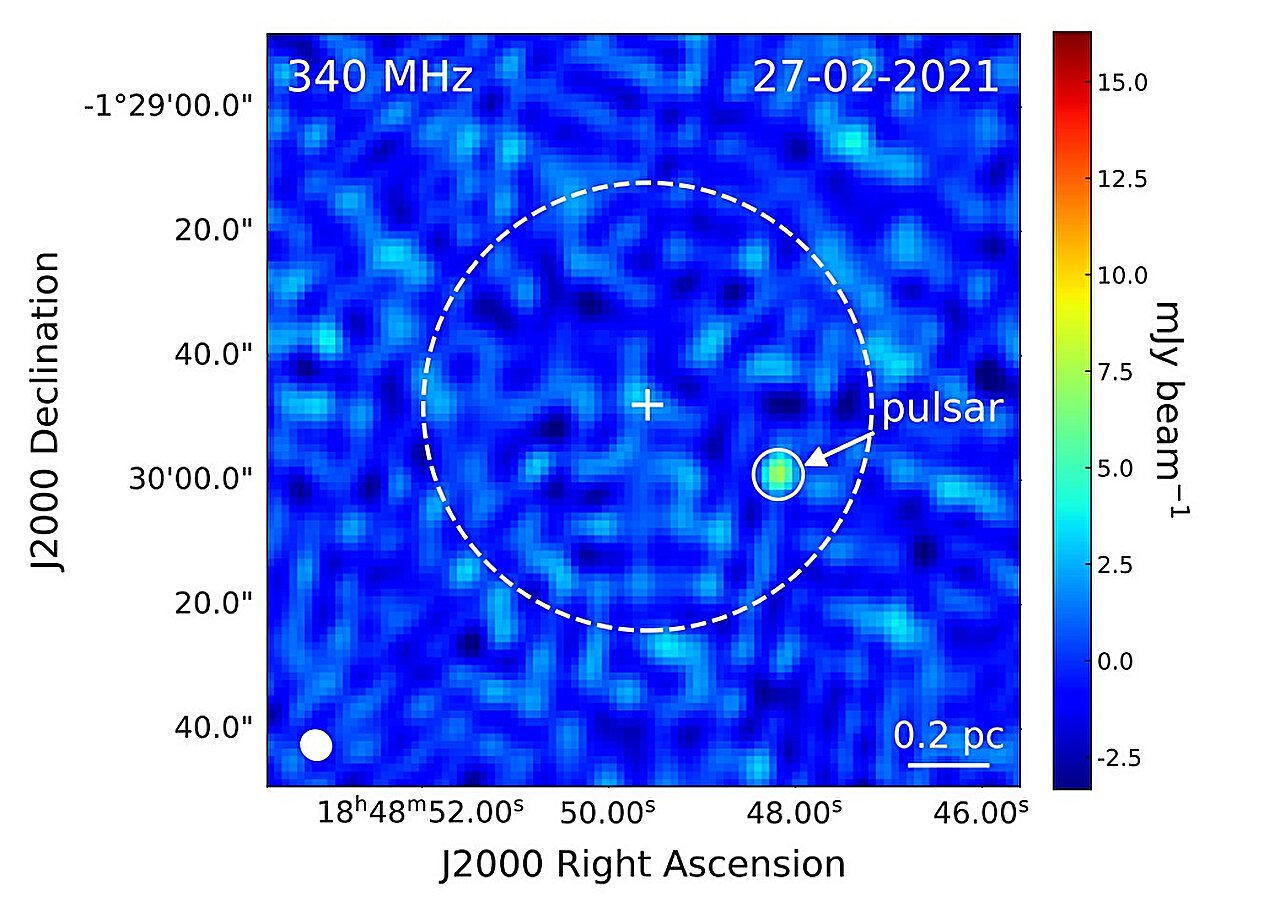
This groundbreaking discovery not only enriches our understanding of pulsar dynamics and formation but also underscores the pivotal role that advanced radio telescopes like the VLA play in unraveling the mysteries of the cosmos. As technology continues to evolve, astronomers anticipate further revelations from celestial bodies within clusters, deepening our comprehension of the intricate interplay between stars in the cosmic arena.
Motivated by the quest to expand our understanding of pulsar populations within the cosmos, a group of astronomers, spearheaded by Amaris V. McCarver from Texas Tech University in Lubbock, Texas, embarked on an ambitious project. Their mission involved conducting an extensive radio imaging search for pulsars across nearly a hundred globular clusters (GCs). To achieve this, the team meticulously analyzed data from the VLA Low-band Ionosphere and Transient Experiment (VLITE) and the VLITE Commensal Sky Survey (VCSS).
In their published paper, the astronomers share the outcomes of this comprehensive search, stating, “In this paper we present a large search for pulsar candidates in globular clusters using low-frequency radio continuum images.” The investigation resulted in the identification of 10 potential pulsar sources from the extensive sample of 97 globular clusters under scrutiny. Subsequently, the researchers conducted a thorough analysis, employing archival and new flux density measurements to determine the spectral index for each identified source.
The standout among the pulsar candidates emerged within the confines of GLIMPSE-C01, a dense and massive intermediate-age globular cluster situated approximately 10,760 light years away from Earth. Notably, this source exhibited an exceptionally steep spectrum, prompting the astronomers to conduct additional analyses using radio, X-ray, and infrared data to validate its pulsar nature.
This significant discovery not only adds to the growing body of knowledge regarding pulsar distributions within globular clusters but also emphasizes the power of radio imaging in uncovering celestial phenomena. By delving into the intricacies of these stellar ensembles, astronomers gain valuable insights into the dynamic processes shaping our cosmic surroundings. The findings, particularly those related to the pulsar candidate in GLIMPSE-C01, contribute to the broader narrative of pulsar behavior and characteristics, paving the way for deeper explorations into the mysteries of our vast and dynamic universe.
The newly identified pulsar, designated GLIMPSE-C01A, has unveiled intriguing characteristics that set it apart within the cosmic panorama. Sporting a spin period of 19.78 milliseconds and a dispersion measure of 491.1 pc/cm3, GLIMPSE-C01A distinguishes itself with a distinctive combination of attributes. Notably, its hard X-ray (2–10 keV) luminosity surpasses that of many millisecond pulsars (MSPs) residing in globular clusters, presenting a remarkable feature despite its comparably slower spin period. This peculiar trait implies the presence of a high magnetic field, estimated to reach an impressive level of 1 billion Gauss. The characteristic age of GLIMPSE-C01A is estimated to be around 100 million years, adding another layer of complexity to its cosmic profile.
In their comprehensive analysis, the researchers underscore the need for regular timing observations and the establishment of an orbital and timing solution for GLIMPSE-C01A. These crucial steps are imperative to unveil additional properties of this pulsar and provide a more nuanced understanding of its behavior and characteristics. This imperative task aligns with the broader scientific pursuit of unraveling the mysteries embedded within the pulsar’s dynamic nature.
The discovery of GLIMPSE-C01A not only enriches our knowledge of pulsar diversity but also serves as a testament to the efficacy of spectral index searches in identifying these cosmic phenomena. The researchers emphasize the significance of such search techniques, underscoring their potential to unveil hidden pulsars and contribute valuable insights to our understanding of the celestial tapestry. As exploration and observations continue, the distinct features of GLIMPSE-C01A promise to deepen our comprehension of pulsar dynamics and magnetic fields, opening new avenues for discoveries within the enigmatic realms of our universe.
Resources
- ONLINE NEWS Nowakowski, T. & Phys.org. (2023, December 30). First pulsar detected in globular cluster GLIMPSE-C01. Phys.org. [Phys.org]
- JOURNAL McCarver, A. V., Maccarone, T. J., Ransom, S. M., Clarke, T. E., Giacintucci, S., Peters, W., Polisensky, E., Nyland, K., Gautam, T., Freire, P. C. C., & Rangelov, B. (2023). A VLITE search for millisecond pulsars in globular clusters: Discovery of a pulsar in GLIMPSE-C01. arXiv (Cornell University). [arXiv.org]
Cite this page:
APA 7: TWs Editor. (2024, January 1). The First Detection of a Pulsar in GLIMPSE-C01 Cluster. PerEXP Teamworks. [News Link]


