



A recent study has reported the successful fabrication of the largest three-dimensional photonic crystal.. Nonlinear photonic crystals are materials featuring a repeating pattern whose optical properties vary with the intensity of the incident light or the strength of the applied electromagnetic field. The larger the photonic crystal, the more responsive it becomes.
This breakthrough enables unprecedented control over light emission and propagation, potentially leading to significant advancements in our understanding of optical phenomena and innovations in telecommunications, medical imaging, and quantum computing.
Despite their potential, creating these nonlinear photonic crystals is challenging due to the chemically inert nature of the materials typically used. This makes it difficult to manufacture and effectively order their photonic crystal structures on an industrial scale.
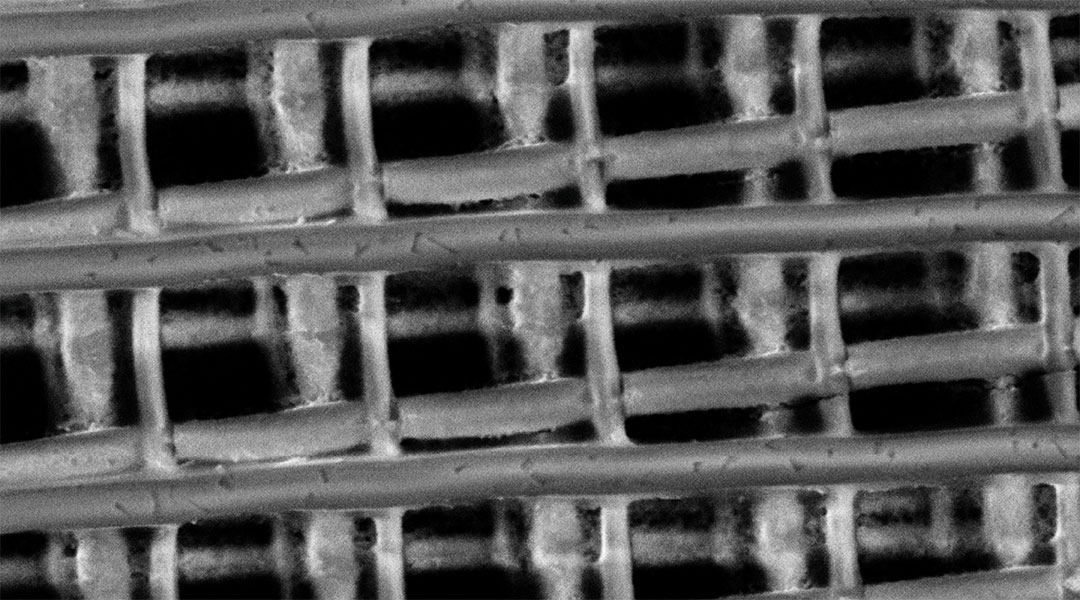
Novel technique for large photonic crystals
The present study investigates innovative methods for producing large nonlinear photonic crystals, addressing the limitations of two common approaches: laser processing and crystal growth from small seeds.
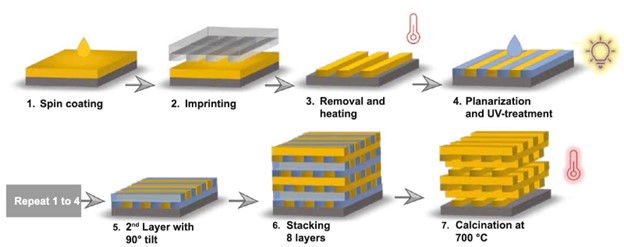
To fabricate their photonic crystal, the researchers used barium titanate, known for its nonlinear optical properties, applying it to a specialized substrate through spin coating. This technique is used to create uniform thin films on flat surfaces.
The process begins with depositing a small amount of liquid coating material onto the center of the substrate, which is then rapidly spun at high speeds. The centrifugal force distributes the liquid evenly, forming a thin layer over the entire surface.
Following this, a micron-sized silicone mold was placed on top of the barium titanate layer to imprint a 2D rod lattice pattern. This patterned layer was then heat-treated to eliminate any solvent, ensuring that the barium titanate remained intact during the subsequent stacking of layers.
The next step involved filling the gaps between the rods with a special substance that facilitates the addition of new layers without disrupting the periodic structure of the previous layer.
After assembling several layers, each rotated 90 degrees relative to the one below it, the setup underwent a final heat treatment to remove all excess material, resulting in the desired woodpile-like structure. High-temperature annealing then transformed the material into polycrystalline barium titanate with a tetragonal phase within the structures.
Using optical and electron microscopy, the research team confirmed that the resulting nonlinear photonic crystal possessed the necessary periodicity to emit light at the correct wavelengths. They determined that the quality of the crystal structure matched what can be achieved through laser processing.
Viola Valentina Vogler-Neuling of ETH Zurich and the University of Fribourg, one of the lead authors of the study, explained that this was the first instance of measuring the periodic variation of light properties in a bottom-up fabricated, three-dimensional nonlinear photonic crystal. She highlighted the significant achievement of fabricating 3D nonlinear photonic crystals that are two orders of magnitude larger than previously possible.
These advancements pave the way for the creation of ultranarrow multi-wavelength and coherent quantum light sources. Such innovations hold promise for breakthroughs in optical sensing, information transfer, and quantum computing, according to Vogler-Neuling.
What’s Next?
While this development marks a significant milestone, the researchers believe there is still room for improvement. The experiment did not achieve perfect precision, as the angle between rods in different layers was not exactly 90 degrees, slightly affecting the crystal’s periodicity. Additionally, minor misalignments between the layers impacted its optical properties. The scientists are confident that these issues can be resolved with more precise equipment.
The team also speculates that materials with an even greater response to electromagnetic fields than barium titanate may exist. Discovering such materials could lead to nonlinear photonic crystals that emit light at the required wavelengths even more efficiently.
- ONLINE NEWS Feldman, A. (2024, June 20). Scientists create the largest nonlinear photonic crystal to date. Advanced Science News. [Advanced Science News]
- JOURNAL Vogler‐Neuling, V. V., Talts, Ü., Ferraro, R., Weigand, H., Finco, G., Winiger, J., Benedek, P., Kusch, J., Karvounis, A., Wood, V., Leuthold, J., & Grange, R. (2024). Large‐Scale Bottom‐Up fabricated 3D nonlinear photonic crystals. Advanced Photonics Research. [Advanced Photonics Research]
APA 7: TWs Editor. (2024, June 20). Largest Nonlinear Photonic Crystal: Unprecedented Control!. PerEXP Teamworks. [Online News Link]


