






Over the past few decades, honey yields in the United States have experienced a notable decline, a perplexing phenomenon that has left honey producers and scientists grappling with uncertainties. In an attempt to unravel the mystery surrounding the diminishing honey production, researchers from Penn State conducted an extensive study, delving into five decades of data spanning the entire country.
Published recently in the journal Environmental Research Letters, the study sought to unearth the factors and mechanisms influencing the abundance of flowers in various regions, subsequently impacting the honey output by honey bees. The investigation unveiled a correlation between the fluctuations in honey yields and the application of herbicides as well as changes in land use practices. The researchers identified a significant connection between the declining honey yields and the widespread use of herbicides, emphasizing the potential adverse effects of these chemicals on the floral resources available to honey bees. Additionally, alterations in land use, characterized by a reduction in land conservation programs supporting pollinators, were identified as contributing factors to the observed decline in honey production.
Moreover, the study highlighted the influence of annual weather anomalies on honey yields. Unpredictable weather patterns and anomalies were found to exert an additional layer of impact on the overall honey output, adding a dynamic element to the complex interplay of factors affecting honeybee foraging and flower availability.
This comprehensive exploration sheds light on the intricate web of elements influencing honey production in the U.S., underscoring the importance of considering not only natural factors but also human-induced changes in land use and agricultural practices. The findings prompt a reevaluation of current approaches to land management and agricultural practices, urging a more sustainable and pollinator-friendly paradigm to ensure the well-being of honeybee populations and the vitality of honey production in the country.
The extensive dataset utilized in this investigation, meticulously extracted from various open-source databases, notably those maintained by the United States Department of Agriculture (USDA) National Agricultural Statistics Service and USDA Farm Service Agency, encompassed a wealth of crucial information. Ranging from average honey yield per honey bee colony to intricate details on land use, herbicide application, climate patterns, weather anomalies, and soil productivity across the continental United States, this comprehensive collection of data formed the bedrock of the researchers’ exploration. As the research unfolded, a nuanced understanding emerged, revealing climate conditions and soil productivity as pivotal elements influencing the estimations of honey yields. The intricate interplay between these two factors, reflecting the inherent ability of soil to sustain crops based on its physical, chemical, and biological properties, proved to be fundamental. Notably, states located in both warm and cool regions demonstrated heightened honey yields when endowed with productive soils, underscoring the intrinsic link between soil quality and honey production.
The research discerned that the eco-regional amalgamation of soil and climate conditions established the foundational benchmarks for honey production. However, the dynamic nature of honey yields was further shaped by a triad of influential variables—changes in land use, herbicide application, and weather patterns. These external factors played a crucial role in determining the annual quantum of honey produced, introducing a layer of complexity to the intricate dynamics of honey bee colonies and their environment.
In essence, the researchers encapsulated their findings by emphasizing the dual nature of influences on honey production. The inherent characteristics of soil and climate formed the bedrock, setting the baseline levels for honey yields, while external factors such as alterations in land use, herbicide utilization, and weather anomalies acted as dynamic forces, modulating the final output in any given year. This comprehensive understanding not only enhances our knowledge of the intricate factors impacting honey production but also provides a nuanced perspective for stakeholders, ranging from honey producers to policymakers, seeking to navigate the complexities of sustaining honey bee populations in the face of evolving environmental dynamics.
Motivated by a recurring sentiment expressed at beekeeper meetings and conferences—namely, the lamentation that “you just can’t make honey like you used to”—Gabriela Quinlan, the lead author of the study and a postdoctoral research fellow supported by the National Science Foundation (NSF) at Penn State’s Department of Entomology and Center for Pollinator Research, embarked on a research endeavor aimed at unraveling the mysteries behind the declining honey yields. Quinlan’s curiosity was piqued by the pervasive notion within beekeeping communities that the honey production landscape had undergone a transformation. The anecdotal observation that honey could no longer be produced with the same ease or abundance as before spurred her to delve into a rigorous scientific investigation. This study, which utilized an extensive dataset spanning several decades and diverse environmental variables, sought to discern the underlying factors contributing to the shifting dynamics of honey production in the United States.
One significant revelation from the research was the increasing correlation between climate conditions and honey yields, particularly evident from the year 1992 onward. The data illuminated the intricate relationship between changing climatic patterns and the production of honey, offering a critical insight into the evolving dynamics of this essential aspect of beekeeping. Quinlan emphasized the uncertainty surrounding the impact of climate change on honey production, while also asserting that the study’s findings could potentially aid in predicting these changes. For instance, the research hinted at the possibility of diminishing pollinator resources in the Great Plains as the climate warms and moderates. Conversely, conditions in the mid-Atlantic region may become more conducive to increased resources due to rising temperatures.
Quinlan’s work not only responds to the anecdotal concerns raised by beekeepers but also contributes valuable scientific insights that may prove instrumental in navigating the challenges posed by climate change on honey production. The study lays a foundation for future research and proactive measures, equipping stakeholders with a more comprehensive understanding of the intricate interplay between environmental factors and the honey production landscape.
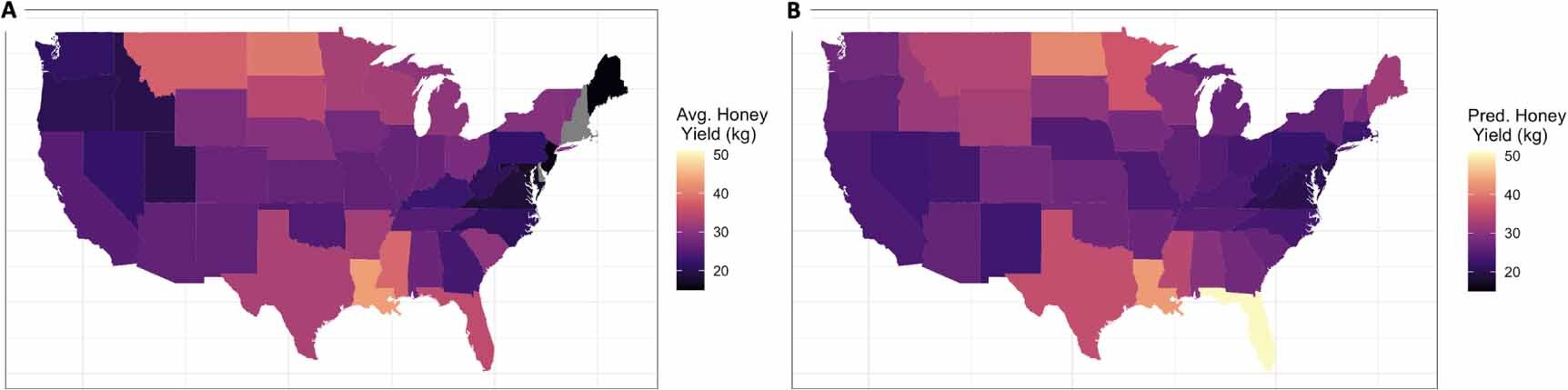
(Environmental Research Letters)
Christina Grozinger, a co-author on the paper and the Publius Vergilius Maro Professor of Entomology, as well as the director of the Center for Pollinator Research, underscored the distinctive contribution of this study in expanding our understanding of the factors influencing flowering plant abundance and flower production. Unlike prior studies that were regionally limited in scope, this research harnessed a remarkable dataset spanning 50 years and encompassing the entirety of the continental United States. Grozinger emphasized the uniqueness of this comprehensive approach, enabling researchers to delve into the nuanced interplay of various factors influencing the availability of nectar for honey bees and other pollinators. The multifaceted analysis considered the impact of soil characteristics, eco-regional climate conditions, annual weather variations, and land use and management practices across diverse landscapes. This expansive scope allowed for a thorough exploration of the intricate dynamics governing the relationship between environmental variables and the availability of crucial resources for pollinators.
The study sheds light on a crucial aspect of pollinator health, highlighting that a significant stressor for these vital insects is the inadequacy of flowers to supply sufficient pollen and nectar for their sustenance. The researchers emphasized that different regions possess unique capacities to support diverse flowering plants, influenced by their specific climate and soil characteristics. This recognition has fueled a growing interest in identifying regions and landscapes inherently conducive to providing an abundance of flowers, thus creating environments that are inherently bee-friendly.
Grozinger’s insights underline the pivotal role of this expansive study in advancing our knowledge of the complexities associated with pollinator health. By examining a wealth of data across the entire continental U.S., the research not only broadens our understanding of the factors influencing honey bee and pollinator well-being but also paves the way for targeted conservation efforts in regions where the availability of flowers can be optimized for the benefit of these essential insect populations. Delving into the intricate dynamics of honey production, lead author Gabriela Quinlan highlighted the central role of flower availability as a primary factor influencing the productivity of honey bees. Given the remarkable foraging abilities of honey bees, adept at collecting nectar from a diverse array of flowering plants and transforming it into honey, Quinlan’s curiosity was sparked by a fundamental question: If beekeepers were witnessing a decline in honey yields, could it be indicative of a broader reduction in floral resources for pollinators? This inquiry led the researchers to scrutinize the environmental factors contributing to this potential shift.
One of the notable revelations from the study, according to Quinlan, was the significant role played by soil productivity—an aspect that has been relatively underexplored in the context of understanding landscape suitability for pollinators. While previous research has often focused on soil nutrient content, the study delved into the impact of various soil characteristics such as temperature, texture, and structure—elements influencing productivity—on the availability of resources for pollinators. This exploration offers a nuanced perspective on the role of soil in shaping the habitats that are conducive to pollinator health.
The researchers also unearthed intriguing insights related to land use changes. The reduction in soybean cultivation and the expansion of Conservation Reserve Program land, a national conservation initiative proven to support pollinators, were identified as factors positively impacting honey yields. This highlights the potential of land management practices to influence the abundance of floral resources and, consequently, honey production. Moreover, the study shed light on the role of herbicide application rates in predicting honey yields. The removal of flowering weeds, facilitated by herbicides, emerged as a significant factor potentially limiting the nutritional sources available to bees. This finding underscores the intricate relationship between agricultural practices, weed management, and the overall health of pollinator communities.
In summarizing the implications of their research, Quinlan emphasized the practical value of their findings. The insights garnered from the study can be applied to refine models, design targeted experiments, and equip beekeepers with the tools to predict honey yields. Moreover, growers stand to benefit from a better understanding of pollination services, while land managers can leverage this knowledge to support the flourishing of plant-pollinator communities and ecosystem services. Ultimately, the study not only unravels the complexities of honey production but also lays the groundwork for informed strategies to enhance pollinator health and foster sustainable beekeeping practices.
Resources
- ONLINE NEWS Bohn, K. & Pennsylvania State University. (2024, January 4). Why are bees making less honey? Study reveals clues from five decades of data. Phys.org. [Phys.org]
- JOURNAL Quinlan, G. M., Miller, D. a. W., & Grozinger, C. M. (2023). Examining spatial and temporal drivers of pollinator nutritional resources: Evidence from five decades of honey bee colony productivity data. Environmental Research Letters, 18(11), 114018. [Environmental Research Letters]
Cite this page:
APA 7: TWs Editor. (2024, January 5). Long-Term Data Analysis Shows Why Honey Production is Declining. PerEXP Teamworks. [News Link]


