



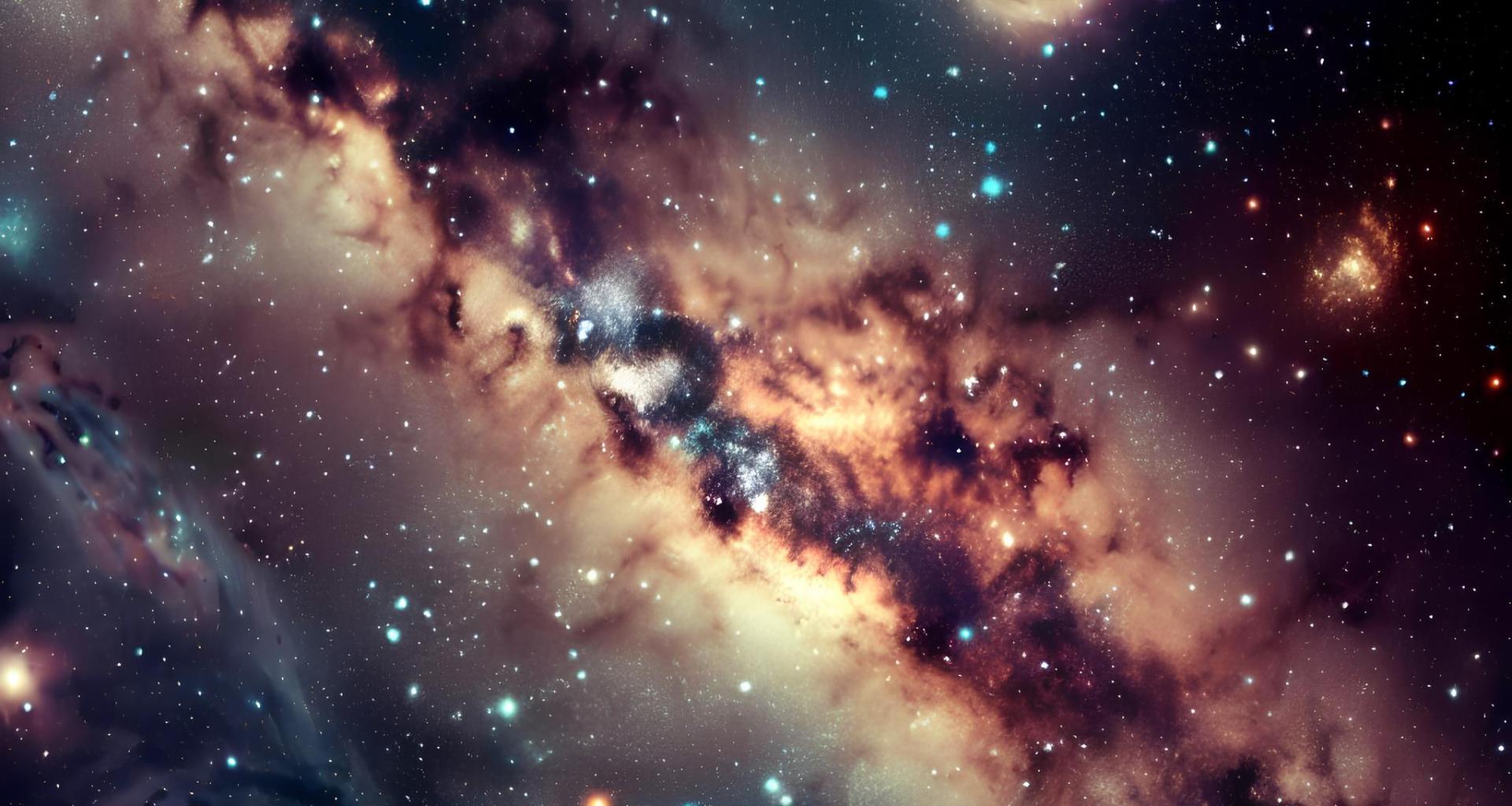
APA 7: TWs Editor & ChatGPT. (2023, September 26). Milky Way-Like Galaxies Found in Early Universe. PerEXP Teamworks. [Article Link]
An international team of researchers, including scientists from The University of Manchester and the University of Victoria in Canada, has made a groundbreaking discovery using the James Webb Space Telescope (JWST). They found that galaxies resembling our Milky Way are prevalent throughout the universe, defying expectations with their surprising abundance.
These galaxies have a deep history in the Universe, with a significant portion of them taking shape over 10 billion years ago or even earlier.
The Milky Way belongs to the category of ‘Disk’ galaxies, characterized by a shape resembling a pancake or compact disk. These galaxies rotate around their centers and frequently feature spiral arms. It’s believed that such galaxies are abundant in the nearby Universe and may be particularly conducive to the development of life, owing to their unique formation history.
Until now, astronomers had held the belief that these galaxy types couldn’t withstand the challenges of the early Universe, an era marked by frequent galaxy mergers that were presumed to disrupt their seemingly delicate forms.
This groundbreaking revelation, detailed in a recent Astrophysical Journal publication, establishes that these ‘Disk’ galaxies are, in fact, tenfold more abundant than previously estimated from observations made using the Hubble Space Telescope.

According to Christopher Conselice, who holds the position of Professor of Extragalactic Astronomy at The University of Manchester: Using the Hubble Space Telescope we thought that disk galaxies were almost non-existent until the Universe was about six billion years old, these new JWST results push the time these Milky Way-like galaxies form to almost the beginning of the Universe.
This research fundamentally challenges the current comprehension of the Universe’s evolutionary processes, prompting scientists to explore new conceptual avenues.
The lead author, Leonardo Ferreira, representing the University of Victoria, commented: “For over 30 years it was thought that these disk galaxies were rare in the early Universe due to the common violent encounters that galaxies undergo. The fact that JWST finds so many is another sign of the power of this instrument and that the structures of galaxies form earlier in the Universe, much earlier in fact, than anyone had anticipated.”

Previously, there was a belief that galaxies resembling the Milky Way, characterized by their disk-like structure, were infrequent across cosmic history and only emerged when the Universe had reached a more mature stage.
Based on our results astronomers must rethink our understanding of the formation of the first galaxies and how galaxy evolution occurred over the past 10 billion years.
Christopher Conselice
In the past, astronomers, relying on data from the Hubble Space Telescope, held the view that galaxies predominantly exhibited irregular and distinctive structures reminiscent of merger events. Nonetheless, the advanced capabilities of JWST have unveiled the genuine structural characteristics of these galaxies, providing a first-of-its-kind revelation.
The scientists suggest that this underscores the idea that the formation of ‘Structure’ in the Universe occurs at a much faster rate than previously expected.
Professor Conselice further elaborates: “These JWST results show that disk galaxies like our own Milky Way, are the most common type of galaxy in the Universe. This implies that most stars exist and form within these galaxies which is changing our complete understanding of how galaxy formation occurs. These results also suggest important questions about dark matter in the early Universe which we know very little about.”
Resources
- WEBSITE University of Manchester News. (2023, September 22). Astronomers find abundance of Milky Way-like galaxies in early Universe, rewriting cosmic evolution theories. University of Manchester. [University of Manchester]
- JOURNAL Ferreira, L., Conselice, C. J., Sazonova, E., Ferrari, F., Caruana, J., Tohill, C., Lucatelli, G., Adams, N., Irodotou, D., Marshall, M. A., Roper, W. J., Lovell, C. C., Verma, A., Austin, D., Trussler, J., & Wilkins, S. M. (2023). The JWST Hubble Sequence: The Rest-frame Optical Evolution of Galaxy Structure at 1.5 < z < 6.5. The Astrophysical Journal, 955(2), 94. [The Astrophysical Journal]


Wow! This is like a breaking news.
Yes, this study is quite new 🙂