



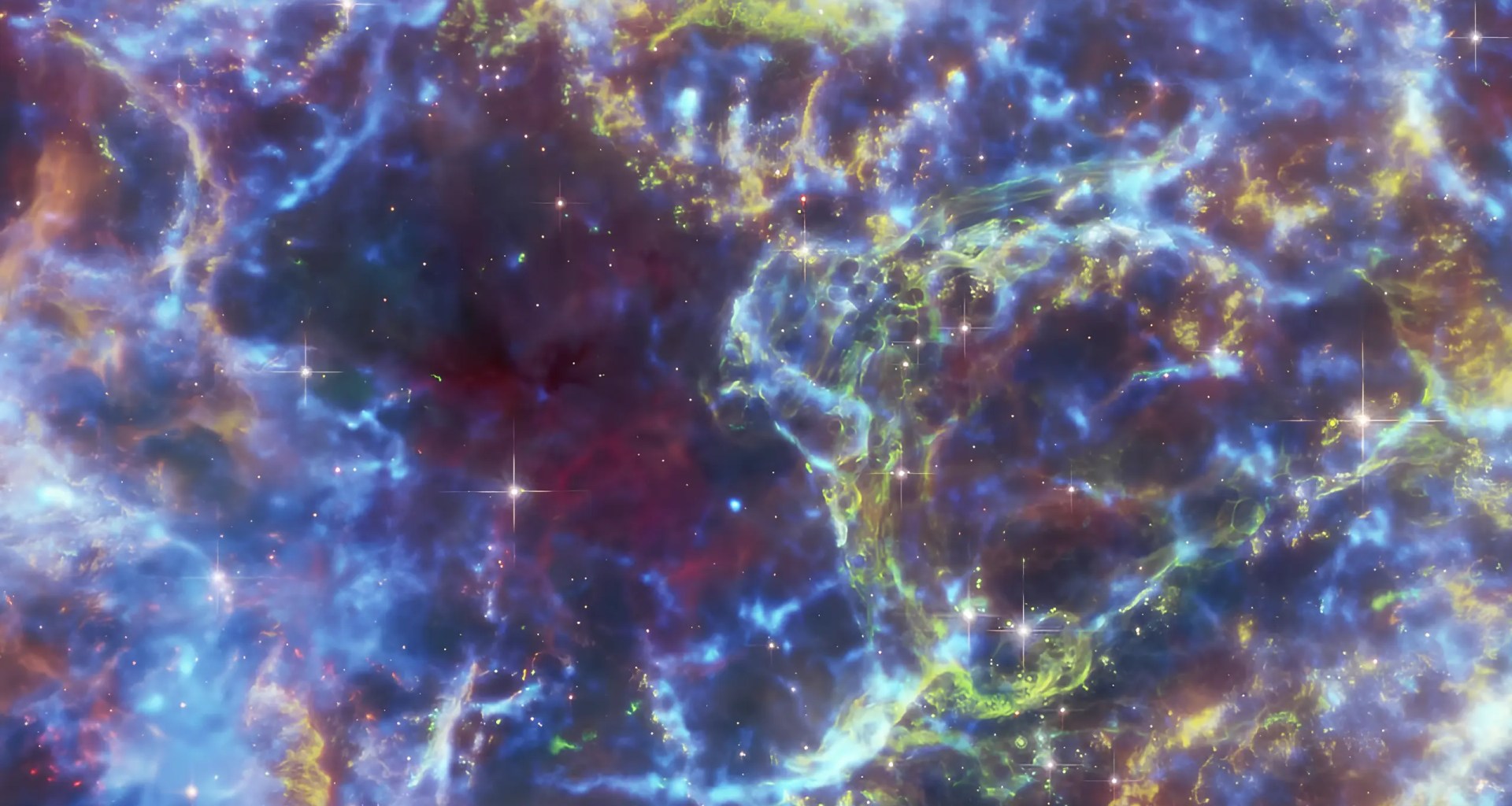
Astronomers may have unraveled a celestial mystery surrounding a peculiar structure within the debris field of the well-known supernova remnant Cassiopeia A (Cas A) by synergizing data from two NASA telescopes—the Chandra X-ray Observatory and the James Webb Space Telescope. This collaborative effort not only provides fresh insights into the remains of the exploded star but also delves into the dynamics of the explosion itself.
The intriguing structure, initially identified in Webb’s infrared data from April 2023 and colloquially dubbed the “Green Monster” due to its visual resemblance to the left-field wall at Fenway Park, had left scientists puzzled about its origin. However, the fusion of Webb’s infrared data with X-ray observations from Chandra has led researchers to believe they have pinpointed the source of the enigmatic Green Monster.
Jacco Vink, leading the Chandra work and affiliated with the University of Amsterdam, stated, “We already suspected the Green Monster was created by a blast wave from the exploded star slamming into material surrounding it. Chandra helped us clinch the case.”
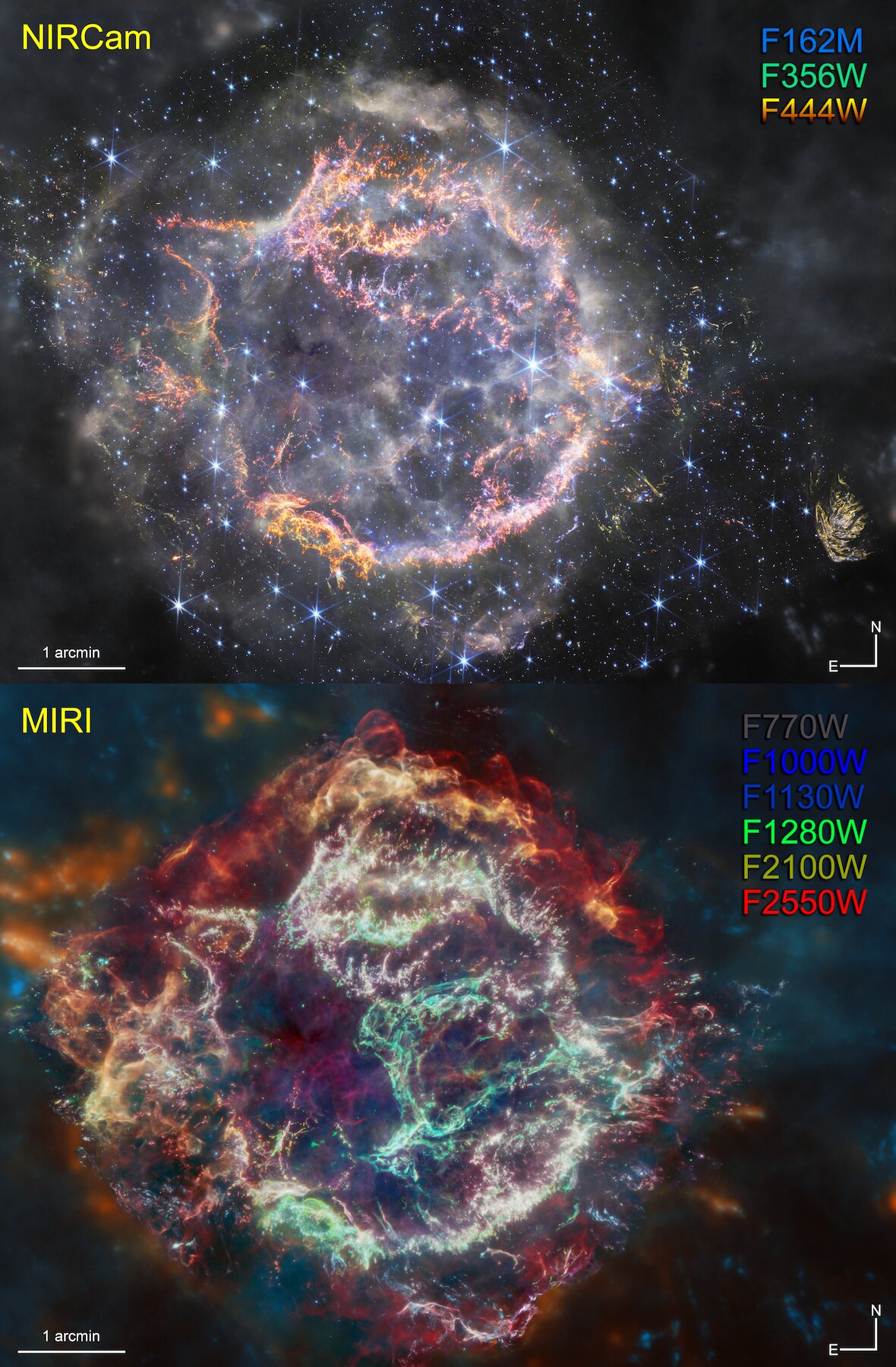
The explosive genesis of Cas A occurred approximately 340 years ago from Earth’s perspective when a massive star underwent a cataclysmic explosion. This event gave rise to a spherical mass of matter and light expanding outward. As the blast wave encountered the outer regions of Cas A, it collided with the surrounding gas ejected by the star between 10,000 and 100,000 years before the explosion. This collision created an environment conducive to the formation of dust as the ejected stellar material cooled down.
This comprehensive study, incorporating data from both Chandra and Webb telescopes, represents a significant advancement in our understanding of the aftermath of supernova explosions, offering a detailed portrayal of the intricate interplay of elements within the remnants of these cosmic events. The integration of these telescopic observations provides the first combined image of Cas A, further enriching our comprehension of the complex processes at play in the vast expanse of our universe.
Examining the intricate tapestry of Casiopeia A (Cas A), Chandra X-ray Observatory data has laid bare a celestial ballet of hot gases, primarily stemming from the remnants of supernova debris rich in elements such as silicon and iron. Additionally, the Chandra observations unveil the presence of energetic electrons engaged in spiraling motions along magnetic field lines within the blast wave, illuminating thin arcs near the periphery of the explosion and manifesting in certain interior regions.
Complementing this dynamic snapshot, the James Webb Space Telescope (Webb) brings its infrared prowess to the tableau, highlighting emissions from warm dust entwined in the hot gases visualized by Chandra. Moreover, Webb captures the glow from much cooler remnants of the supernova, adding layers to our understanding of the aftermath of this cosmic cataclysm.
Amidst this cosmic chaos, the “Green Monster” emerged as a distinct feature in the original Webb image. Researchers, including Jacco Vink and collaborators, conducted a meticulous analysis of Chandra data, revealing that filaments in the outer reaches of Cas A closely matched the X-ray characteristics of the Green Monster. Notably, the Green Monster exhibited lower levels of iron and silicon compared to the surrounding supernova debris, implying a shared origin with the blast wave.
Further insights from Chandra disclosed that the material within the Green Monster is converging towards us, indicating a collision with the star’s expelled gas on the near side of Cas A. This peculiar motion, at about half the average speed of the blast wave, hints at a higher density within the Green Monster compared to the surrounding material—a key clue in reconstructing the intricate history of the star’s mass loss leading up to its explosive demise.
Ilse De Looze from Ghent University, a co-investigator of the Webb study, explained the findings: “We concluded that the Green Monster is also part of the blast wave and is photobombing the central part of Cas A rather than being part of it. We then digitally removed the Green Monster from the rest of the image to learn more about what is behind it.” This analogy of a “completed, 3D jigsaw puzzle” with removable parts encapsulates the researchers’ ability to dissect and unveil the internal layers of this cosmic spectacle, adding new dimensions to our comprehension of the intricate interplay of forces within the remnants of a supernova.
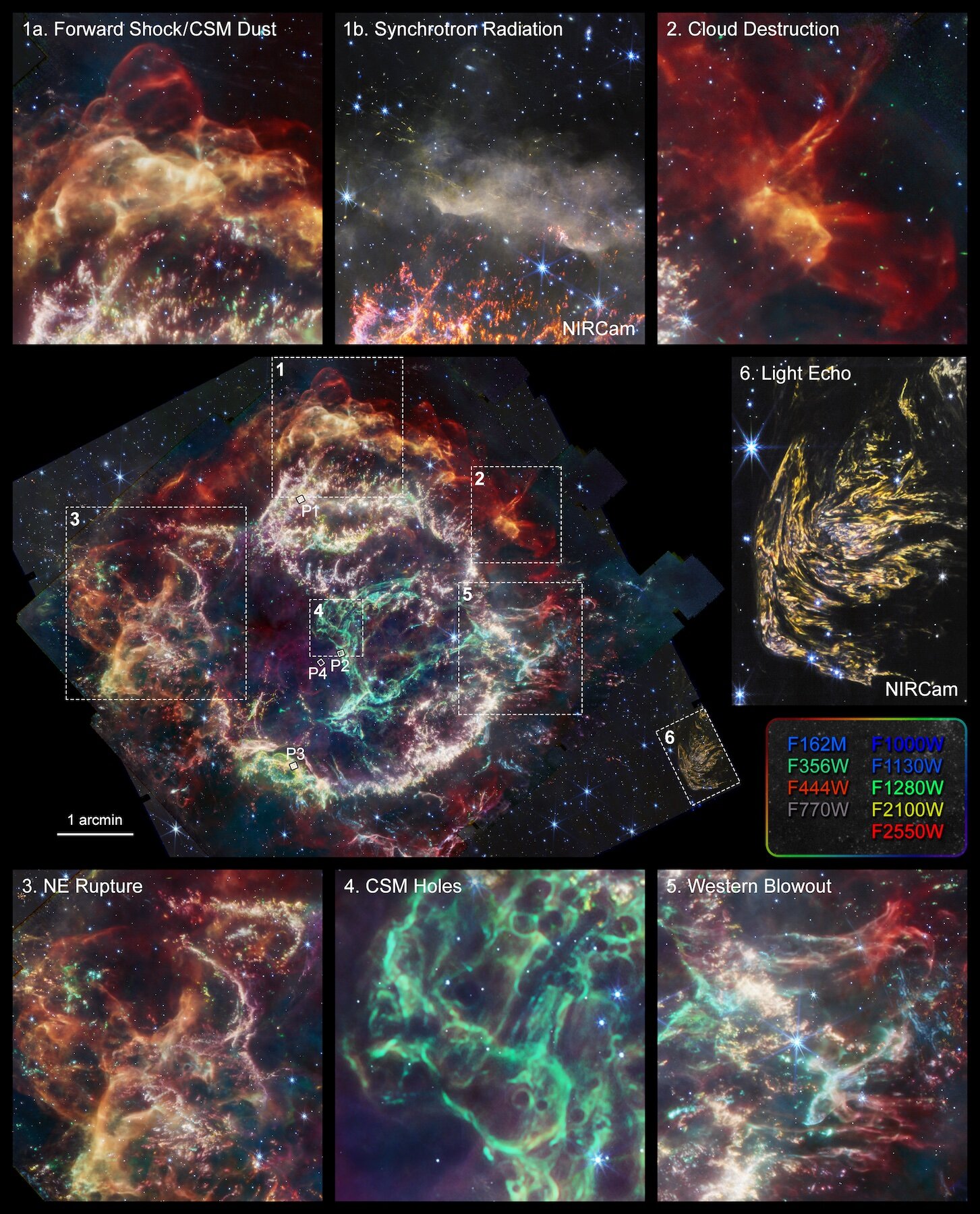
Chandra’s observation of the Casiopeia A (Cas A) supernova remnant captures the aftermath of the star’s explosion by detecting heated debris reaching temperatures in the tens of millions of degrees due to shock waves, akin to sonic booms from a supersonic plane. Complementing this view, the James Webb Space Telescope (Webb) unveils a distinct perspective, capturing “pristine” debris that remains unaffected by shock waves. A substantial portion of this untouched debris lies concealed behind the enigmatic “Green Monster.”
This collaborative synthesis of Webb and Chandra data presents a more comprehensive census of the debris emanating from the exploded star, offering a detailed mapping of the remnants in Cas A. Dan Milisavljevic, leading the Webb study at Purdue University, describes this as the first-ever map of the “web-shaped, pristine debris” at the center of a supernova remnant. This unique structure, unseen in previous observations of exploded stars, adds a new dimension to our understanding of these cataclysmic events.
In their pursuit of unraveling the intricacies of the supernova explosion, the research team compared the Webb view of the pristine debris at the heart of Cas A with X-ray maps showcasing radioactive elements generated during the supernova. NASA’s NuSTAR (Nuclear Spectroscopic Telescope Array) data facilitated the mapping of radioactive titanium—still observable today—while Chandra pinpointed the locations of radioactive nickel by measuring the distribution of iron, as radioactive nickel ultimately decays into iron.
This comparative analysis yielded noteworthy revelations. Filaments of pristine debris, distinctly visible with Webb near the center of Cas A, were found to be connected to the iron observed with Chandra at a more distant location. Additionally, regions exhibiting a weaker presence of pristine debris coincided with the appearance of radioactive titanium. These nuanced findings provide valuable insights into the interplay of elements during the explosive demise of massive stars and offer a more comprehensive understanding of the intricate structures emerging in the aftermath of a supernova. The collaborative synergy between Webb and Chandra contributes to a richer narrative of the complex processes underlying these cosmic events.

Comparisons between the radioactive material detected in X-rays and the pristine debris observed near the center of the Casiopeia A (Cas A) supernova remnant by the James Webb Space Telescope (Webb) suggest a symbiotic relationship. The X-ray data from telescopes like Chandra indicate that the radioactive material has played a pivotal role in sculpting the pristine debris, forming intricate cavities within this central region.
The fine structures discerned within the pristine debris are believed to have originated during a tumultuous phase when the star’s inner layers underwent violent mixing with hot, radioactive matter generated during the collapse of the star’s core under the influence of gravity. These revelations, drawn from Webb’s comprehensive survey data and corroborated by complementary observations from Chandra and other telescopes, contribute to addressing longstanding questions surrounding the explosions of massive stars.
Tea Temim, a co-investigator of the Webb study from Princeton University, emphasizes the broad implications of these findings for our understanding of the formation and evolution of stellar populations, as well as the enrichment of galaxies with metals and dust. The interplay between the explosive demise of massive stars, the resultant debris, and the role of radioactive material emerges as a crucial factor in shaping the cosmic landscape.
These groundbreaking results are detailed in two papers submitted to Astrophysical Journal Letters, with one led by Dan Milisavljevic focusing on the Webb results and the other led by Jacco Vink concentrating on the Chandra results. The collective efforts of the research team, spanning multiple papers, underscore the significance of these findings in advancing our comprehension of the complex processes governing stellar explosions and their broader astrophysical implications.
Resources
- ONLINE NEWS Chandra X-ray Center. (2024, January 9). NASA telescopes chase down “Green Monster” in star’s debris. Phys.org. [Phys.org]
- JOURNAL Milisavljevic, D., Temim, T., De Looze, I., Dickinson, D., Laming, J. M., Fesen, R., … Wheeler, J. C. (2024). A JWST survey of the supernova remnant Cassiopeia A. Astrophysical Journal Letters. [Astrophysical Journal Letters]
- JOURNAL Vink, J., Agarwal, M., Slane, P., de Looze, I., Milisavljevic, D., Patnaude, D., & Temim, T. (2024). X-ray diagnostics of Cassiopeia A’s “Green Monster”: evidence for dense shocked circumstellar plasma. Astrophysical Journal Letters. [Astrophysical Journal Letters]
Cite this page:
APA 7: TWs Editor. (2024, January 9). NASA Telescopes in Pursuit of the Celestial “Green Monster” within a Star’s Debris. PerEXP Teamworks. [News Link]


