






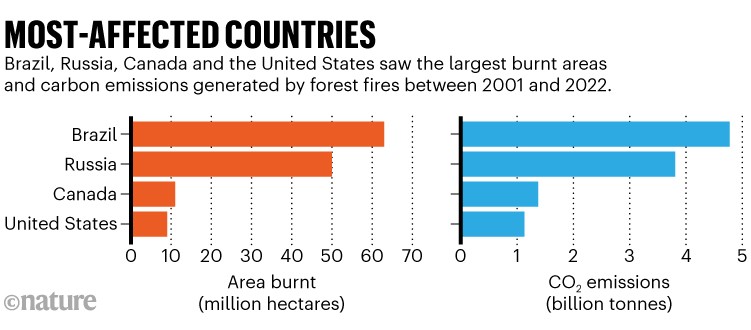
A report from the Chinese Academy of Sciences (CAS) reveals that global forest fires have emitted a staggering 33.9 billion tonnes of carbon dioxide (CO2) between 2001 and 2022. This annual CO2 output surpasses that of Japan, the world’s sixth-largest emitter from burning fossil fuels. The surge in emissions is attributed to the rise in “extreme forest-fire events,” characterized by larger burned areas, prolonged duration, and more significant impacts compared to average forest fires.
The study, led by landscape ecologist Xu Wenru and her colleagues at the CAS Institute of Applied Ecology, identifies a pronounced increase in emissions, primarily driven by intensified fires on the peripheries of rainforests between 5 and 20 degrees south and in boreal forests above 45 degrees north. Boreal-forest blazes, in particular, exhibited a notable and rapidly growing trend.
The researchers attribute the heightened frequency of forest fires to the escalating heatwaves and droughts induced by climate change, creating a feedback loop where CO2 emissions from fires contribute to global warming. Human activities also played a role, with many fires ignited by activities such as building fires for warmth, using fireworks, or discarding cigarette butts.
Meteorologist Zhou Tianjun from the CAS’s Institute of Atmospheric Physics expressed shock at the findings, emphasizing a concerning statistic that the average area burnt by forest fires during the study period was 11 times larger than the forests planted by humans during the same timeframe. This revelation raises questions about the efficacy of tree plantations as a strategy to increase carbon sinks, suggesting that the impact of natural forest fires might offset human efforts in this regard. The intricate interplay between climate change, human activities, and the resulting forest fires underscores the urgency of addressing these interconnected challenges to mitigate their collective impact on global ecosystems and climate stability.
The worst fires ever recorded
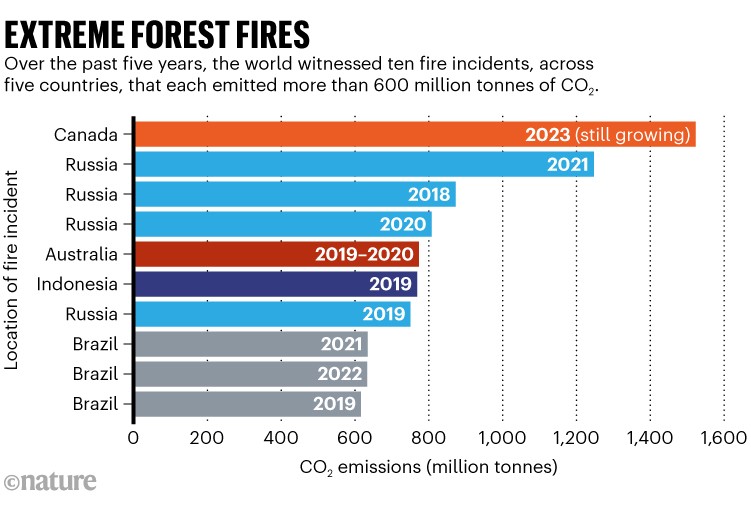
The recent report from the Chinese Academy of Sciences (CAS) highlights ten severe forest-fire incidents occurring between 2018 and 2023, each releasing over 600 million tonnes of carbon dioxide (CO2) into the atmosphere. These extreme events were concentrated in five countries with extensive forest cover: Russia, Brazil, Canada, Australia, and Indonesia.
Canada, home to 28% of the world’s boreal forests, stands out in the report, particularly due to the record-breaking forest fires in 2023. This year, Canada witnessed more than 6,700 fires that ravaged approximately 18.5 million hectares of land, nearly half the size of Norway. The CAS report underscores that the forest fires in Canada this year alone have emitted over 1.5 billion tonnes of CO2 as of October, surpassing the total emissions from all forest fires in the country over the previous 22 years combined.
These findings shed light on the disproportionate impact of recent extreme forest fires, emphasizing the urgent need for global attention and collaborative efforts to address the complex interplay of climate change, human activities, and their cascading effects on forest ecosystems. As the world grapples with escalating climate challenges, the significance of understanding and mitigating the drivers of extreme forest fires becomes increasingly critical for both environmental sustainability and climate resilience.
The impact of forest fires and wildfires is anticipated to intensify globally in the coming decades. Wang Yuhang, an atmospheric scientist and professor at the Georgia Institute of Technology, notes that the recent report aligns with his research, predicting a roughly 20% increase in the global burnt area by the 2050s compared to the 2000s. Particularly noteworthy is the expectation that global fire carbon emissions will double, underscoring the growing significance of fire as a substantial carbon source in the near future.
Wang emphasizes the importance of incorporating carbon emissions from forest fires into national climate plans and advocates for the establishment of a robust monitoring, reporting, and verification system for such emissions. This aligns with the report’s recommendation for countries to consider the role of forest fires in their climate strategies given their substantial contribution to carbon emissions.
Considering the scale of emissions generated by forest fires, Xu Wenru, a landscape ecologist at the Chinese Academy of Sciences, underscores that these emissions have become a significant and unavoidable source of carbon dioxide emissions. As the world grapples with the implications of climate change, recognizing and addressing the role of forest fires in carbon emissions is imperative for developing effective climate mitigation strategies and fostering global environmental sustainability.
Resources
- JOURNAL You, X. (2023). Surge in extreme forest fires fuels global emissions. Nature. [Nature]
- JOURNAL Zou, Y., Wang, Y., Qian, Y., Tian, H., Yang, J., & Alvarado, E. (2020). Using CESM-RESFire to understand climate–fire–ecosystem interactions and the implications for decadal climate variability. Atmospheric Chemistry and Physics, 20(2), 995–1020. [Atmospheric Chemistry and Physics]
Cite this page:
APA 7: TWs Editor. (2023, December 21). Global Emissions Rise as Extreme Forest Fires Increase. PerEXP Teamworks. [News Link]


2 comments