



Introduction
In recent days, Governor Greg Abbott of Texas stated that “Texas is under invasion” and issued a challenge to President Biden. In his statement, Abbott declared a “state of occupation,” alleging that Biden had breached the agreement between the states and the federal government by failing to fulfill his legal responsibilities regarding illegal immigrants. Citing the Constitution, Abbott argued that Texas has the right to protect itself, including the ability to close its borders. Tensions escalated due to the Supreme Court’s decision to remove the barbed wire fences previously erected by the Texas Border Patrol. Consequently, Texas law enforcement took action to ensure border security. In response, Biden gave Abbott a specific period to reverse his decision. Following Biden’s actions, 25 states announced their support for Texas, and Abbott expressed readiness for potential conflict. In summary, there is a dispute between states and the federal government concerning public property.
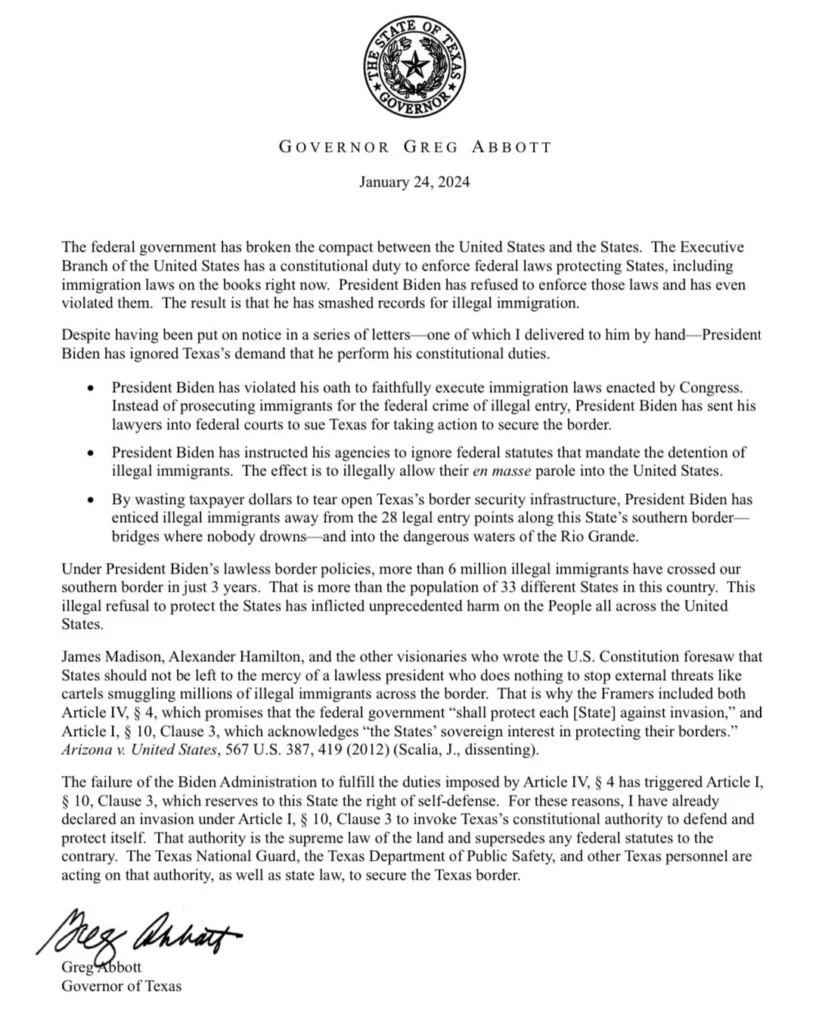
The significant backlash against the federal government in America has also divided American libertarians. The minority group expressed its support for Texas, while the other group argued that Texas committing a crime against humanity by closing its borders and advocated for an open border policy as the ethically correct stance.
Of course, there can be many interpretations of the issue at hand. However, before delving into questions of federal allegiance or the status of borders, this issue is fundamentally a problem of public property. When a property is owned by everyone—or, in other words, by no one—it undermines the legitimacy of decisions concerning that property. The crisis sparked by Texas is an empirical example of the consequences that can arise from the problem of public property. The decision conflict arising from public property—that is, indecision—has led to this crisis. While not a major crisis in American history, this crisis serves as a notable example of why public property can be problematic.
The problem of public property, in its simplest form, concerns the ownership and decision-making related to public property. Of course, “public” is a broad concept. Followers of Kropotkin and his school consider all property belonging to the entire community as public property. For Fabian socialists, property seized by the state through nationalization is considered public property and is owned by the state, or at least decisions are made by the state. On the opposite end of these collectivist views lies the individualist perspective. We will focus our discussion on the internal conflicts of the individualist side.
It is thought that the active role of the state in public property is a necessity

Taking the individualist stance in the border policy debate is challenging. This is because both sides involve people, and erecting a wall between them constitutes state intervention. If you advocate for non-interference in people’s lives by the state, you’ll need to exert considerable effort to avoid contradiction when defending the construction of a wall between two border towns of the United States and Mexico, which are closely intertwined. These distinctions are often easily made by statist thinkers. However, for libertarians, this justification isn’t as straightforward. Because it’s not easy, those who make this justification have often been accused of inconsistency. A significant effort was made on this issue in the early 2000s by Hans-Hermann Hoppe. Before Hoppe, these ideas had been expressed by Rothbard, but Hoppe systematically destroyed – or tried to – and provided justification for the open border paradigm, which was a great taboo in libertarianism.
Although Hoppe broke a significant taboo, he found himself caught in another. This taboo dictated that the state must necessarily play a role in border control. As Zoey Poll points out, this taboo is upheld by both poles of American politics. 1 Anti-immigration advocates already accept and advocate for increased state control. However, according to Poll, even immigration activists are concerned not with whether border protection should be carried out, but with how it should be done. This observation indicates the existence of a definite paradigm. Hans-Hermann Hoppe seems to have become part of this paradigm as well.

While libertarians generally prefer to steer clear of politics and engage in the struggle at an intellectual level, Hoppe appears to be quite influenced by politics as a result. However, we are not concerned with everyday politics. In our discussion, the term “state” refers not to the government or public system of any country but to the abstract concept of the state in political philosophy.
Of course, Hoppe’s defense of restricted immigration was not accepted by everyone. Another important thinker, Walter Block, opposed this. According to Block, the libertarian stance should be to support an open border policy, that is, to advocate that the state do nothing. This is how the most important and influential debate of 2000s libertarianism emerged. Various thinkers have sided with Block or Hoppe at various times. But we are not trying to make a chronological order. We aim to summarize the arguments of the two main names of the debate and make a small assessment of consistency. We find it appropriate to start with Hoppe first, as he is on the more unexpected side. But before moving on to Hoppe’s theoretical defense, we must draw boundaries, as we will be performing a libertarian consistency test.
Extent of consistency test
According to Hoppe, we can summarize the most important conditions of libertarianism as follows: a foundation created by private property and the non-aggression principle (for a more detailed examination, see Getting Libertarianism Right, pp. 23-30). The reason for private property being foundational is the scarcity of resources, which necessitates distribution. In this distribution process, for unowned property to become private property, someone must mix their labor with it. This is John Locke’s theory of property acquisition and holds significant importance in the general libertarian -or Rothbardian- understanding. Once property becomes owned, it can be transferred to others through exchange. However, exchanges must be non-conflicting. Any exchange or seizure that occurs without the consent of the property owner violates the non-aggression principle and is therefore illegitimate. Our consistency test will be developed based on these two fundamentals.
Hoppe’s position on the public property debate: Restricted immigration
To understand Hoppe’s side in the debate, we must first understand how he views public property. On public property, Hoppe writes: ”Public property is the result of State-government confiscations—of legislative expropriations and/or taxation—of originally privately owned property. While the State does not recognize anyone as its private owner, all of government controlled public property has in fact been brought about by the tax-paying members of the domestic public. Austrians, Swiss, and Italians, in accordance with the amount of taxes paid by each citizen, have funded the Austrian, Swiss, and Italian public property. Hence, they must be considered its legitimate owners. Foreigners have not been subject to domestic taxation and expropriation; hence, they cannot claim any rights regarding Austrian, Swiss or Italian public property.” 2 Here Hoppe is explicitly referring to the Lockean appropriation of property, which we know he already accepted. 3
For example, the properties of the Austrian state are financed by Austrians; the state produces nothing and if there is any labor that could be claimed to be mixed with the goods, it belongs to the citizens. He then continues: “Recognizing the moral status of public property as expropriated private property is not sufficient justification to reject the open border proposal as a moral outrage. It is equally sufficient to combat the current semi-open “affirmative discrimination” immigration policies of Western welfare states.” 4 Here, he means that the ownership mentioned in the first quote is a type of private property, and therefore, border violation would be based on violation of private property, hence illegitimate.
For example, the properties of the Austrian state are financed by Austrians; the state produces nothing and if there is any labor that could be claimed to be mixed with the goods, it belongs to the citizens. He then continues: “The recognition of the moral status of public property as expropriated private property is not just sufficient grounds for rejecting the open border proposal as a moral outrage. It is equally sufficient for combating the present semi-open “affirmative action” immigration policies of the Western welfare States.” Here, he means that the ownership mentioned in the first quote is a type of private property, and therefore, border violation would be based on violation of private property, hence illegitimate.
This legitimacy debate extends back to the modern state, and Hoppe states: “(…) the modern State’s legitimacy is derived from its claim to protect its citizens and their property from domestic and foreign invaders, intruders, and trespassers.” 5 This thought is clarified further by Stephan Kinsella’s explanation: “What I am getting at is that the state does own many resources, even if (as I and other anarcho-libertarians believe) the state has no natural or moral right to own these things. Nonetheless the state does own some resources — roads, ports, buildings and facilities, military bases, etc. We can allow that a road, for example, is actually, or legally, owned by the state, while also recognizing that the “real” owners are the taxpayers or previous expropriated owners of the land who are entitled to it.” 6
Based on the fact that the state is physically the owner of certain things in one way or another, Hoppe uses the example of a secured site to clarify the state’s role in border policy. According to this, if the state adopts an open border policy, it should act like the security of a secured site. In other words, it should track the person entering until they reach their destination. 7 The understanding from this example is that the right of passage is possible; Hoppe does not advocate for a completely closed border. Rather, he opposes foreigners settling in the country illegally, accessing resources, and receiving assistance from the state. 8 According to him, immigration can only become legitimate when welfare programs are abolished and free trade is adopted.
Here, Hoppe completely rejects protectionism, which imposes restrictions on the passage of commercial goods across borders, stating that goods should be completely free to cross borders. Then he makes an analogy to oppose: if goods can freely cross the border, how can we justify preventing the passage of people? After all, both will benefit someone inside; goods will be used, and people will produce value. Thus, the fundamental basis of Hoppe’s border policy revolves around these two questions or thoughts.
The objection to welfare programs we previously discussed is based on the premise that if the modern state – either directly owning citizens’ property at the time or acting as their agent – it should not make any decisions that would harm the citizens. When each citizen fully owns their property, they will prioritize their own interests in every contract they make. Therefore, the state should do the same. Every immigrant who enters the country and settles, if they benefit from welfare programs, will, ceteris paribus lower the standard of living of the native citizens who are recognized as the true owners of public property. This situation, which is not in the interest of citizens, should not be implemented by the state, and the cost of immigrants should not be paid by the citizens.
According to Hoppe, imigration can be legitimate even with welfare programs and trade as they currently exist. This legitimacy would be ensured if all the costs of the immigrant are borne by a private property owner inside the country. Similar to the justification for free trade, if a good is ordered from abroad by a private property owner and responsibility is assumed, it enters the country. Thus, just as trade is inherently a process based on mutual agreement, it should be free. If imigration is to be free, like trade, it should be demanded by a private property owner inside the country.
Public property, by its nature, belongs to everyone, so decisions should be made with the individual approval of each person. However, this is not feasible or too cumbersome. Therefore, a decision that will concern and burden everyone should not be made, and borders should be kept closed to illegal imigration. This decision is legitimate if it concerns only one person who consents to it. At this point, we must keep in mind that Hoppe thinks like a complete politician or ruler at the top of a democracy.
Of course, it should also be taken into account that Hoppe mostly made this argument for high-wage regions. His basic assumption is that there will be a imigration trend from low-wage areas to high-wage areas. 9 Hoppe fundamentally opposes utilitarian arguments. He argues that the high-wage region does not always benefit from immigration. In his view, if immigration were allowed, “the capital stock that high-wage regions have accumulated over time and with difficulty will be plundered, welfare costs will skyrocket, and civilization will vanish as it once did in Rome and Greece.”
In summary, Hoppe’s immigration policy can be outlined as follows:
- The reason for not having completely open borders is that, ceteris paribus immigrants entering the country might benefit from welfare programs, thus lowering the standard of living for native citizens.
- People to be admitted should be allowed in if they are sponsored by someone inside the country and invited, without imposing an extra burden on the populace.
- Open borders could be considered only if tax-funded welfare programs are terminated and free trade is adopted.
Nevertheless, it is important not to forget that Hoppe’s debate on open borders is a classic libertarian debate. His criticism fundamentally targets the welfare states of our era. The primary mistake, according to him, is tax-funded welfare programs and increasing centralization. While Hoppe’s perspective is accepted within libertarian circles, Walter Block has argued that Hoppe is inconsistent on this issue. Block alleges that Hoppe uses the statism and centralization he criticizes and demands that the state do something. 10 However, it’s important to consider Block’s criticism of Roderick Long.
The problem with public property, according to Block, has never been fully understood. According to Block, many thinkers see public property only as a type of private property collectively owned by a community, and Hoppe is one of them. 11 Block’s criticism rests on these two foundations. His criticism is noteworthy for pointing out inconsistencies and constitutes the primary basis of his thought.
Walter Block’s position on the public property debate: Open borders
Let’s start by defining Block’s thought, highlighting the points where he agrees with Hoppe. Like all libertarians, Block’s fundamental problem is the existence of public property. He illustrates this using the example of a library. 12
Imagine a bum causing a disturbance in the library. What will be done about this vagrant? If the library is private, meaning it has an owner, the owner can throw this person out. Alternatively, if they allow the person to stay inside, customers may leave, leading to bankruptcy. 13
The critical point in the example is whether the library has an owner or not. If there is an owner, there will be no dispute in managing the library, and the problem can be easily resolved. But what if it’s not private, so a public property? Here, Block takes a radical stance; he argues that public property doesn’t have any owner, and therefore no decision can be made. Referring to Lockeian property acquisition, he states that these properties are unowned and can be claimed by the first settler.
However, according to Simon Guenzl, Block eventually changed part of his stance. 14 In later writings, Block says that public property is “not unowned” and acknowledges that the state is the de jure owner. He adds that he agrees with Kinsella on this point. The previous quotes should not lead to the misconception that Kinsella is a restricted immigration advocate. On the contrary, Kinsella clarified the issue more deeply because he believed he was misunderstood, stating that he is a supporter of open borders. 15
Block’s stance is clearly the opposite of Hoppe’s position. Like Hoppe, he acknowledges that public property has a controversial status. However, unlike Block, Hoppe legitimizes the state’s position as an uninvited caretaker due to its physical ownership of the property. According to Block, the state has no moral right to property, so this is an illegitimate ownership – in other words, unowned. Both agree on the point that public property is expropriated by taking it from private owners. The point where Hoppe and Block sharply diverge is the legitimacy of the state’s caretakership.
Block tries to further clarify his position by giving an example of a stolen bicycle. Imagine individuals A and B and a mafia. The mafia steals person A’s bicycle, and person B retrieves the bicycle from the mafia. In this case, who should own the bicycle? According to Block, B’s action should be to return the bicycle. 16 However, if B does not return the bicycle when A refuses or accuses him, they cannot be classified as a thief because they did not forcibly take the bicycle from its rightful owner. To explain further, this example is developed to illustrate the situation where the state expropriates private property.
So, when private property is expropriated, it rises to a state of unowned or illegitimate ownership. In other words, the property is open to acquisition by anyone, and all decisions made regarding it until it is claimed are illegitimate. Returning it to its rightful owner or being taken by them is the correct and desirable outcome, but if that’s not possible, claiming it is not theft. And Hoppe seems to agree with this view at a fundamental level. According to Hoppe, public property should be immediately privatized; at that moment, the property is unowned, and if the legitimate owner cannot prove that the property was stolen or cannot be found, it should belong to those who have invested labor in it (see De-Socialization in a United Germany, 1991).
The privatization of unowned property leads us to the Blockian Proviso. One of the most significant reasons for Block’s advocacy of open borders is that restricting border crossings prevents the appropriation of unowned land. According to this, anyone who wants to claim unowned land should have the right to cross any border at any time (for more information, see The Blockean Proviso, 2007). Block analyzes this through private property owners, but it’s also possible to apply the Proviso in a primitive form to border discussions. Private property owners are, of course, the primary decision-makers until someone rejects the fundamental principle of ownership. As Kinsella said, “libertarians hate unowned land.”
Starting from Block’s assessments, it’s possible to argue that emphasizing the necessity of the state’s active decision-making is morally equivalent to viewing the state as a legitimate owner. Isn’t making judgments about the decisions made by someone who is not morally legitimate ownership tantamount to recognizing them as a legitimate owner? After all, we assume that ownership is a primary requirement for making decisions – or at least Hoppe assumes so (to better understand Hoppe’s assumption and to evaluate any potential contradictions, see Socialism and Capitalism, pp. 27-33). If, as Hoppe claims, decisions and ownership are a priori related, then the decisions of the state must also require legitimate ownership.
Block’s some specific arguments against Hoppe
Block applies a simple reductio ad absurdum against Hoppe’s arguments. According to Block, Hoppe contradicts himself. We won’t analyze all of Block’s criticisms; instead, we will present arguments that seem logical and consistent to us and aim to identify contradictions.
We’ve discussed how Hoppe sees the state as a caretaker on property. Like Block claimed, Hoppe views public property as a kind of private property. Therefore, he argues that the state, or the rulers, should act as private property owners. However, private property owners are not only concerned with who enters and exits their property. Rather, they deal with a wide range of usage details that concern every part of their property. Here, Guenzl poses the question: If the state should act like a private property owner, why advocate this only for border policy? 17 This is a really critical and key question.
Hoppe rejects welfare programs, meaning he does not want state interventions or regulations in the economy. However, if the state were to mimic a private property owner, it would need to involve itself in all these aspects. Anthony Gregory and Block also emphasize this: Although Hoppe and others have argued that free immigration, for cultural and political reasons, will ultimately lead to bigger government and more statism than restricted immigration, it is vastly problematic to allow and empower the state to protect the borders and enforce immigration laws in the hope that the state will do so in a manner that limits its future size, expense, and power. 18
Hoppe anticipates this criticism and responds as follows: “free trade and illegal imigration are not the same, as goods are the result of mutual agreement in trade, while illegal imigration is not a contract.” 19 Because restricted imigration is contract-based, Hoppe’s claim is internally consistent but leaves him vulnerable to state expansion.
Additionally, if Hoppe’s belief that democracies will always make bad choices is justified (see “Democracy: The God That Failed,” 2001), then the leaders chosen by democracy should not be allowed to interfere with people’s freedom of movement. Once the state is given authority, bureaucrats will not only sit at the border and control crossings but will also strive to make the state’s active role effective in every aspect of life. Historical processes have proven this.
The Irish Problem
The Irish Problem is a pro-immigration argument developed jointly by Walter Block and Gene Callahan, with the original idea credited to Callahan. It focuses on the contradictions in Hoppe’s proposition that only immigrants invited on specific terms are legitimate. The problem is divided into two parts: the first part analyzes immigration through a hypothetical scenario in the United States, while the second part discusses Hoppe’s concept of “restricted immigration.” Given our main focus, we will address the second part of the problem.
Imagine two Irish couples who migrated to America before the establishment of social welfare institutions. 20 The first couple decides to have 10 children, while the second couple does not want children but invites 10 relatives to the United States. According to Hoppe, the migration of the relatives is legitimate as long as the invitees assume the costs. Now, let’s imagine that the relatives settle in America, and the children of the other couple start to reach their teenage years. Will these people stay on the private -their relatives’- property of the invitees all day long? This is where the problem begins for the Hoppean perspective. According to Hoppe’s view, new individuals brought through invitations or children who have already started their lives on those lands should not leave private property.
However, their departure is inevitable. Regardless of the situation with the relatives, it is not possible for the children to stay indefinitely. When they leave the property, they will use public roads and benefit from various other services. As a result, those who harbor resentment towards the Irish may do everything in their power to make life difficult for them. This could force immigrant Irish to live in Irish neighborhoods and only interact with other immigrants throughout their lives. Such a situation could potentially drive Irish immigrants to crime. So, who does Hoppe want to hold responsible for the crimes committed by Irish immigrants invited upon request?
On the subject, Hoppe wrote: “On the other hand, it implies that the receiving party must assume legal responsibility for the actions of his invitee for the duration of his stay. The invitor is held liable to the full extent of his property for any crimes by the invitee committed against the person or property of any third party (as parents are held accountable for crimes committed by their offspring as long as these are members of the parental household). This obligation, which implies that invitors will have to carry liability insurance for all of their guests, ends once the invitee has left the country, or once another domestic property owner has assumed liability for the person in question by admitting him onto his property.” 21
Block refers to Hoppe’s idea as “More nonsensical, unlibertarian thing could not even be imagined.” 22 Here, it’s worth noting that the same criticism was directed by Hoppe towards Block. Hoppe accused Block of disregarding the foundational principle of libertarianism, the non-aggression principle, and argued that if this accusation were justified, it would mean losing the entire legitimate basis of libertarianism (see An Open Letter to Walter E. Block, 2024, Hoppe). However, let’s continue with an example as this is not our focus.
Block applies Hoppe’s stance to a scenario involving renting a house. When the Irish child of immigrants grows up and moves out to a rented house separate from their parents, all the crimes they commit will be attributed to their parents. In fact, this approach would not only apply to immigrant scenarios but also hold landlords responsible for all the crimes of their tenants. Another example Block provides is a restaurant scenario. Let’s say the owner of the restaurant, person A, allows persons B and C to enter the restaurant as customers. Now, imagine if person B assaults person C, and let’s apply Hoppean logic to the scenario.
According to Hoppean thinking, Block argues, the person responsible for the crime is the property owner, so the guilt lies with A rather than B. If B were to murder C, then A should bear the consequences, and upon doing so, B would likely escape punishment.
Vicarious Liability Problem
Legally assigning responsibility to someone else is logically nonsensical in every respect. Another prominent libertarian and mentor to Hoppe, Murray N. Rothbard, sees this legal rule, which he calls the “vicarious liability,” 23 as an assault on capitalism and individualism. 24 Rothbard made this comment on a different issue than the one we’re discussing, but the implications and logical grounds are quite close to our topic. But Rothbard’s concerns are valid. Hoppe’s agency logic tends to lead to a strong tendency towards a preventive imprisoning system. Refusing to admit people due to potential evils such as committing crimes or lowering the standard of living could lead to the legitimization of imprisoning people who have a cultural tendency to commit crimes. 25 This detention is absolutely contradictory to libertarianism.
Another contradiction, again related to vicarious liability, emerges here. Block sees babies born into the world as “invitees” and draws an analogy from this. Accordingly, parents should be held responsible for the potential crimes committed by their children – a notion that is explicitly stated in Hoppe’s statements. However, parents will undoubtedly have the right to reject this responsibility. If parents do not want to take on responsibility, it means they do not have the legitimacy to procreate. This is clearly contrary to the bodily ownership that Hoppe advocates.
Invitee Baby Analogy
Another version of the analogy where babies are seen as “invitees” pertains to the right to use public assistance. Hoppe has a criticism or response to this analogy. In his response, Hoppe writes: “[the analogy between immigrants and babies] just doesn’t [work] as soon as you consider the time dimension in the process of property acquisition, and accordingly the establishment of easements, carefully enough. Certainly the babies of domestic tax payers have a right to domestic public goods (and their parents have an easement to have the kids), because their parents [were forced to finance] these goods. . . . The kids inherit ownership from the parents. Obviously, foreigners have no such inheritance claim to domestic public goods.” 26
So, says Block; if property can be inherited before death and taxpayer status confers a right to public goods, then immigrants also have a claim on these goods. He explains this by writing a corrected version of Hoppe’s criticism: “Certainly the guests of domestic tax payers have a right to domestic public goods (and their hosts have an easement to invite the guests), because their hosts were forced to finance these goods. The guests inherit ownership from the hosts.” The correction is correct in every respect.Domestic taxpayers have had their property confiscated by the state, and then have been forced to finance the state’s expenditures through taxation. This makes them the true owners of public property and gives them rights over it. And in the same vein, these taxpayers also have the right to pass on their property to their children.
Based on the baby immigrant analogy, we can say that immigrants have as much right as natives to benefit from public property or social programs. Because, in both cases, there has been a transfer of rights/property from the real owner to the invitees.
The hypothetical contradiction of restricted immigration advocates
Hoppe’s radical decentralist stance also seems to fundamentally assume open borders, even though theorists were opposed to it. Hoppe’s vision of a decentralized Europe consisting of thousands of Liechtensteins is closely tied to the acceptance that there will always be competition for productive people to stay or leave, and the general tendency will be towards efficiency. 27 However, if we are in a scenario where borders are only open to restricted migration, this transition will not be possible. So people won’t be able to “vote with their feet.”
In addition to Hoppe, another radical decentralist, Ryan McMaken, also seems to be caught in the same contradiction. McMaken bases the necessity of decentralization on the idea that people may want to escape from a tyranny or a legal system they are dissatisfied with. 28 He assumes the validity of the right of displacement for people wanting to escape from a tyrant who applies disproportionate violence. However, in other statements of his, he takes a stance in favor of closed (or restrictally open) borders (cf. Why Open Borders Don’t Work for Small Countries, 2024; The Problem with Open Borders, 2024). 29
Hoppe and McMaken’s assumption that people will want to leave unsatisfactory places is indeed correct. Indeed, people have such a tendency, and in fact, the acceptance of this tendency underlies the basis of the defense of open borders.
Ludwig von Mises, on whose many views both Hoppe and McMaken rely, wrote the following about the desire for displacement: “These people will certainly still have just as much cause to complain as before—not over the unequal distribution of raw materials, but over the erection of migration barriers around the lands with more favorable conditions of production. And it may be that one day they will reach the conclusion that only weapons can change this unsatisfactory situation. Thus, we may face a great coalition of the lands of would-be emigrants standing in opposition to the lands that erect barricades to shut out would-be immigrants.” 30 According to Mises, migration restrictions would always result in war and violence. And “Without the reestablishment of freedom of migration throughout the world, there can be no lasting peace.”
Rothbard’s change of mind in debate
As mentioned above (in the section on the Agency Problem), we discussed how Rothbard indirectly opposed his student Hoppe’s agency view. In addition, Rothbard spent almost his entire life as an advocate for open borders. In 1980, Rothbard called for America to “return to traditional American policy” and to “greet immigrants at the golden door by lifting the lamp” (see Immigration Roundtable: Murray Rothbard, 2018). 31 Rothbard argued that America was built by immigrants and that “we lost much of our soul when immigration was sharply restricted by a combination of racism and labor union restrictionism.”
In the 1980s, Ed Clark announced anti-immigrant policies. According to Bryan Caplan, Rothbard angrily referred to this as “probably the biggest scandal of the Clark campaign.” 32 Furthermore, Rothbard criticized Clark’s anti-immigrant stance by mockingly noting that Clark saw immigrants as “illegal aliens.” 33
However, Rothbard set aside his lifetime of struggle and advocacy and began to reconsider his views in his article named Nations By Consent: Decomposing the Nation-State (1984). The reason for this rethink was the Soviet Union’s policy of moving its citizens. Rothbard wrote: “The question of open borders, or free immigration, has become an accelerating problem for classical liberals. This is first, because the welfare state increasingly subsidizes immigrants to enter and receive permanent assistance, and second, because cultural boundaries have become increasingly swamped. 1 began to rethink my views on immigration when, as the Soviet Union collapsed, it became clear that ethnic Russians had been encouraged to flood into Estonia and Latvia in order to destroy the cultures and languages of these peoples.” 34
In the following lines, Rothbard also mentioned that even in an anarcho-capitalist model, a fully privatized country could not have open borders. What he meant here was that in a completely privatized country, the movement would be subject to the preferences of private property owners (However, the Blockean Proviso proves that this is invalid.). His emphasis on being invited, and his statement that the United States’ open border policy is in no way consistent with the desires of citizens, especially recalls Hoppe’s argument.
We will never know whether Hoppe’s argument convinced Rothbard or if Hoppe was influenced by Rothbard. But what we do know is that Rothbard was convinced enough to set aside over half a century of his life. Therefore, Block refers to Rothbard as Rothbard I and Rothbard II. Rothbard I is an advocate of open borders and represents the path libertarians should follow, according to Block. However, Rothbard II represents the Rothbard who has abandoned open borders, and Block harshly criticizes this version of Rothbard in the title of his article. 35 If Rothbard really agrees with Hoppe, then the contradictions should affect him as well.
Conclusion
The border security crisis in Texas in recent days has brought to light a topic that has not been deeply explored in libertarian literature for many years. The public property problem is a philosophical problem that we can see examples of in today’s world. In our opinion, the root of the crisis in Texas is also public property. The conclusion of our research is comprehensive, but insufficient due to the scarcity of literature on the topic. The aspect of public property that both sides of the debate acknowledge as contentious is how decisions should be made about it. According to Hoppe, the state is the physical owner of public property.
Therefore, he believes that it should act like a private property owner. When making these decisions, the state should not do anything that would harm its citizens. It seems apparent that Hoppe legitimizes not the physical ownership of the state but its agency resulting from it. If the state should act like a private property owner, why should it limit itself only to border security? This question appears to be a contradiction that cannot be resolved with Hoppe’s foundation. Therefore, Hoppe’s immigration policy proposal cannot be defended because it contradicts libertarian principles, which are its own foundations.
Public property, being unowned, is not open to any decision. The impossibility of decision-making requires the state to be completely indifferent to public property. This shifts the correct policy towards open borders. The moral weakness of the decisions to be made on public property makes it difficult for the state to be the decision-maker on property. Based on these points, it can be argued that Block’s position is consistent. However, since our research does not aim to measure Block’s consistency, studies aimed at confirming his consistency are undoubtedly needed.
Hoppe’s hypothesis that “citizens would always be against foreign entry” is weak. Expecting everyone to react the same way in every situation is unreasonable. Moreover, those with interests, political support, or sympathy for war refugees may see immigration as legitimate. Furthermore, this assumption’s collective and holistic understanding is akin to a statist perspective. Once power is given to the state, it will be the primary trigger for its expansion. Considering that Hoppe is against this expansion, it is not logical for him to consider this authority legitimate. Selected arguments from Block, namely the (i) The Irish Problem, (ii) Viraious Liability Problem, and (iii) Invitee Baby Analogy, seem successful in criticizing Hoppe’s consistency. In the context of these arguments, it appears that Hoppe’s stance on the issue contradicts the foundational principles of private property and the non-aggression principle.
In the Hoppean perspective, it is stated that it is unethical for the state to seize private property, but it is said to have physical property. Accordingly, ownership is legitimized because an interpretation is made regarding the active decisions to be made. For decisions to be deemed legitimate according to Hoppean libertarian principles, the assumption of legitimate ownership is necessary. Therefore, by accepting the legitimacy of the state’s ownership, a contradiction arises. This acceptance of legitimacy disregards the non-aggression principle due to the seizure of private property, while legitimizing decisions undermines the foundational principle of private property.
Additionally, as demonstrated in the Invitee Baby Analogy section, Hoppe’s rationale allows for the legitimization of the use rights of immigrants, whom he otherwise rejects. In this case, the consistent stance of libertarians on immigration appears to be open border policies. Or at least, it is understood that the restricted immigration stance is contradictory.
The fact that Rothbard, who we can point to as Block’s teacher, took a side in favor of restricted immigration in the last years of his life may seem to totter Block’s success. However, Block did not care about this and preferred to respect Rothbard’s legacy by dividing him into periods. Although Rothbard’s defection draws attention to Hoppe’s argument, the contradictions in the defense are obvious. It is logically meaningless to see one wrong (welfare policies) triggering another wrong (immigration restrictions) as legitimate.
Our broadest conclusion, after all our research, is that public property is justified in viewing public property as illegitimate, as Rothbard, Hoppe, and Block agree. Regardless of libertarian principles, when it comes to public property, decisions are always contradictory, and therefore discussions or conflicts are inevitable.
Resources
- BOOK Poll, Z. (2020). The Case for Open Borders. The New Yorker. ↩︎
- BOOK CHAPTER Hoppe, H-H. (2002). NATURAL ORDER, THE STATE, AND THE IMMIGRATION PROBLEM (p. 90). Journal of Libertarian Studies. ↩︎
- BOOK CHAPTER Hoppe, H.H. (2022). Sosyalizm ve Kapitalizm -Bir Teori- (pp. 27-39). Liberus Kitap. ↩︎
- BOOK CHAPTER Hoppe, H-H. (2002). NATURAL ORDER, THE STATE, AND THE IMMIGRATION PROBLEM (pp. 90-91). Journal of Libertarian Studies. ↩︎
- BOOK CHAPTER Hoppe, H-H. (2002). NATURAL ORDER, THE STATE, AND THE IMMIGRATION PROBLEM (p. 91). Journal of Libertarian Studies. ↩︎
- WEBSITE Kinsella, S. (2005, September 1). A simple Libertarian argument. LewRockwell. [LewRockwell] ↩︎
- BOOK CHAPTER Hoppe, H-H. (2002). NATURAL ORDER, THE STATE, AND THE IMMIGRATION PROBLEM (p. 91). Journal of Libertarian Studies. ↩︎
- BOOK Hoppe, H-H. (1998). The Case for Free Trade and Restricted Immigration. Journal of Libertarian Studies. ↩︎
- BOOK CHAPTER Hoppe, H-H. (1998). The Case for Free Trade and Restricted Immigration (p. 224). Journal of Libertarian Studies. ↩︎
- BOOK Gregory, A. & Block, W. (2007). Reply to Hoppe (Section 2.). Journal of Libertarian Studies. ↩︎
- BOOK CHAPTER Block, W. (2010). LIBERTARIANISM IS UNIQUE AND BELONGS NEITHER TO THE RIGHT NOR THE LEFT: A CRITIQUE OF THE VIEWS OF LONG, HOLCOMBE, AND BADEN ON THE LEFT, HOPPE, FESER, AND PAUL ON THE RIGHT (p. 144). Journal of Libertarian Studies. ↩︎
- BOOK CHAPTER Gregory, A. & Block, W. (2007). Reply to Hoppe (p. 35). Journal of Libertarian Studies. ↩︎
- BOOK CHAPTER Block, W. (1998). A Libertarian Case for Free Immigration (pp. 180-181). Journal of Libertarian Studies. ↩︎
- BOOK CHAPTER Guenzl, S. (2016). PUBLIC PROPERTY AND THE LIBERTARIAN IMMIGRATION DEBATE (pp. 158-159). Journal of Libertarian Studies. ↩︎
- WEBSITE Kinsella, S. (2010, April 27). I’m Pro-Immigration and Pro-Open borders. StephanKinsella.com. [StephanKinsella.com] ↩︎
- BOOK CHAPTER Block, W. (2011). Hoppe, Kinsella and Rothbard II on Immigration: A Critique (pp. 603-604). Journal of Libertarian Studies. ↩︎
- BOOK CHAPTER Guenzl, S. (2016). PUBLIC PROPERTY AND THE LIBERTARIAN IMMIGRATION DEBATE (p. 172). Journal of Libertarian Studies. ↩︎
- BOOK CHAPTER Gregory, A. & Block, W. (2007). Reply to Hoppe (p. 31). Journal of Libertarian Studies. ↩︎
- BOOK CHAPTER Hoppe, H-H. (2002). NATURAL ORDER, THE STATE, AND THE IMMIGRATION PROBLEM (p. 90). Journal of Libertarian Studies. ↩︎
- BOOK CHAPTER Block, W. & Callahan, G. (2003). Is There a Right to Immigration?: A Libertarian Perspective (pp. 56-57). Human Rights Review. ↩︎
- BOOK CHAPTER Hoppe, H-H. (2001). Democracy The God That Failed (p. 167). Transaction Publishers. ↩︎
- BOOK CHAPTER Block, W. & Callahan, G. (2003). Is There a Right to Immigration?: A Libertarian Perspective (p. 58). Human Rights Review. ↩︎
- BOOK CHAPTER Rothbard, M. N. (1982). Law, Property Rights, and Air Pollution (p. 74). Cato Journal. ↩︎
- BOOK CHAPTER Rothbard, M. N. (1982). Law, Property Rights, and Air Pollution (p. 75). Cato Journal. ↩︎
- BOOK CHAPTER Block, W. & Callahan, G. (2003). Is There a Right to Immigration?: A Libertarian Perspective (p. 59). Human Rights Review. ↩︎
- BOOK CHAPTER Block, W. & Callahan, G. (2003). Is There a Right to Immigration?: A Libertarian Perspective (p. 59). Human Rights Review. ↩︎
- BOOK Hoppe, H-H. (2022). Decentralized and Neutral. Mises Institute. ↩︎
- BOOK CHAPTER McMaken, R. (2022). Breaking Away (p. 20). Mises Institute. ↩︎
- BOOK McMaken, R. (2020). Why Open Borders Between States In America Might Lead To Disaster. Eurasia Rewiew. ↩︎
- BOOK Mises, L. v. (1935). The Freedom To Move as an International Problem. Mises Institute. ↩︎
- WEBSITE Henderson, D. (2020, November 13). Murray Rothbard on Humane Immigration Policy. Econlib. [Econlib] ↩︎
- WEBSITE Caplan, B. (n.d.). Autobiography of Bryan Caplan. George Mason University – Bryan Caplan. [George Mason University – Bryan Caplan] ↩︎
- BOOK CHAPTER Rothbard, M. N. (1980). The Clark Campaign: Never Again (p. 5). The Libertarian Forum. ↩︎
- BOOK CHAPTER Rothbard, M. N. (1994). Nations By Consent: Decomposing the Nation-State (pp. 6-7). The Journal of Libertarian Studies. ↩︎
- BOOK CHAPTER Block, W. (2011). Hoppe, Kinsella and Rothbard II on Immigration: A Critique (p. 594). Journal of Libertarian Studies. ↩︎
Cite this page:
APA 7: Şafak, E. K. (2024, February 20). Public Property Problem and Open Borders: Hoppe vs. Block. PerEXP Teamworks. [Article Link]


