



In a recent discovery, a group of scientists, led by Benjamin Wallis, a glaciologist from the University of Leeds, employed satellite observations to monitor the Cadman Glacier’s behavior. This glacier, located in the west Antarctic peninsula and flowing into Beascochea Bay, revealed insights into rapid dynamic changes associated with ocean warming. The researchers detailed their findings in the analysis titled “Ocean warming drives rapid dynamic activation of marine-terminating glacier on the West Antarctic Peninsula,” published in Nature Communications.
Over the period from November 2018 to May 2021, the Cadman Glacier experienced an eight-kilometer retreat, coinciding with the collapse of the ice shelf at its terminus. The ice shelf, situated at the glacier’s end where ice extends into the sea and anchors to the sea floor at the grounding zone, acted as a stabilizing buttress, impeding the glacier’s movement toward the sea. Warmed by surrounding ocean waters, the scientists propose that the ice shelf underwent thinning and ungrounding, losing its ability to restrain the glacier.
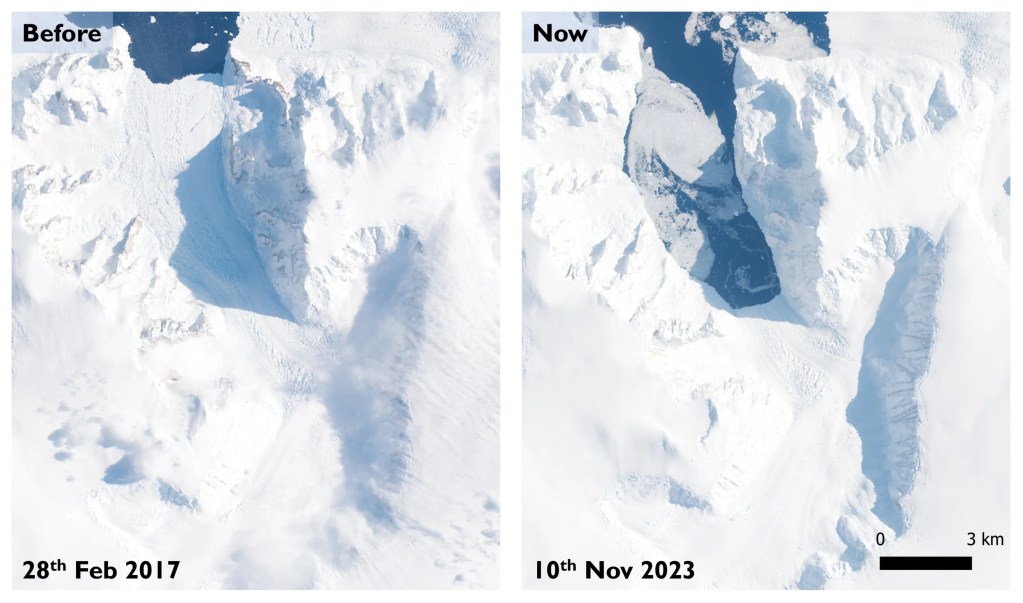
Consequently, the flow velocity of the glacier underwent a significant acceleration, doubling its speed. This acceleration, in turn, led to an increased discharge of ice into the sea through the process known as iceberg calving.
Wallis expressed surprise at the rapid transition of Cadman Glacier from apparent stability to a state of sudden deterioration and substantial ice loss. Notably, neighboring glaciers in this section of the west Antarctic Peninsula did not exhibit a similar response, presenting valuable insights for projecting the impact of climate change on this crucial polar region. The study, encompassing data from three decades, nine satellite missions, and in-situ oceanographic measurements, underscores the significance of long-term monitoring using a variety of sensors to comprehensively understand changes in Earth’s polar regions. This approach allows each sensor to contribute a distinct piece to the overall narrative.
As per the scientists’ assessment, the Cadman Glacier currently exists in a state of “Significant dynamic imbalance.” Ongoing thinning of the glacier’s ice is occurring at a rate of approximately 20 meters per year, akin to the annual loss in height of a five-story building. Notably, an estimated 2.16 billion metric tons of ice are annually flowing from the Cadman Glacier into the ocean.
The causes of Cadman Glacier’s rapid collapse
The abrupt dynamic transformation of the Cadman Glacier system is attributed to exceptionally elevated ocean water temperatures observed in the early part of 2018 and 2019 in the vicinity of the west Antarctic peninsula.
Through an analysis of historical satellite data, scientists propose that warmer ocean waters, potentially dating back to the early 2000s or even the 1970s, gradually thinned the ice shelf of the Cadman Glacier. Importantly, this warmer water wasn’t confined to the ocean’s surface but penetrated deep into the water column. This heated water likely reached the ice shelf, where it is grounded on the sea floor, triggering a bottom-up melting process. By 2018/19, the ice shelf had become so thin that it detached from the grounding zone, effectively floating. This detachment allowed the Cadman Glacier to discharge more ice into the seas. However, a lingering question remained for the scientific team: Why did the Cadman Glacier collapse while neighboring glaciers like Funk and Lever remained comparatively stable?
The role of subsea ridges in glacier preservation
Through a thorough examination of subsea oceanographic data, the researchers propose that a sequence of subsea rock structures, known as ridges or sills, positioned at depths of 200 meters and 230 meters, serves as a protective barrier. These formations effectively divert channels of warmer water, preventing them from reaching the glaciers. However, caution is advised, as an escalation in ocean warming could potentially undermine the protective capacity of these ridges, putting certain glaciers at risk.
Professor Michael Meredith, associated with the British Antarctic Survey and a contributor to the study, highlighted the longstanding awareness of the rapid warming of the ocean surrounding Antarctica. This warming trend poses a substantial risk to glaciers and the overall ice sheet, carrying global implications for rising sea levels. The recent research underscores a critical insight: seemingly stable glaciers have the potential to undergo rapid and unpredictable transitions, leading to significant thinning and retreat. Professor Meredith emphasizes the urgency of establishing a comprehensive ocean observing network around Antarctica, particularly in regions near glaciers where measurements are challenging but essential for understanding and monitoring these dynamic processes.
The researchers, in their paper, characterize the transformation of the Cadman Glacier as indicative of a “Glaciological tipping point.” This concept describes a scenario where a system in a stable state can follow different trajectories due to a change in an environmental parameter. The tipping point for the Cadman Glacier occurred in 2018, marked by the intrusion of unusually warm ocean water that led to the ungrounding of the ice shelf. Upon reaching this critical juncture, the Cadman Glacier experienced a 28% increase in ice discharge within a span of 13 months. The researchers caution that other glaciers on the Antarctic Peninsula may be susceptible to analogous abrupt changes, influenced by the region’s subsea geology.
Resources
- ONLINE NEWS University of Leeds. (2023, November 28). Scientists track rapid retreat of Antarctic glacier. Phys.org. [Phys.org]
- JOURNAL Wallis, B.J., Hogg, A.E., Meredith, M.P., et al. (2023). Ocean warming drives rapid dynamic activation of marine-terminating glacier on the West Antarctic Peninsula. Nature Communications, 14, 7535. [Nature Communications]
Cite this page:
APA 7: TWs Editor. (2023, November 28). Rapidly Retreating Antarctic Glacier Under Scientific Observation. PerEXP Teamworks. [News Link]


