



In the dynamic milieu of open star clusters, the gravitational tumult between celestial bodies can catapult individual stars to extraordinary distances, transcending the boundaries of the Milky Way galaxy. Groundbreaking research has now emerged, detailing the mapping of stars situated beyond the galactic disk to their clusters of origin. This significant stride in understanding the celestial diaspora is made possible by the wealth of new data harvested from the European Space Agency’s Gaia Mission.
The insightful findings, titled “Stellar Paternity Tests: Matching High-Latitude B Stars to the Open Clusters of Their Birth,” were unveiled by researchers from Lehigh University. The revelation, marking the first-ever attempt to connect stars outside the galaxy’s disk to their birth clusters, was presented during a press conference at the 243rd meeting of the American Astronomical Society (AAS) in New Orleans.
M. Virginia (Ginny) McSwain, an associate professor of physics at Lehigh University, elaborated on the significance of the research, explaining that by retracing the celestial journey of these stars through time, they successfully correlated 15 of them with the specific star clusters of their origin. The elucidation of this cosmic genealogy offers profound insights into the historical evolution of star clusters within the Milky Way.
The majority of these extragalactic stars, situated outside the Milky Way’s thin disk – which encompasses the spiral arms with a denser diameter at the center – boast ages exceeding eight billion years. Their antiquity suggests that these celestial entities took form during the early epochs of the galaxy’s existence. The fact that these ancient stars have traversed extensive distances from their birthplaces adds another layer to our comprehension of the Milky Way’s cosmic narrative.
Given that the vast majority of star formation within our galaxy occurs within the thin disk, the presence of hot B-type stars outside this region is a rarity. These youthful stars, estimated to be between 10 to 100 million years old, defy the norm by occupying high-altitude positions both above and below the galactic disk. It is postulated that these celestial outliers were likely expelled from their birth clusters within the last few million years.
Brandon Schweers, an astrophysics senior at Lehigh University and a crucial contributor to the research, emphasized the singularity of hot stars venturing beyond the galactic disk. Schweers noted that their conspicuous displacement from the thin disk is a consequence of gravitational interactions within their parent clusters. In particular, close three- or four-body gravitational encounters could launch a member of the cluster at high speeds, propelling them away from the Milky Way’s plane.
The study highlighted a specific star ejected at an exceptionally high speed, leading to speculation that it might have been expelled during a supernova event within a close binary star system. Interestingly, stars ejected from their birth clusters may not follow a unidirectional trajectory; some might experience gravitational interactions that propel them back towards the galactic plane, only to be slingshotted out again into the cosmic void.
While the existence of these “orphaned” stars has been acknowledged for approximately two decades, their precise connections to their birth clusters remained elusive due to a lack of quality data. The advent of data from the Gaia Mission, however, has transformed this narrative. Researchers now possess the means to scrutinize the motions of these celestial nomads with unprecedented precision, unraveling the mysteries of their origin and trajectory.
Launched in 2013, the Gaia Mission represents a monumental endeavor with the ambition to comprehensively survey over one billion stars within the Milky Way, constructing an intricate three-dimensional map of our galaxy. The wealth of data gathered by Gaia encompasses unparalleled positional measurements for stars, coupled with radial velocity measurements for the brightest 150 million celestial objects.
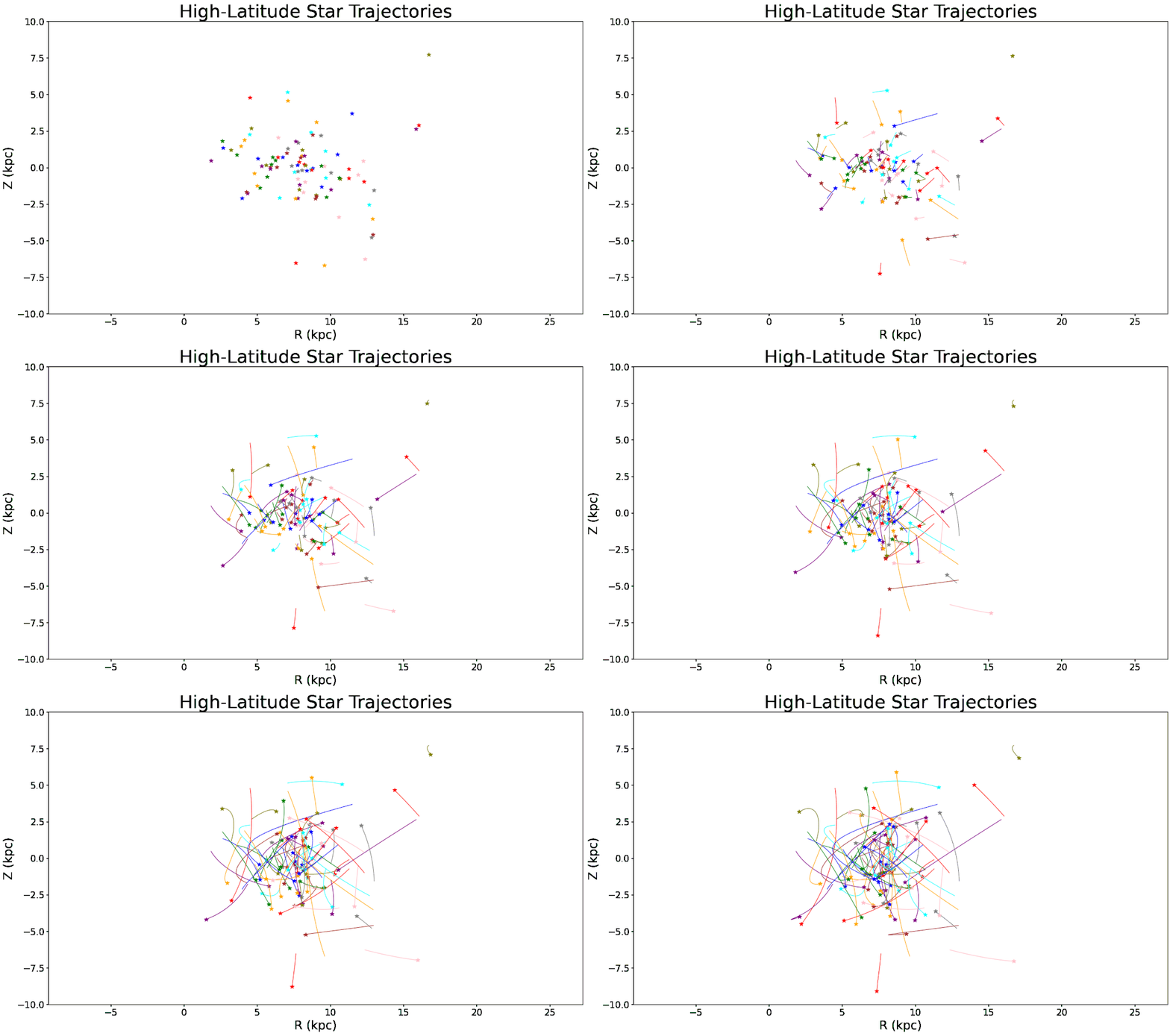
Leveraging Gaia’s 2022 data release, researchers from Lehigh University embarked on a meticulous exploration, focusing on 95 high-latitude B stars and approximately 1,400 recognized galactic open clusters. Their goal was to unravel the historical interplay between these stars and clusters, identifying moments in the past where intersections could have led to stellar ejections.
M. Virginia (Ginny) McSwain, associate professor of physics at Lehigh University, detailed the methodology employed in this ambitious pursuit. Utilizing the 3D positions and velocities of each star and cluster over the past 30 million years, researchers harnessed the open-source Python galpy package for galactic dynamics analysis. This facilitated the modeling of the galaxy’s gravitational field at distinct points in its evolutionary timeline.
Upon identifying potential matches, the researchers conducted a nuanced examination by comparing the color and brightness of each ejected star to the Hertzsprung-Russell (H-R) diagram – a pivotal color magnitude diagram for each open cluster. McSwain emphasized that the H-R diagram’s shape is primarily contingent on the cluster’s age, enabling the researchers to discern if the ejected star aligns with the age of its potential cluster counterparts. This H-R test served as a critical filter, refining the list of potential matches.
In the final stages of their investigation, the researchers delved into the core densities of each cluster that emerged as a plausible match. Higher-density clusters, characterized by intensified gravitational interactions among their members, were identified as having a greater propensity for ejecting stars. This comprehensive and multi-step approach not only narrowed down potential matches but also provided a nuanced understanding of the dynamical processes shaping the galactic ballet of stars and clusters over millions of years.
The results were positive
Employing a blend of analytical tools, the research team successfully validated positive paternity matches for 15 orphaned stars, marking a pivotal achievement in unraveling the intricate celestial genealogy. The inspiration for the presentation’s title, “Stellar Paternity Tests,” emerged during the comparison phase of color and brightness for potential matches, particularly when discarding those with a poor correlation in the Hertzsprung-Russell (H-R) diagrams.
Brandon Schweers, the senior astrophysics student at Lehigh University and a key contributor to the research, drew a vivid analogy to “The Maury Povich Show” during this phase. Schweers likened the process to comparing the “DNA” of orphaned stars with that of their potential siblings. This step, reminiscent of the iconic paternity tests on the television show, involved discerning and confirming the true parentage of these cosmic wanderers.
“I think everyone has heard the saying, ‘You are not the father’ that came from that show. For many of these clusters, I was essentially telling them they are not the parent of these orphaned stars, so I came up with the name ‘Stellar Paternity Tests,'” explained Schweers, adding a touch of humor to the serious scientific endeavor.
Delving into the temporal dimension, the researchers utilized trajectory calculations to estimate that the ejections occurred approximately 5 to 30 million years ago. The cosmic forces responsible for these events flung the abandoned stars across the Milky Way at remarkable speeds ranging from 30 to 220 kilometers per second (67,000 to 490,000 miles per hour), eventually settling them in their present locations within the galaxy.
Beyond unveiling the chronology of these stellar ejections, the study provided valuable insights into the interplay of dynamical forces versus supernovae ejection in young open clusters. This nuanced understanding of the celestial dynamics contributes to our broader comprehension of the complex processes governing the evolution and dispersion of stars within the Milky Way.
Resources
- ONLINE NEWS White, A. & Lehigh University. (2024, January 10). “Stellar paternity tests” match orphaned stars to their Milky Way origins. Phys.org. [Phys.org]
Cite this page:
APA 7: TWs Editor. (2024, January 11). Tracing Orphaned Stars Back to Their Milky Way Origins with “Stellar Paternity Tests.” PerEXP Teamworks. [News Link]


