



APA 7: TWs Editor & ChatGPT. (2023, November 4). Research Identifies Robust Noise Correlations Among Silicon Qubits. PerEXP Teamworks. [News Link]
Scientists from the Tokyo Institute of Technology and RIKEN conducted a study to accurately measure noise correlations between pairs of semiconductor-based qubits. These qubits are crucial for the advancement of scalable quantum processors. Their findings, published in Nature Physics, revealed robust interqubit noise correlations between adjacent silicon spin qubits.

In the words of Jun Yoneda, one of the researchers involved in the study, the idea of a functional quantum computer hinges on having millions of tightly packed, precisely controlled qubits with minimal and relatively independent errors. Yoneda emphasized the team’s focus on investigating potential error correlation issues within silicon qubits, considering their growing significance as a promising platform for extensive quantum computations.
Creating high-performance quantum processors that rely on numerous closely spaced silicon qubits has been a formidable task. Such systems tend to display correlated noise among different qubits. This correlation diminishes the fault tolerance of the devices, resulting in higher error rates and consequently hindering their overall performance.
In their recent research, Yoneda and his team embarked on an investigation to determine the magnitude of these correlations in noise between adjacent qubits. Their aim was to provide valuable insights for the advancement of semiconductor-based quantum computing systems. To achieve this, they conducted an analysis focused on quantifying the extent of noise correlation between two silicon-based qubits positioned just 100 nanometers apart.
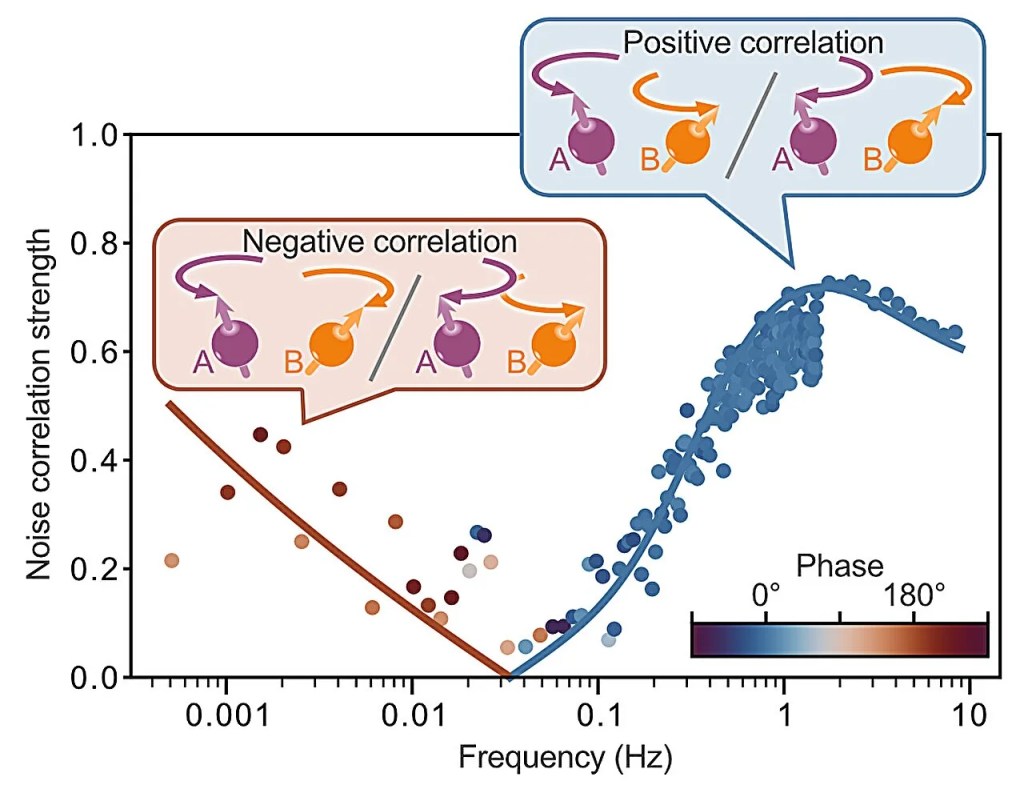
Errors in silicon spin qubits are dominated by fluctuations of the qubit energy, that is, the energy difference between the spin-up and -down states, Yoneda explained. Again Yoneda: We measured the simultaneous time evolution of qubit energies and assessed the degree of similarity between the two time traces via a quantity called the cross power spectral density.
Subsequently, the researchers applied a Bayesian estimation technique they had previously developed as part of their research efforts. This technique is designed to provide probability distributions for cross power spectral densities. It enabled them to verify the statistical significance of the observed correlations, ultimately confirming that both qubits were influenced by closely correlated noise.
“We observed strong noise correlations between silicon qubits, with a correlation strength as large as 0.7 at some frequencies,” Yoneda explained. These correlations, stemming from electrical noise, are expected to persist over significant distances, highlighting the importance of addressing error correlation in densely-packed silicon qubit arrays. Additionally, our analysis of noise correlations offers fresh insights into the origins of qubit noise.
The statistical techniques utilized by this group of researchers are both distinctive and potent. Unlike conventional approaches, their method doesn’t rely on prior knowledge of auto-spectrums, such as 1/f, to evaluate and measure qubit noise. In summary, the outcomes of this recent study affirm the complexities of noise correlation among closely spaced silicon qubits, underscoring the necessity to develop novel strategies for mitigating or reducing noise in quantum computers based on semiconductors.
Yoneda added that their future research will involve examining the extent of correlation in a qubit array. They plan to use the methods they developed in this experiment to include cross-correlations in noise analysis. This investigation is crucial for understanding fault-tolerance and gaining insights into the source of noise.
Resources
- NEWSPAPER Fadelli, I. (2023, November 3). Study observes strong noise correlations between silicon qubits. Phys.org. [Phys.org]
- JOURNAL Yoneda, J., Arias, J. S., Stano, P., Takeda, K., Noiri, A., Nakajima, T., Loss, D., & Tarucha, S. (2023). Noise-correlation spectrum for a pair of spin qubits in silicon. Nature Physics. [Nature Physics]


Love This !! my thoughts on this ….
Thanks – PomKing