



Superluminal motion occurs when something appears to be moving faster than it should be able to, according to the theory of relativity. This phenomena creates a pair event that can create visual copies of objects, which states that nothing can exceed the speed of light. There are two exceptions for going much faster than you should be able to: Relativity works for matter and energy, and there are two types of speed: relative and actual. Here, we discuss how things can appear to exceed the speed of light within these exceptions.
History of space-highway criminals
The first time it was seen was in 1901 by Charles Dillon, who, while observing the Nova Persei nebula, noticed that it was moving significantly faster than expected values this phenomenon was caused by some interstellar dust that was reflecting the light of the nebula while it wasn’t exceeding the speed of light It’s the first time we’ve noticed things seem to move faster than their original speed.
In 1902, Jacobus Kapteyn observed the first real superluminal motion in the ejecta of Nova GK Persei, but his findings, published in Astronomische Nachrichten, gained little attention from English-speaking astronomers.
Martin Rees theorized in 1966 that relativistically moving objects could appear to have transverse velocities exceeding the speed of light. In the late 1960s and early 1970s, Very Long Baseline Interferometry (VLBI) revealed sources, including radio galaxies and quasars, which are the main causes of superluminal motion. This technique allowed us to calculate apparent and angular speeds a lot easier. With this technique, scientists have calculated velocities up to six times the speed of light.

How to exceed light speed?
As mentioned before, there are two possible ways to exceed the speed of light. It might be a shadow of something; as is known, shadows aren’t matter or energy, so the limitations set by relativity don’t apply there. Alternatively, its linear speed might be faster than light; this topic is also explained below.
However, it’s more exciting to think about how things seem while they’re moving faster than light. With our greatest power, imagination, we’re able to see something that’s moving faster than light I’ll call this thing a “ball,” but it can be any kind of thing that’s moving faster than light. Imagine That ball’s pathway coming towards the observer. How can the observer see that kind of thing? This event is called a pair event.


If we needed to explain a pair event easily, think of equally spaced lightbulbs on the ball’s pathway, and the lightbulbs flash when that ball passes them. When the ball passes the first lightbulb, the light created from that event won’t reach the observer before the second one. The reason is that when the first lightbulb gets flashed, the light from that bulb won’t reach even the second bulb before the ball because the ball itself moves faster than light. Knowing that we can also guess, we can’t see the ball itself before it comes right by the observer. For the same reason, the light created by the ball will delay, and the ball will reach before the light created by itself.

It is weirder to think about how the observer will see it. It is called a pair event when the observer first sees the ball; it should be in the same line as the observer that’s perpendicular to the ball’s pathway. Bearing in mind that the second bulb’s light reaches the observer before the first one, for the reasons mentioned, the direction of the ball seen by the observer is the opposite of the real direction of the ball caused by the delayed light of the ball.
Real-life examples of speedsters
In space, it’s possible to find galaxies moving in all directions. When the right conditions are met (a galaxy coming towards us at a small angle and the right speed), its relative speed to Earth can be faster than light. I’ll leave the proof down here:
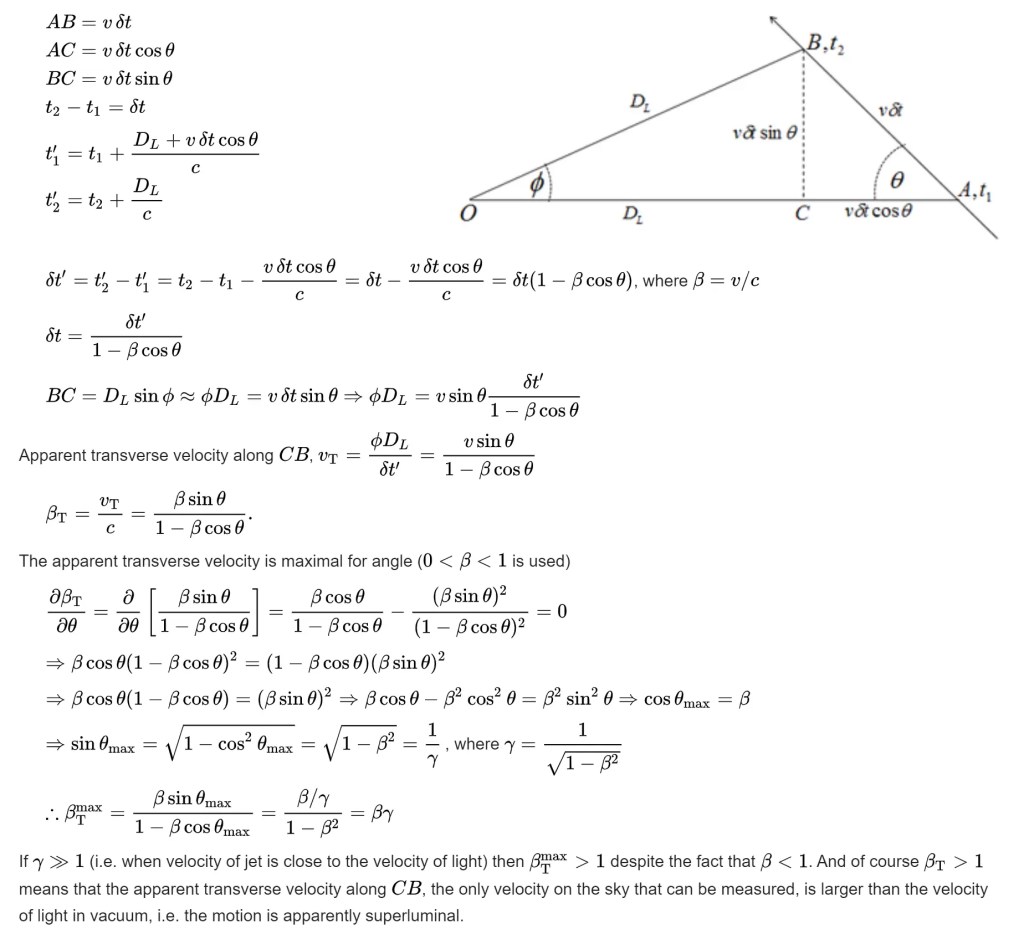
This is quite complicated, but, using some trigonometry and derivatives, we’re able to calculate the apparent speed of bodies relative to us. When the math is done, it shows that the speed of a moving body is superluminal (faster than light).
Cherenkov radiation
Every fluid has a medium that limits the maximum speed of a moving body inside it. For example, light isn’t at

Sonic booms
Even if this event seems like all theoretical science, we can experience it on Earth easily. When aircraft fly, there are two pressure waves following them: one in the front and one in the back, like ships floating on the water.
When the aircraft passes the speed of sound, these waves start to merge and become one energetic wave. The reason is that when the jet exceeds the speed of sound, the shockwave should be in front of the jet, but it can’t stay there, recalling that most of the waves move at speeds close to the speed of sound When the jet itself moves faster than the wave it creates, the wave falls behind and gets closer to the back of the jet. At the right time, the delayed front wave and back wave of the jet will merge to create a bigger and stronger wave. This is the sonic boom we hear. This event is also similar to superluminal motion in most ways, which makes it easier to understand.

Difference between angular and linear speed
It’s possible to try this in everyday life. When an opaque object moves past a light source, it casts a shadow behind it. But how far? There’s no limit. If we imagine that the light source has infinite brightness, when holding the light source to a close object and letting the shadow cast very far away from a fast-moving opaque object, what is the speed of the shadow it casts? It should start and stop at the same time as the object. So, using that information, we can calculate the shadow’s average speed pretty easily. Also, remember that light spreads like a sphere, so the starting and stopping points should also spread like a sphere. However, when the shadow is cast very far away from the light source, the displacement that the shadow has to cover is impossible in the amount of time given, so it has to exceed the speed of light and create superluminal motion.
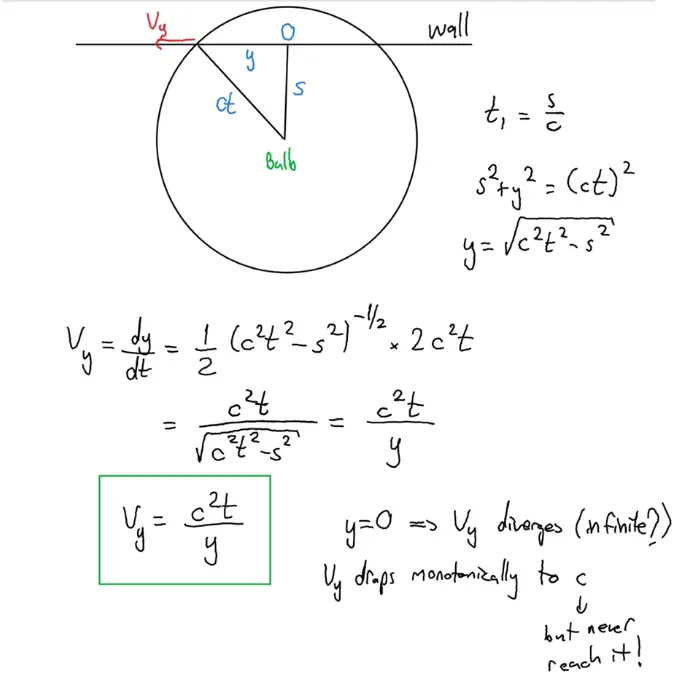
Another way to observe this is by using a laser. When it’s facing a wall and rotating around itself, it’s easily noticeable that the point on the wall is moving faster than the laser that’s rotating. When rotating the laser, the angular velocity should be the same everywhere (the time needed to complete a full circle), but the linear velocity increases by the radius. Imagine two cars racing on a circular road. If both are racing on the same circular road, one in the inner circle and one in the outer circle, which one has to go faster for them to finish the race at the same time? With that said, when the laser is held to a very far point and rotated with some angular velocity, the linear velocity of the light coming from the laser at that point should rotate with the same angular velocity. If the radius of the circle rotating around is too big, there’s no way to finish that circle within the speed of light, so there’s no way but to exceed the speed of light.
- DICTIONARY ENTRY Wikipedia English. (n.d.). Superluminal motion. In Wikipedia English. [Wikipedia English]
- JOURNAL Nemiroff, R. J. (2017). Pair events in superluminal optics. Annalen Der Physik, 530(2). [Annalen Der Physik]
- DICTIONARY ENTRY Wikipedia English. (n.d.). Cherenkov radiation. In Wikipedia English. [Wikipedia English]
- DICTIONARY ENTRY Wikipedia English. (n.d.). Sonic boom. In Wikipedia English. [Wikipedia English]
- DICTIONARY ENTRY MinutePhysics. (n.d.). Exceeding the speed of light with a laser. In Encyclopedia Britannica. [Britannica]
APA 7: Göktaş, S. M. (2024, August 15). Breaking the Speed Limits: Superluminal Motion. PerEXP Teamworks. [Article Link]


1 comment