




By harnessing the unique insights provided by impact craters, Alexander Morgan, a Research Scientist at the Planetary Science Institute, has successfully established maximum timescales for the development of Martian valley networks shaped by the influence of flowing water.
The current Martian landscape, resembling a global desert, conceals compelling evidence of historical water activity, including intricate river valleys. Morgan’s research, encapsulated in the article titled “New maximum constraints on the era of Martian valley network formation” published in Earth and Planetary Science Letters, delves into the profound implications of the timescale over which these valleys took shape on early Mars’ potential habitability. Extended periods of stable liquid water, Morgan notes, could significantly enhance the likelihood of supporting life.
Dating back over 3 billion years, Martian valley networks have stood as crucial indicators of past liquid water on the planet. While previous studies determined the minimum time required for valley erosion, the current research advances our understanding by constraining the frequency of flow events. Morgan utilized pre-existing and post-existing impact craters to establish upper limits, extending into hundreds of millions of years, for the era during which these valley systems were actively forming. This approach, distinct from prior research focusing on minimum timescales, offers a comprehensive framework for evaluating the temporal dynamics of Martian valley activity.
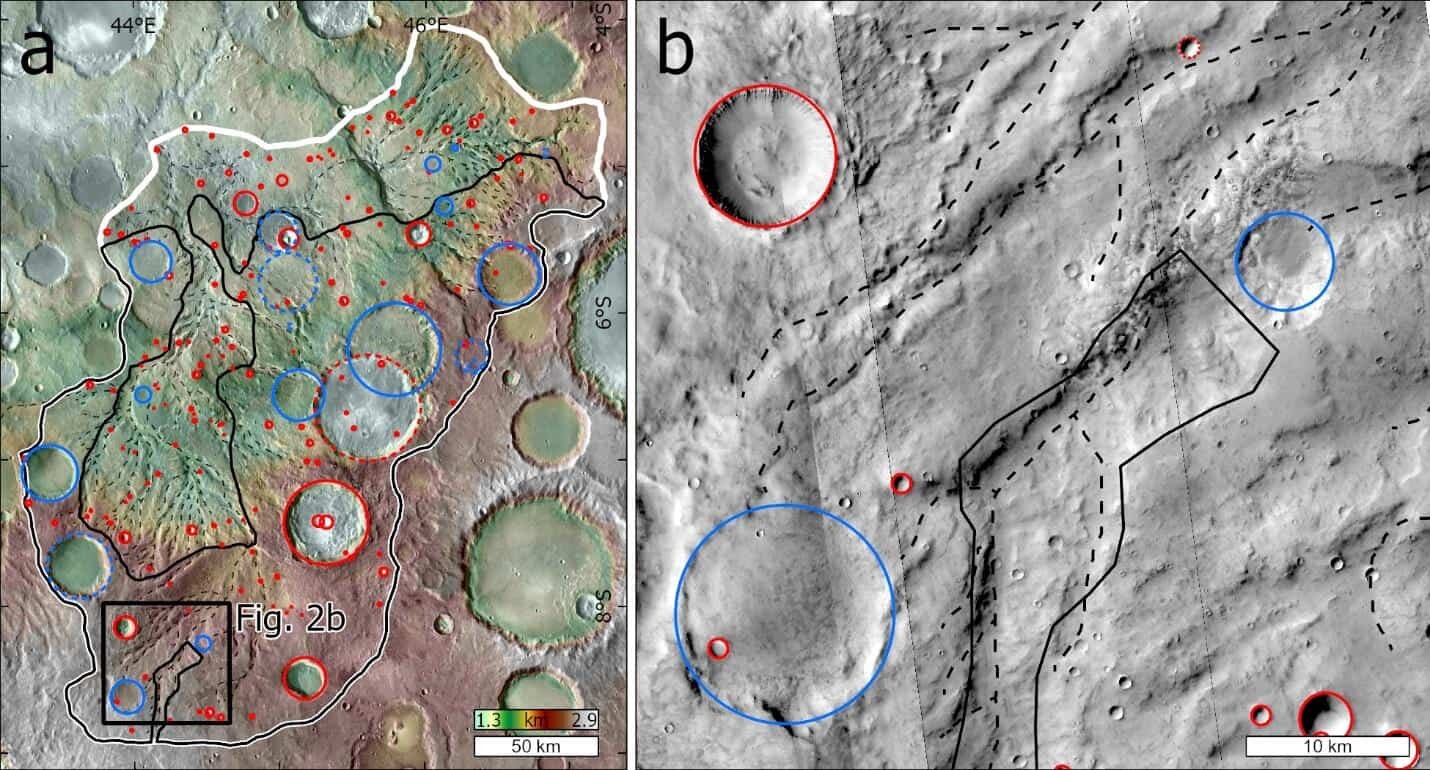
The study’s findings, led by Alexander Morgan from the Planetary Science Institute, shed light on the dynamic environmental conditions of early Mars, challenging the simplistic dichotomy that has characterized previous discussions about the planet’s climate. Traditionally, scientists debated whether early Mars was “warm and wet” with oceans or “cold and icy” featuring massive ice sheets.
Morgan highlights the inadequacy of these binary descriptors, emphasizing that attempts to encapsulate hundreds of millions of years of climate history in two words oversimplify the complexity of early Martian conditions. Drawing a parallel to Earth’s intricate climatic shifts over its history, Morgan notes that the surface conditions supporting rivers on early Mars likely exhibited considerable variability.
The research proposes that the erosion of Mars’ rivers occurred at a sluggish pace, akin to certain regions of Earth, such as the Atacama Desert in Chile. The sluggish erosion rate prompts considerations about potential inhibiting factors, such as the accumulation of substantial boulders on the riverbed, which may have resisted further breakdown processes. These insights into the gradual and intermittent nature of Martian river erosion contribute to a more nuanced understanding of the planet’s climatic history, challenging previous oversimplified narratives about the Martian climate.
An alternative explanation posits that Martian rivers experienced infrequent flow, possibly as rare as .001% of the time. This suggests a scenario where rivers on Mars were predominantly dry, only becoming active during specific events like volcanic activity or shifts in the planet’s axial tilt and orbit around the sun. These climatic variations, analogous to Earth’s Milankovitch cycles that influence the planet’s glacial periods, could have intermittently warmed Mars’ surface.
Alexander Morgan, leading the study, draws parallels to Earth’s rivers, where short-term flow dynamics are influenced by rainfall or upstream snowmelt, while longer-term changes are driven by climatic shifts. A case in point is Earth’s history, where 20,000 years ago, regions like Nevada featured large lakes and rivers due to climatic changes. The proposal is that Martian rivers exhibited similar behavior, with short-term variability linked to events like storms or snowmelt, and longer-term variability influenced by alterations in the planet’s spin and orbit around the sun. This nuanced perspective challenges the notion of consistent river activity on Mars and aligns with Earth’s diverse river dynamics shaped by both short-term and long-term climatic influences.
Resources
- ONLINE NEWS Fischer, A. & Planetary Science Institute. (2024, January 15). Water may have flowed intermittently in Martian valleys for hundreds of millions of years. Phys.org. [Phys.org]
- JOURNAL Morgan, A. M. (2024). New maximum constraints on the era of martian valley network formation. Earth and Planetary Science Letters, 626, 118509. [Earth and Planetary Science Letters]
Cite this page:
APA 7: TWs Editor. (2024, January 15). Intermittent Flow of Water Possibly Lasted Hundreds of Millions of Years in Martian Valleys. PerEXP Teamworks. [News Link]


